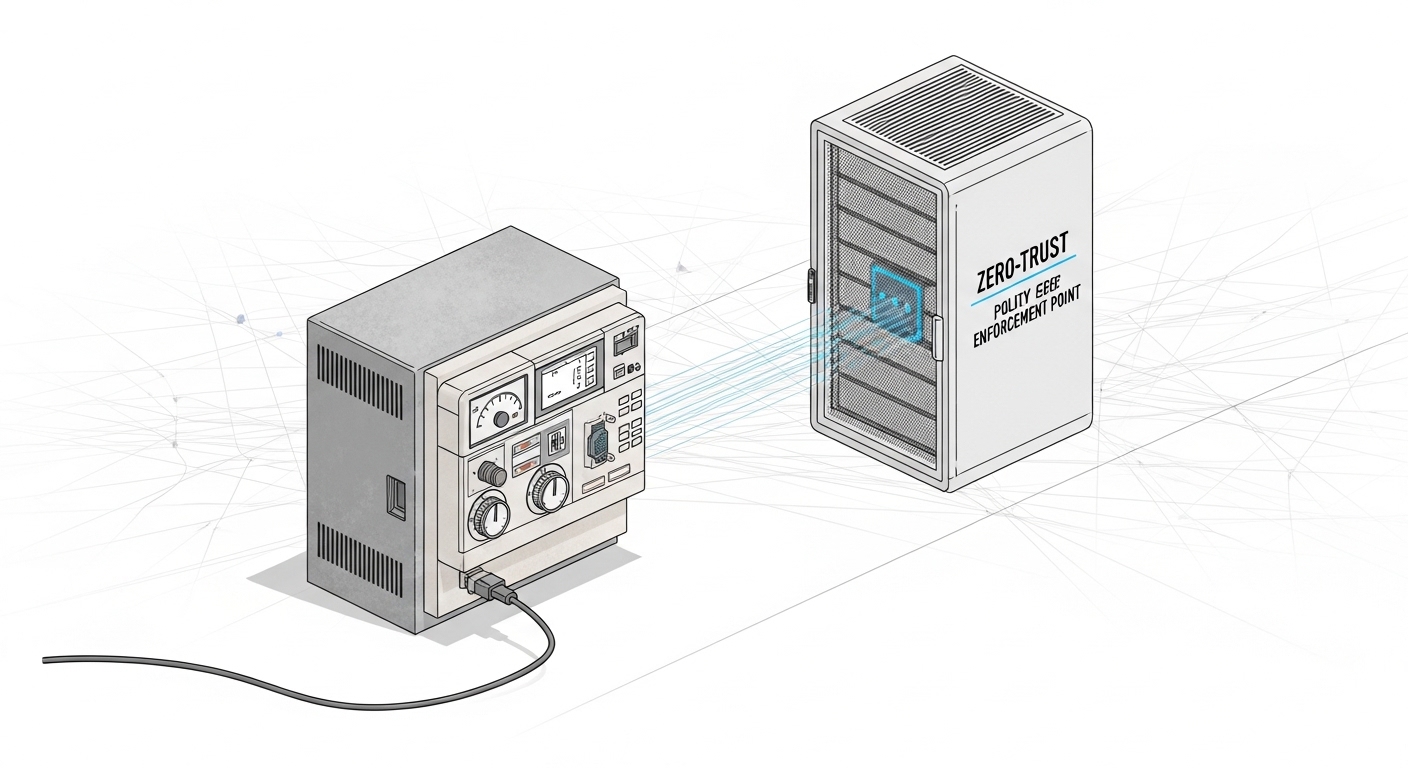
The Brownfield Conundrum: Architecting Zero-Trust for Legacy Modbus and DNP3 Systems
Apex Insights Research Desk
The Paradigm Shift to "Never Trust, Always Verify"
The foundational security principle for decades in Operational Technology (OT) was the perimeter model—a hardened shell protecting a soft, trusted interior. This "trust but verify" architecture assumed that any actor or device within the industrial network was legitimate. However, the convergence of IT and OT, coupled with the escalating sophistication of state-sponsored threats, has rendered this model dangerously obsolete. Enter Zero-Trust, a security architecture predicated on the principle of "never trust, always verify." It mandates that no actor, system, network, or service operating inside or outside the security perimeter is trusted. Instead, we must verify every request as though it originates from an untrusted network.
While this paradigm is revolutionizing enterprise IT security, its application within the deterministic, high-availability world of Industrial Control Systems (ICS) presents a distinct and formidable set of challenges. This is particularly true for brownfield environments built upon foundational, yet inherently insecure, protocols like Modbus and Distributed Network Protocol 3 (DNP3). These protocols are the bedrock of global critical infrastructure, from electrical grids and water treatment plants to manufacturing floors. Retrofitting a Zero-Trust framework onto these systems is not a simple lift-and-shift operation; it is a complex architectural undertaking fraught with technical, operational, and protocol-level hurdles. This analysis from the Apex Insights Research Desk dissects these challenges and explores viable architectural blueprints for achieving least-privilege access in environments never designed for it.
Understanding the Protocol Debt: Modbus and DNP3
To grasp the difficulty of this task, one must first understand the design philosophy of the protocols themselves. They were engineered for efficiency, reliability, and interoperability in isolated, physically secure networks where all connected devices were implicitly trusted. Security was an externality, not a feature.
Modbus: The Lingua Franca of Simplicity
Developed in 1979, Modbus is a master-slave (now client-server) protocol whose primary virtue is its simplicity. It provides a straightforward method for transmitting control data over serial lines (Modbus RTU/ASCII) and Ethernet networks (Modbus TCP). However, this simplicity comes at a steep security cost. The standard Modbus protocol includes:
- No Authentication: Any device that can connect to the network can send commands to a Modbus server (e.g., a PLC or RTU). The server has no mechanism to verify the client's identity.
- No Encryption: All communications are transmitted in cleartext, making them susceptible to eavesdropping and man-in-the-middle (MitM) attacks.
- No Command Integrity: There is no mechanism to ensure that a command received by a server is the same as the one sent by the client.
DNP3: A More Capable Successor with Similar Trust Assumptions
DNP3 is a more robust protocol, widely used in the electric and water utility sectors. It offers advanced features like time-stamping, unsolicited reporting by exception, and data prioritization. While a security extension, DNP3 Secure Authentication, exists to provide authentication and message integrity, its adoption is far from universal, especially in older deployments. The base protocol, like Modbus, largely operates on an implicit trust model, assuming the underlying communication channel is secure.
This inherent protocol-level trust deficit creates a fundamental architectural mismatch with the core tenets of Zero-Trust, which demand explicit and continuous verification of every transaction. The challenge lies in imposing this verification layer without disrupting the deterministic processes these protocols govern.
Practical Implementation Challenges
Applying Zero-Trust principles to Modbus and DNP3 environments moves beyond theoretical discussion and into a series of highly specific engineering problems. The core pillars of Zero-Trust—identity verification, micro-segmentation, and least-privilege access—each collide with the realities of legacy OT.
Hurdle 1: The Identity and Authentication Void
Zero-Trust begins with identity. The Policy Decision Point (PDP) must answer the question: who is making this request? Legacy Modbus and DNP3 devices offer no native answer. A Modbus request originates from an IP address, targeting a server at another IP address and unit ID. There is no concept of a user, service account, or cryptographically verifiable device identity. This makes it extraordinarily difficult to build policies around authenticated entities. How do you grant an HMI permission to write to a specific PLC when neither device has a robust identity? This forces a reliance on weaker, network-based identifiers like IP or MAC addresses, which are easily spoofed. Architecting compensating controls for such systems is a significant focus, as detailed in our analysis on Zero-Trust for identity-agnostic PLC networks.
Hurdle 2: The Need for Granular, Protocol-Aware Policy Enforcement
A standard Layer 4 firewall can permit or deny Modbus TCP traffic on port 502, but this is a blunt instrument. It cannot differentiate between a benign read request (Read Holding Registers, function code 03) from a monitoring system and a potentially catastrophic write command (Write Multiple Coils, function code 15) from an unauthorized source. Effective Zero-Trust requires policy enforcement at Layer 7, the application layer.
The cardinal rule of OT security architecture is that security controls must not compromise the safety, availability, or integrity of the industrial process. This means any verification mechanism must operate within the strict latency and jitter tolerances of the control loop.
This necessitates the use of industrial firewalls or segmentation gateways capable of Deep Packet Inspection (DPI) for Modbus and DNP3. The Policy Enforcement Point (PEP) must be able to parse the protocol data unit (PDU) and enforce rules based on:
- Function Code: Allowing only specific read functions from certain sources while blocking all write functions.
- Register/Point Address: Restricting access to specific memory ranges on a PLC or I/O points on an RTU.
- Data Values: Setting bounds on permissible values being written to a setpoint to prevent unsafe operational states.
Achieving this level of insight requires specialized technology, and a deep understanding of how to build protocol-aware DPI into your SCADA security architecture is paramount.
Hurdle 3: The Determinism and Latency Mandate
Industrial processes, especially high-speed manufacturing or grid balancing, are intolerant of latency and jitter. Every security control added to the communication path—from packet inspection to cryptographic processing—introduces delay. While a few extra milliseconds may be negligible in an IT environment, it can be catastrophic in an OT control loop, potentially causing process instability or safety shutdowns. Any Zero-Trust solution must be architected for ultra-low latency, ensuring that policy enforcement and verification happen at line rate without disrupting the deterministic nature of the control system communications.
Hurdle 4: The Brownfield Imperative of Non-Disruption
The vast majority of Modbus and DNP3 systems are considered "brownfield"—they have been in continuous operation for years, if not decades. These systems often have fragile legacy endpoints, unpatched operating systems, and limited processing power. The prospect of deploying agents, re-IPing subnets, or forcing firmware upgrades is often a non-starter due to the immense operational risk and potential for downtime. Therefore, the architectural imperative is to implement Zero-Trust using compensating controls that are external to the endpoints themselves. A successful strategy must focus on architecting Zero-Trust for legacy Modbus SCADA without operational disruption by leveraging network-based enforcement and passive discovery.
Architectural Blueprints for Compensating Controls
Given that modifying the legacy endpoints or protocols is often infeasible, the only viable path forward is to build a Zero-Trust fabric around them. This is accomplished through network-based compensating controls that act as intelligent, protocol-aware guards.
Micro-segmentation with Industrial Firewalls: This is the most common and pragmatic first step. Next-generation or industrial firewalls are deployed as segmentation gateways in front of critical assets or zones (e.g., a group of PLCs controlling a specific process). These gateways act as Policy Enforcement Points, inspecting all inbound and outbound Modbus/DNP3 traffic. They terminate the initial connection, verify it against a granular policy, and only then initiate a new, authorized connection to the protected asset. This creates micro-perimeters around devices that have no security of their own.
Software-Defined Perimeters (SDP): An SDP, also known as a "black cloud," takes a different approach. It creates a logical overlay network that makes all protected assets (e.g., PLCs, HMIs, engineering workstations) invisible on the underlying physical network. A device or user must first authenticate to an SDP Controller, which then grants them a unique, ephemeral connection directly to the specific asset they are authorized to access. This "authenticate-first, then-connect" model powerfully enforces the Zero-Trust principle by default, cloaking the attack surface from unauthorized discovery.
Secure Serial Device Gateways: For Modbus RTU and other serial protocols, the challenge is bringing them into a manageable, IP-based security architecture. This can be achieved using secure terminal servers or gateways. These devices encapsulate the serial traffic within an encrypted IP tunnel (e.g., IPsec) and forward it to a central inspection point or firewall. This allows a consistent Zero-Trust policy to be applied to both modern TCP/IP and legacy serial communications, effectively bridging the technology gap.
Conclusion: Building a Verifying Fabric Around an Implicitly Trusted Core
Applying Zero-Trust principles to industrial networks running Modbus and DNP3 is not an impossible task, but it is one that requires a fundamental shift in approach. It is not about securing the protocols themselves, but about architecting an intelligent and pervasive verification fabric around them. The challenges are significant—the absence of native identity, the need for deep protocol awareness, the stringent demands of real-time determinism, and the operational constraints of brownfield environments. However, through the strategic deployment of compensating controls like protocol-aware micro-segmentation and Software-Defined Perimeters, organizations can enforce least-privilege access and move from a fragile model of implicit trust to a resilient architecture of continuous verification. This evolution is not merely an academic exercise; it is an essential step in safeguarding the critical infrastructure that underpins our modern world.
Sources / References
- NIST Special Publication 800-207, Zero Trust Architecture: https://csrc.nist.gov/publications/detail/sp/800-207/final
- Modbus Organization, Protocol Specifications: https://modbus.org/specs.php
- IEEE Standard for Electric Power Systems Communications--Distributed Network Protocol (DNP3), IEEE Std 1815-2012: https://standards.ieee.org/ieee/1815/4844/
- CISA, Recommended Practice: Implementing a Zero Trust Architecture: https://www.cisa.gov/resources-tools/resources/implementing-zero-trust-architecture