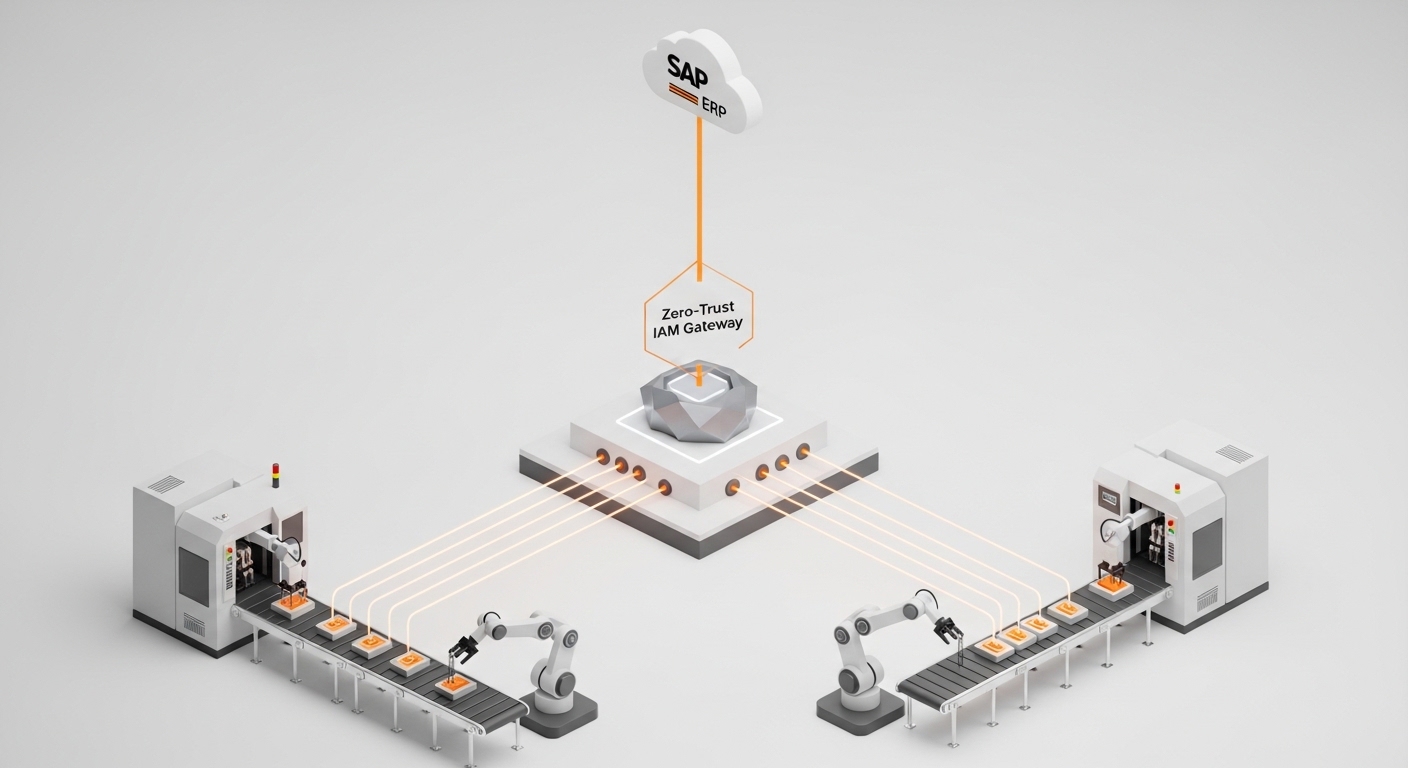
Architecting Zero-Trust IAM for Modbus TCP and SAP ERP Integration in Real-Time Manufacturing
Apex Insights Research Desk
The OT/IT Nexus: A New Frontier for Identity and Access Management
The convergence of Operational Technology (OT) and Information Technology (IT) represents the central nervous system of modern manufacturing. On one end, the ubiquitous and elegantly simple Modbus TCP protocol orchestrates real-time physical processes via PLCs, sensors, and actuators. On the other, SAP Enterprise Resource Planning (ERP) systems manage the overarching business logic—production orders, inventory, quality control, and supply chain logistics. The integration of these two domains, while essential for Industry 4.0, creates a high-value, high-risk attack surface where the deterministic, unauthenticated world of OT collides with the transactional, identity-rich environment of IT.
Traditional security paradigms, architected around a hardened perimeter, are fundamentally inadequate for this converged ecosystem. A threat actor who breaches the corporate network can often move laterally into the OT environment with devastating ease, exploiting the inherent trust model of protocols like Modbus TCP. The core challenge is no longer just about preventing intrusion but about eliminating implicit trust within the network itself. How can an organization enforce granular, identity-based access control for Modbus TCP devices, driven by business context from an SAP ERP system, without compromising the real-time performance critical to manufacturing operations? This article presents a definitive architectural blueprint for implementing a Zero-Trust Identity and Access Management (IAM) framework that securely bridges this critical OT/IT chasm.
Deconstructing the Core Challenge: The Modbus and SAP Dichotomy
To architect a viable solution, one must first deeply understand the fundamental disparities between the two systems being integrated. Modbus TCP, designed in an era when network security was an afterthought and networks were physically isolated, operates on a principle of implicit trust. A device's ability to connect to the network port and speak the protocol is its only required credential. It lacks native concepts of authentication, authorization, or encryption. Any client that can route to a Modbus server can, in principle, read its entire register map or, more dangerously, write new values to control outputs, shut down processes, or alter recipes.
Conversely, SAP ERP is built upon a sophisticated, multi-layered security model. Access is governed by a robust framework of users, roles, authorizations, and transaction codes, often managed through modules like SAP Governance, Risk, and Compliance (GRC). Every interaction is authenticated, authorized against a specific business role, and logged for audit purposes. The integration challenge, therefore, is not merely a matter of protocol translation but of security posture translation. It involves mapping the ephemeral, device-centric, and identity-agnostic nature of OT communications to the persistent, user-centric, and identity-driven security model of the IT world. A direct, unfiltered connection between an SAP application server and a Modbus-enabled PLC is an architectural pattern for catastrophic failure.
The Architectural Blueprint: A Zero-Trust IAM Overlay
Since modifying legacy Modbus TCP devices to support modern security protocols is often infeasible without significant downtime and recertification, the solution lies in a network-centric overlay. This architecture introduces compensating controls that enforce Zero-Trust principles without altering the endpoint devices themselves. It is a system of explicit verification built around an identity-aware fabric.
The Identity Abstraction & Enforcement Layer: The cornerstone of this architecture is a Zero-Trust Gateway acting as a Policy Enforcement Point (PEP). This is not a standard firewall but a specialized, protocol-aware proxy deployed at the boundary between the OT cell/area network and the IT network segments where SAP connectors or middleware (like SAP MII or PCo) reside. All traffic destined for Modbus devices from the IT side must be funneled through this PEP.
Universal Identity Provisioning: Every actor in the transaction—both the requesting IT service and the target OT device—must be assigned a strong, cryptographically verifiable identity. This moves beyond fragile IP/MAC-based rules. Using a framework like SPIFFE/SPIRE, each SAP connector service, HMI, or SCADA server is issued a short-lived X.509 certificate (a SPIFFE Verifiable Identity Document, or SVID) that serves as its identity. While Modbus devices cannot host an agent, the Zero-Trust Gateway can be configured to represent their identities, creating a verified digital twin of each asset.
The Context-Aware Policy Decision Point (PDP): A centralized PDP serves as the brain of the operation. When the PEP intercepts a connection attempt, it queries the PDP for an access decision. The PDP's decision is not a simple allow/deny based on IP addresses; it is a rich, context-aware judgment based on a synthesis of signals:
- Source Identity: Who is making the request? (e.g.,
spiffe://acme.com/sap/mii/prod-connector) - Destination Identity: What is being accessed? (e.g.,
spiffe://acme.com/ot/line5/plc-filler-a) - Resource & Action: What specific action is being attempted? This is derived from deep packet inspection (DPI) of the Modbus frame (e.g.,
Function Code: 0x06 - Write Single Register,Address: 40100). - IT Business Context: What is the business justification? The PDP makes a real-time API call to the SAP ERP system to query the current production order, maintenance schedule, or batch number.
- Source Identity: Who is making the request? (e.g.,
Dynamic, Granular Policy Enforcement: The synthesis of this context allows for extremely granular policies. For example: "Allow service
sap-connector-prodto execute 'Write Single Register' on address40100ofplc-filler-aonly when the active production order in SAP isBATCH-9B341and only with a value between250and275." This transforms the PEP from a simple gatekeeper into an active participant in process integrity.Closing the Loop with SAP Roles: The identity chain is extended back to the originating SAP user or process. By integrating the PDP with SAP GRC, the authorization check can be tied to the permissions of the user initiating the workflow within SAP. A request triggered by a maintenance engineer's work order in SAP can be granted write access for diagnostics, while a request from a production planning module is restricted to read-only access for inventory tracking.
Immutable Audit and Secure Transit: All communication brokered by the PEP is encrypted, typically within a mutually authenticated TLS (mTLS) tunnel established using the SPIFFE identities. Every access request, policy decision, and outcome (allow/deny) is cryptographically signed and streamed to a central logging repository, creating an immutable audit trail for forensic analysis and compliance reporting.
The core engineering principle is a shift from 'allow and log' to 'deny by default'. Every single Modbus TCP packet originating from the IT environment must be explicitly authenticated, authorized against dynamic business context, and audited before it is permitted to reach the OT endpoint. This is the essence of applying Zero Trust to legacy industrial protocols.
Practical Implementation Challenges
Architecting such a system is not without significant engineering hurdles that require meticulous planning and deep domain expertise.
Real-Time Performance and Determinism: The most critical challenge is the potential for latency injection. The entire process—PEP interception, PDP query, SAP API call, and policy evaluation—must occur within the deterministic time constraints of the manufacturing process. For many applications, violating this can lead to physical process failure. Achieving this requires high-performance, edge-deployed PEPs and an optimized PDP architecture, a constraint explored in detail in analyses of The 50ms Mandate: Architecting Deterministic Zero-Trust for Legacy Modbus SCADA.
Scalable Identity Lifecycle Management: Provisioning and managing cryptographic identities for thousands of OT-adjacent services and device proxies is a complex operational task. It necessitates a highly automated Public Key Infrastructure (PKI) designed for the unique constraints of OT, including certificate rotation, revocation, and secure bootstrapping processes.
SAP Integration Overhead: The real-time API linkage between the PDP and SAP is a frequent point of failure and complexity. It requires specialized knowledge of SAP interfaces (like BAPIs, OData, or RFCs), and the performance of the SAP system itself can become a bottleneck for the security architecture. Securing the service account used by the PDP to query SAP is also a critical security task in its own right.
Protocol-Level Granularity: Effective policy enforcement demands that the PEP possess a deep understanding of the Modbus TCP protocol. A generic firewall is blind to the difference between a benign
Read Coil Statusrequest and a maliciousWrite Multiple Coilscommand that could halt a production line. This requires sophisticated DPI engines capable of not just parsing the protocol but also enforcing policy at the function code and register address level, a concept central to Architecting Granular Control: A Blueprint for Zero-Trust Policy at the PLC Register Level.Brownfield Deployment Strategy: Introducing an inline enforcement point into a running, 'brownfield' manufacturing environment is fraught with risk. The deployment must be phased, typically starting in a non-blocking 'monitor and log' mode to baseline normal traffic patterns. Only after all legitimate flows have been identified and codified into policy can the system be switched to active enforcement. This requires a close partnership between IT security and OT engineering teams to manage change and avoid production stoppages.
Summary: From Implicit Trust to Explicit Verification
Securing the integration between Modbus TCP devices and SAP ERP is a microcosm of the entire Industry 4.0 security challenge. The solution is not to rip and replace legacy OT equipment but to superimpose an intelligent, identity-driven security fabric that enforces Zero-Trust principles. This architecture effectively creates a secure, verifiable, and auditable bridge between the two domains.
By moving the perimeter to the identity of each workload and enforcing access based on real-time business context, organizations can finally move beyond the fragile security of the flat OT network. This network-centric blueprint for Zero-Trust on legacy PLCs & HMIs allows manufacturers to reap the benefits of IT/OT convergence—enhanced efficiency, predictive maintenance, and data-driven decision-making—without exposing their most critical physical processes to unacceptable levels of cyber risk. The journey from implicit trust to explicit verification is complex, but it is the foundational requirement for building the secure, resilient smart factories of the future.
Sources / References
- NIST Special Publication 800-207: Zero Trust Architecture -
https://csrc.nist.gov/publications/detail/sp/800-207/final - Modbus-IDA: Modbus TCP Security Protocol Specification -
https://modbus.org/docs/Modbus_Security_Protocol_V1_0_2018-07-24.pdf - SPIFFE (Secure Production Identity Framework For Everyone) Official Documentation -
https://spiffe.io/docs/ - SAP Help Portal: SAP Access Control -
https://help.sap.com/docs/SAP_ACCESS_CONTROL