The Modbus Paradox: Implementing Zero-Trust in Legacy OT Without Halting Production
Apex Insights Research Desk
The Inherent Vulnerability of Legacy Modbus TCP/IP
In the world of Operational Technology (OT), the Modbus TCP/IP protocol is a testament to engineering simplicity and longevity. Developed in 1979, its robustness and ease of implementation have made it a cornerstone of industrial control systems (ICS) for decades. However, this same simplicity is its Achilles' heel in the context of modern cybersecurity. Modbus was designed for trusted, isolated networks. It contains no inherent mechanisms for authentication, authorization, or encryption. Every command, whether a benign read of a temperature sensor or a critical write to a valve controller, is sent in cleartext and implicitly trusted by the endpoint device. For threat actors, a network segment running Modbus TCP/IP is a target-rich environment, a digital landscape where commands are whispers that cannot be challenged.
The core challenge for asset owners is not merely recognizing this vulnerability, but rectifying it on a live production floor. The devices speaking this protocol—Programmable Logic Controllers (PLCs), Remote Terminal Units (RTUs), and various sensors and actuators—are often the bedrock of continuous manufacturing, utility distribution, and critical infrastructure processes. They cannot be easily patched, upgraded, or replaced without incurring massive downtime and re-validation costs. This creates the Modbus Paradox: the systems most critical to operational uptime are often the most fragile from a cybersecurity perspective. The mandate, therefore, is not to rip and replace, but to architect a layer of modern security controls around these legacy assets, establishing Zero-Trust principles without disrupting the deterministic, real-time data flows that define the operation.
Adapting Zero-Trust for the Deterministic World of OT
The Zero-Trust maxim, "Never Trust, Always Verify," born in the dynamic and user-centric IT world, requires careful adaptation for the machine-centric, deterministic OT environment. A direct translation of IT-based Zero-Trust models often fails because OT networks prioritize availability and safety above all else. A denied packet that causes a momentary login delay in an IT system could trigger a multi-million-dollar process shutdown in an OT system. Therefore, Zero-Trust in OT is less about user identity and more about process and communication identity.
The core tenets are re-focused:
Machine & Process Identity: Instead of verifying users, we verify the communication source (e.g., HMI with IP address X), the destination (PLC with IP address Y), the protocol being used (Modbus TCP/IP), and the specific context of the command (Function Code 03 - Read Holding Registers). Every communication flow is a verifiable transaction.
Micro-segmentation: The flat, open networks common in legacy OT are dismantled. The network is logically partitioned into small, isolated segments—ideally a segment per device or a small, functional group of devices. An HMI should only have a network path to the specific PLCs it needs to control, and nothing else. This containment strategy is fundamental, and as detailed in our research on the subject, a blueprint for real-time micro-segmentation of Modbus TCP/IP is essential for any brownfield deployment.
Least-Privilege Access: Access policies are enforced with surgical precision. It's not enough to allow HMI-A to talk to PLC-B. The policy must state that HMI-A can only read Modbus holding registers 40001-40050 and only write to coil 00001 on PLC-B. Any other function code or register range is explicitly denied. This is the essence of granular control.
An Architectural Blueprint for Non-Disruptive Deployment
Implementing these principles on a live network requires a phased, methodical approach that prioritizes visibility and gradual enforcement over a disruptive flag day cutover. This blueprint ensures that production continues uninterrupted while the security posture is systematically hardened.
Phase 1: Passive Discovery and High-Fidelity Baselining Before any control can be implemented, you must achieve perfect visibility. Deploy network TAPs or utilize SPAN ports on existing switches to create a passive copy of all network traffic. This traffic is fed into an OT-aware monitoring tool capable of Deep Packet Inspection (DPI) for industrial protocols. The objective is to build a comprehensive asset inventory and a detailed communication map. This map should answer: Which devices are communicating? What protocols are they using? What specific Modbus function codes are being executed? Who are the masters and who are the slaves? This phase is non-intrusive and provides the foundational data for all subsequent policy creation. It is impossible to secure what you cannot see, making effective deep packet inspection of proprietary OT protocols the critical first step.
Phase 2: Introducing Network Overlays and Compensating Controls With a verified baseline, the architectural shift begins. Since the Modbus endpoints cannot be changed, security must be enforced at the network level. This is achieved by deploying OT-aware security gateways or next-generation firewalls inline, strategically placed in front of critical legacy devices or groups of devices. Initially, these gateways are placed in a passive or "monitor-only" mode. They inspect traffic and log potential policy violations against the established baseline, but they do not block any traffic. This allows engineers to validate that the gateway is correctly interpreting all traffic and that its latency impact is within acceptable operational tolerances.
Phase 3: Gradual Policy Enforcement and Micro-segmentation Once confidence in the compensating controls is established, enforcement can begin. Start with broad policies that mimic the existing communication patterns. For example, create a rule that allows all Modbus TCP traffic between the SCADA server subnet and the PLC subnet. Monitor for any legitimate traffic being blocked. Once stable, begin refining the rules. Shrink the segments. Instead of allowing entire subnets to communicate, create policies for specific functional groups (e.g., the bottling line PLCs can only communicate with the bottling line HMI). Continue this process until you reach the desired level of granularity—ideally, a micro-segment for each critical asset, with explicit rules defining every allowed conversation.
Phase 4: Deep Protocol Whitelisting and Least-Privilege Mandate This phase moves beyond IP addresses and ports into the application layer. Using the DPI capabilities of the security gateways, create highly specific policies that enforce least-privilege access. If the baseline analysis showed that a specific HMI only ever uses Modbus function codes 1 (Read Coils) and 3 (Read Holding Registers), then a policy should be created to explicitly deny it from using function code 16 (Write Multiple Registers). This prevents an attacker who has compromised the HMI from leveraging it to send malicious write commands to the PLC. This level of detail is the core of a robust Zero-Trust architecture in OT and is a central theme in architecting least-privilege access on legacy PLC infrastructure.
Practical Implementation Challenges
Architecting this solution on paper is straightforward; deploying it within the constraints of a 24/7 production environment presents significant engineering hurdles that must be addressed with precision.
Latency Jitter and Determinism
Introducing any inline device, or "bump in the wire," adds latency. While the absolute latency of a modern security appliance may be measured in microseconds, the more significant threat to a control process is jitter—the variation in latency. A PLC control loop expecting a response within a 50ms window can be disrupted if response times vary unpredictably. This requires deploying security gateways with hardware acceleration and a real-time processing kernel specifically designed for OT environments. Rigorous testing in a lab that mirrors the production environment is non-negotiable to certify that the chosen solution will not compromise process stability.
Fail-State Engineering
In IT, a security control that fails typically "fails-closed," blocking all traffic to prevent a breach. In OT, this can be catastrophic. A security gateway failure that halts communication between a safety controller and an actuator is an unacceptable risk. Therefore, these devices must be deployed in high-availability (HA) pairs with sub-second failover. Furthermore, a clear risk-based decision must be made for the ultimate fail state. Should the device fail-open (becoming a pass-through wire, temporarily sacrificing security for availability) or fail-closed? This decision varies by process and requires deep collaboration between cybersecurity and process control engineers.
Policy Orchestration at Scale
Defining granular, least-privilege policies for thousands of devices is a monumental task. Manually managing these rules is unsustainable and prone to error. An effective Zero-Trust implementation in a large-scale OT environment necessitates a centralized management platform that supports policy-as-code principles. This allows engineers to define, version-control, and deploy policies programmatically, ensuring consistency and auditability across the entire infrastructure.
The Principle of Compensating Controls
A foundational concept in securing legacy systems is the use of compensating controls. As defined by standards bodies, these are measures put in place to satisfy the requirement for a security control that cannot be implemented on the device itself. For a legacy Modbus device that lacks authentication, a compensating control is an external security gateway that enforces authentication and authorization on its behalf.
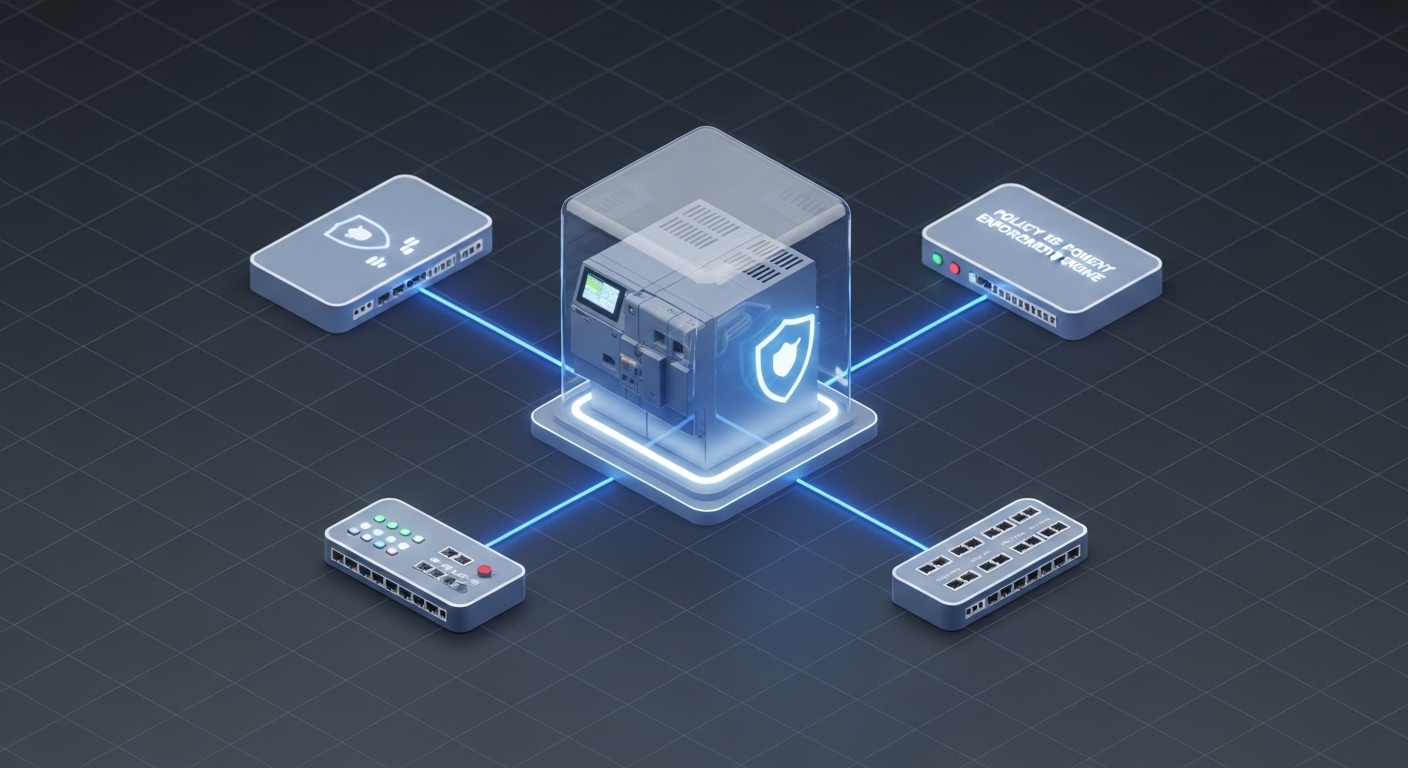
NIST Special Publication 800-53 states: "Compensating controls are security and privacy controls employed by an organization in lieu of the recommended controls in the baselines that provide equivalent or comparable protection for a system or organization." In the context of Modbus, the security gateway becomes the Policy Enforcement Point (PEP), effectively creating a trust boundary directly in front of the untrusted device.
Conclusion: Wrapping Legacy Systems in a Modern Security Fabric
The goal of securing OT networks containing legacy Modbus TCP/IP devices is not to make the devices themselves inherently secure—that is an engineering impossibility without wholesale replacement. The goal is to build a surrounding network architecture that imposes security upon them. By treating every device as potentially compromised and every network connection as untrusted, a Zero-Trust model provides a robust framework for this task.
Through a phased approach of passive discovery, gradual enforcement via compensating controls, and the definition of granular, protocol-aware policies, organizations can fundamentally transform their security posture. This methodology allows for the systematic reduction of the attack surface without ever needing to take critical processes offline. It is an architectural solution to a device-level problem, enabling continuous production to coexist with a state-of-the-art cybersecurity defense.
Sources / References
- NIST Special Publication 800-82 Rev. 2, Guide to Industrial Control Systems (ICS) Security: https://csrc.nist.gov/publications/detail/sp/800-82/rev-2/final
- ISA/IEC 62443 Series of Standards on Industrial Automation and Control Systems Security: https://www.isa.org/standards-and-publications/isa-standards/isa-iec-62443-series-of-standards
- Modbus Application Protocol Specification V1.1b3: https://modbus.org/specs.php