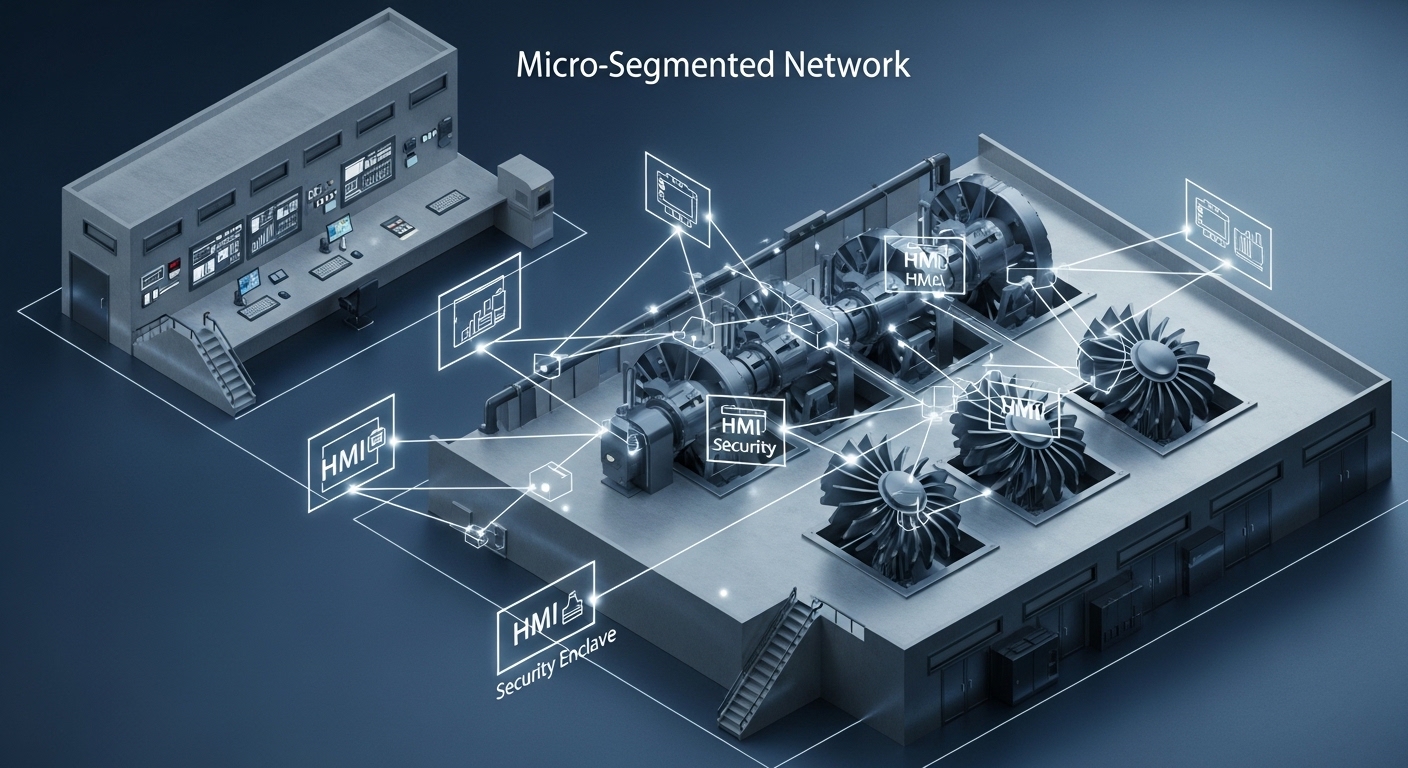
The Digital Penstock: Architecting Zero-Trust Micro-segmentation for Air-Gapped Hydroelectric OT Networks
Apex Insights Research Desk
The Foundational Flaw of the Air Gap in Critical Infrastructure
For decades, the operational technology (OT) networks governing critical infrastructure like hydroelectric power plants have been secured by a single, formidable principle: the air gap. The physical isolation from external, untrusted networks was considered the ultimate defense. However, the modern threat landscape, characterized by sophisticated state-sponsored actors and complex supply chain vectors, has rendered this assumption dangerously obsolete. An air gap is not a panacea; it is a porous boundary, easily bridged by a contractor's laptop, a compromised USB drive, or an insider threat. The Stuxnet worm, which traversed an air gap to physically destroy Iranian nuclear centrifuges, remains the canonical example of this vulnerability.
In the context of a hydroelectric facility—where a cyber-physical attack could have catastrophic kinetic consequences—relying solely on perimeter defense is an unacceptable risk. The imperative has shifted from a trust-based model ('trust but verify') to a Zero-Trust architecture ('never trust, always verify'). This article from the Apex Insights Research Desk presents an engineering blueprint for designing and deploying a Zero-Trust micro-segmentation architecture specifically for legacy, air-gapped hydroelectric OT environments, where internet connectivity is non-existent and operational continuity is paramount.
Rethinking Security: Zero-Trust Principles in an Offline World
Zero-Trust in an IT context often revolves around user identity and cloud access. In an air-gapped OT network, the paradigm is re-contextualized. It is not about protecting from the internet; it is about assuming the internal network is already compromised. The objective is to eliminate an attacker's ability to move laterally from a non-critical system (like a building management system) to a critical one (like a turbine governor PLC). Every device, every data packet, and every command is treated as a potential threat until its identity, context, and authorization are rigorously verified against a strict policy.
This means that communication between two PLCs on the same network segment is scrutinized with the same intensity as a connection originating from an external network would be. The goal is to shrink the implicit trust zone from the entire network down to an individual device or a small, logically-grouped set of assets. This approach fundamentally contains the 'blast radius' of any potential breach, preventing a localized compromise from becoming a facility-wide catastrophe.
An Architectural Blueprint for Phased Implementation
Deploying a Zero-Trust architecture in a live, sensitive OT environment cannot be a 'rip-and-replace' project. It requires a methodical, phased approach that prioritizes visibility and minimizes operational risk.
Phase 1: Deep Visibility and Deterministic Baselining The foundational step is achieving complete, granular visibility into every corner of the OT network. You cannot secure what you cannot see. This involves deploying passive network sensors (using SPAN or TAP ports) to capture all east-west traffic without introducing any latency or points of failure. The key is using protocol-aware Deep Packet Inspection (DPI) that understands the specific languages of OT, such as DNP3, Modbus, or IEC 60870-5-104. This allows for the creation of a high-fidelity asset inventory and a deterministic communication map. This map documents precisely which devices communicate, the protocols used, the frequency of communication, and the specific commands or data registers accessed. Navigating the unique challenges of this process is critical, as detailed in our analysis of real-time anomaly detection in legacy Modbus/DNP3 OT networks. This baseline of 'normal' behavior becomes the foundation upon which all security policies are built.
Phase 2: Defining Micro-Perimeters and Functional Enclaves With a complete communication map, assets can be logically grouped into micro-segments or 'enclaves' based on their operational function, criticality, and communication patterns. For example, all components related to Turbine Control Unit 1 (PLCs, sensors, local HMI) would form one enclave. The SCADA historian and its sources would form another. The goal is to enforce the principle of least privilege at a network level, ensuring that enclaves can only communicate with each other through explicitly defined and policed conduits.
Phase 3: Granular Policy Definition and Virtual Enforcement This phase translates the deterministic baseline into a proactive security policy. The policy should be a strict 'allow-list' model. For instance: "Allow IP address 10.10.1.5 (SCADA HMI) to read DNP3 object group 2 from IP 10.10.2.10 (RTU-7) every 5 seconds. Deny all other communication." Crucially, before enforcement, these policies should be run in a simulation or 'monitor-only' mode. The system flags any traffic that would have been blocked, allowing engineers to refine policies and eliminate false positives that could otherwise cause an operational disruption. This iterative refinement process is the key to a safe and successful deployment.
Core Engineering Principle: A Zero-Trust policy must be granular enough to control not just the source and destination of a communication flow, but also the specific application-layer commands and function codes being executed within that flow. This is the difference between basic network segmentation and true micro-segmentation.
- Phase 4: Enforcement Through Compensating Controls Since legacy PLCs, RTUs, and IEDs cannot host security agents, enforcement must be handled at the network layer using compensating controls. These are purpose-built OT security appliances or hardened network switches deployed at the boundaries of each micro-segment. These devices act as transparent, inline gatekeepers, inspecting every packet against the defined policy and dropping anything that deviates. These enforcement points must be designed for OT environments, featuring ruggedized hardware, low-latency processing, and fail-open/fail-closed capabilities to ensure operational resilience.
Practical Implementation Challenges
Transitioning a legacy hydroelectric OT network to a Zero-Trust architecture is fraught with unique engineering hurdles that demand careful consideration.
- Deterministic Latency Constraints: Hydroelectric control systems often operate on real-time deterministic networks. Introducing an inline enforcement device, even one with microsecond-level latency, can introduce jitter that disrupts sensitive control loops governing turbine speed or wicket gate positioning. Any potential solution must be rigorously tested in a lab environment to certify that it does not violate the network's deterministic performance characteristics.
- Air-Gap Data Management: In a truly air-gapped facility, managing the Zero-Trust infrastructure itself is a challenge. How are policies updated? How are security logs and alerts exfiltrated for analysis? This requires a highly disciplined 'sneaker-net' process using physically controlled, scanned removable media or, preferably, the implementation of a unidirectional data diode to move data out of the secure OT zone without allowing any data back in.
- Proprietary Protocol Nuances: While many systems use standard protocols like DNP3, vendors often include proprietary extensions or custom function codes. A DPI engine that doesn't fully understand these nuances might incorrectly flag legitimate traffic as malicious, causing a denial-of-service condition. The chosen solution must either have a comprehensive library of these proprietary variants or a robust mechanism to learn and safely allow them.
- Physical vs. Logical Identity: A core tenet of Zero-Trust is strong identity verification. This is profoundly difficult for headless, legacy OT devices. This necessitates a shift towards a more comprehensive understanding of identity, blending network identifiers (IP/MAC) with behavioral analytics and physical location. This is a core component of the brownfield imperative for Zero-Trust micro-segmentation across all industrial sectors.
Identity as the Bedrock of OT Zero-Trust
The most significant conceptual leap is extending identity beyond human users to machines. In an OT network, the vast majority of communications are machine-to-machine (M2M). How do you authenticate a 30-year-old PLC? Since traditional authentication mechanisms like certificates or tokens are unavailable, identity must be derived from a composite of attributes: the device's network fingerprint (static IP, MAC address), its expected physical location (which switch port it's connected to), and its behavioral baseline (the specific protocols and commands it is known to use). Building a vendor-agnostic M2M identity fabric is the ultimate goal, creating a system where trust is continuously evaluated based on a holistic and contextual understanding of each device's role and expected behavior within the industrial process.
By architecting security around this robust, context-aware M2M identity, the Zero-Trust model can be effectively realized. An attacker who compromises a single device cannot simply spoof its IP address to gain access to other systems, as the enforcement points would recognize that the behavioral patterns and commands originating from that IP do not match the established identity profile of the legitimate device, and the traffic would be blocked. This containment is the ultimate promise of Zero-Trust in critical infrastructure, transforming the entire OT network into a self-defending system.
Sources / References
- NIST Special Publication 800-82 Revision 3: Guide to Operational Technology (OT) Security -
https://csrc.nist.gov/pubs/sp/800/82/r3/final - ISA/IEC 62443 Series of Standards on Industrial Automation and Control Systems (IACS) Security -
https://www.isa.org/standards-and-publications/isa-standards/isa-iec-62443-series-of-standards - CISA: Industrial Control Systems (ICS) Resources -
https://www.cisa.gov/resources-tools/resources/industrial-control-systems-ics - NISTIR 8320: Hardware-Enabled Security: Enabling a Layered Approach to Platform Security for Cloud and Edge Computing Use Cases -
https://csrc.nist.gov/publications/detail/nistir/8320/final