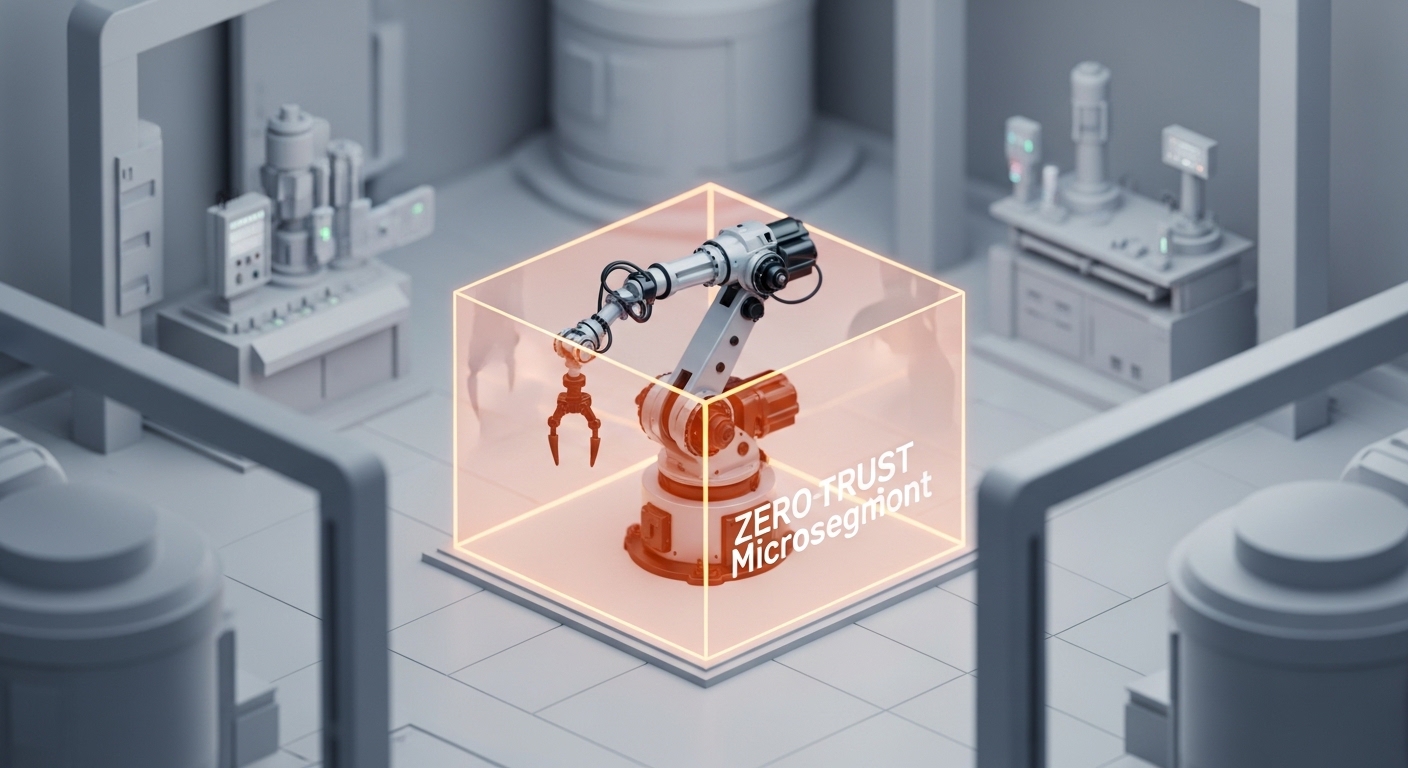
The Robotic Enclave: A Blueprint for Zero-Trust Micro-segmentation in Real-Time Robotic OT
Apex Insights Research Desk
The Core Dilemma: Securing Legacy Robotics Without Disrupting Deterministic Operations
Industrial robots, the high-precision workhorses of modern manufacturing, represent a significant cyber-physical attack surface. These legacy systems, often operating for decades on unpatched, proprietary operating systems, are increasingly connected to broader plant networks, exposing them to lateral threats moving from IT to OT. The conventional security response—deploying firewalls and implementing coarse VLAN-based segmentation—is wholly inadequate for this environment. The primary engineering constraint is the absolute requirement for deterministic, low-latency communication to maintain the integrity of real-time control loops. A few milliseconds of jitter introduced by a traditional security appliance can lead to quality defects, emergency stops, or catastrophic physical damage.
This creates a paradox: the very systems requiring the most robust protection are the least tolerant of the security controls designed to provide it. The challenge, therefore, is not merely to segment the network, but to implement a granular, zero-trust security posture at the individual asset level without introducing a single microsecond of non-deterministic latency. This research blueprint outlines an architectural methodology for achieving precisely this, creating secure 'robotic enclaves' for legacy systems without disrupting the sensitive control plane.
Deconstructing the Robotic Workcell Attack Surface
A typical robotic workcell is a complex ecosystem of interconnected devices. The robot controller itself is the nexus, communicating with a variety of endpoints:
- PLCs (Programmable Logic Controllers): For orchestrating broader cell logic and coordinating with other machinery.
- Teach Pendants: Human-machine interfaces used by operators and engineers for programming, diagnostics, and manual control.
- Upstream Systems: Such as Manufacturing Execution Systems (MES) for production orders or historian databases for performance logging.
- Safety Controllers: Dedicated systems for emergency stops, light curtains, and other personnel safety functions.
These communications often utilize a mix of proprietary, unauthenticated protocols (e.g., FANUC's private protocols, KUKA's KRL, ABB RAPID) running over standard TCP/IP. An adversary gaining a foothold on the network can easily spoof commands, exfiltrate sensitive intellectual property (robotic path programs), or manipulate the robot's physical behavior. The objective of zero-trust micro-segmentation is to render this lateral movement impossible by enforcing a policy of least privilege on every connection, treating every device as a potential threat.
Architectural Blueprint: The Compensating Control Overlay
To achieve zero-trust for legacy robots without an operational overhaul, a non-intrusive overlay architecture is required. This approach layers security on top of the existing network fabric, enforcing policy without modifying the robot controller's firmware or the underlying control logic. The implementation follows a precise, multi-stage process.
Passive Discovery and Deterministic Baselining: The foundational step is to achieve perfect visibility without risk. An out-of-band approach using network TAPs or SPAN ports is the only acceptable method. This traffic is fed into a deep packet inspection (DPI) engine capable of parsing the specific L7 protocols used by the robot vendor. The goal is to build a high-fidelity 'digital twin' of the robot's communication patterns. This baseline must capture every legitimate command-response pair, source/destination, and port/protocol tuple over a representative production cycle. It is not enough to know that the robot talks to a PLC; the system must learn the specific, legitimate function codes and data registers being accessed.
Micro-Perimeter and Policy Definition: With a validated baseline, the micro-perimeter for each robot is defined. This is the 'segment of one' concept, where the implicit trust of the flat network is revoked. The baseline is translated into an explicit, stateful whitelist policy. For example:
ALLOW Robot_Controller_A (MAC: 0A:1B:...) to send KUKA_KRL 'Read_Axis_Position' command to PLC_B (MAC: 0C:2D:...). Any communication not explicitly defined in this policy—a scan from an unknown IT asset, an attempt to upload new firmware from an unauthorized engineering station, or communication with another robot controller—is axiomatically denied.Deployment of the Segmentation Enforcement Point (SEP): This is the most critical architectural decision. Traditional inline firewalls, with their software-based packet processing on general-purpose CPUs, are unacceptable due to their variable latency. The SEP must be a purpose-built device, often referred to as a transparent 'bump-in-the-wire' appliance or a function embedded within a capable industrial switch. Its core characteristic is the ability to enforce the defined L7 policy at wirespeed with fixed, deterministic latency—typically measured in microseconds, well below the tolerance threshold of any robotic control loop.
Policy Enforcement and Real-Time Verification: The SEP, placed directly in the communication path of the robot controller, inspects every packet against the established whitelist policy. If a packet matches an allowed rule, it is forwarded with negligible, predictable delay. If it does not, it is dropped, and a high-priority alert is sent to the security operations center (SOC). This model is a core tenet of our research into creating The Modbus Enclave: A Blueprint for Zero-Trust Micro-segmentation in Legacy OT Without Impacting Control Integrity, where the principles of protocol-aware whitelisting are paramount.
Centralized, Non-Disruptive Policy Orchestration: As production needs evolve, policies must be updated. This process cannot introduce risk. A central management platform must be able to push updated policies to hundreds of SEPs simultaneously. Critically, this update process must be atomic. The SEP receives and validates the new policy in a secondary memory space while continuing to enforce the active policy. Once validated, the policy is swapped atomically into the live enforcement engine, ensuring no packet loss or jitter is introduced. This concept of maintaining control plane stability is fundamental, as detailed in our analysis of The Deterministic Mandate: Ensuring Control Plane Integrity During Dynamic Policy Updates in Brownfield SCADA Micro-segmentation.
Core Engineering Principle: The Primacy of Determinism In real-time control systems, consistency is more important than raw speed. The introduction of variable latency, or jitter, is the primary enemy of control loop stability. Any security solution implemented within these environments must be verifiably proven to add only a fixed, minimal latency to the data path. This is typically achievable only through hardware-level packet processing via FPGAs or specialized network processors, bypassing the non-deterministic nature of software-based security stacks.
Practical Implementation Challenges
Deploying this architecture in a brownfield environment presents significant engineering hurdles that require careful planning and specialized expertise.
- Proprietary Protocol Obfuscation: Robot vendors often guard their communication protocols as trade secrets. Effective L7 policy enforcement requires a DPI engine that can accurately parse these undocumented protocols. This necessitates either partnering with a security vendor who has already performed the requisite reverse engineering or undertaking a complex and resource-intensive protocol analysis project in-house.
- Physical Network Interruption: While the architecture is logically non-intrusive, inserting physical SEPs requires a brief physical disconnection of the network link to the robot controller. This necessitates a scheduled maintenance window, which can be difficult to secure in 24/7 manufacturing operations.
- Handling Ad-Hoc Maintenance Access: A rigid whitelist policy can block legitimate maintenance activities, such as a technician connecting a laptop or teach pendant for diagnostics. The policy orchestration system must support identity-based, time-limited access controls. For instance, an authenticated engineer can be granted temporary, role-based access to a specific robot for a two-hour window, after which the access rule is automatically revoked.
- Safety System Non-Interference Verification: Robotic safety systems (e.g., PROFIsafe, CIP Safety) are certified to meet stringent international standards (e.g., IEC 61508). It is absolutely imperative to prove and certify that the SEP cannot, under any failure condition, interfere with the delivery of safety-critical messages. This often requires extensive testing in a lab environment that mirrors the production cell.
- Scalability and Policy Lifecycle Management: Managing thousands of granular micro-segmentation policies by hand is untenable. The success of the deployment hinges on a robust central management console that can automate policy creation from baselines, group assets logically, and provide clear audit trails for all policy changes. The entire system's efficacy relies on achieving a Blueprint for Resilience: Verifiable Micro-segmentation in Legacy OT Without Operational Disruption, ensuring that the security posture is both strong and maintainable at scale.
Conclusion: From Liability to Resilient Asset
Implementing zero-trust micro-segmentation for legacy industrial robots is not a simple undertaking, but it is an essential one. By moving beyond outdated perimeter security models and adopting a non-disruptive overlay architecture, manufacturers can transform their most critical production assets from significant liabilities into hardened, resilient components of a secure industrial ecosystem. The methodology of passive discovery, granular L7 policy definition, and enforcement via deterministic, hardware-accelerated SEPs provides a viable path to security that respects the stringent real-time demands of modern robotics. This architectural shift effectively eliminates the threat of lateral movement, contains potential breaches to a single workcell, and builds a foundational layer of security for the future of smart manufacturing.
Sources / References
- NIST Special Publication 800-82 Rev. 3 (Draft): Guide to Operational Technology (OT) Security. URL:
https://csrc.nist.gov/publications/detail/sp/800-82/rev-3/draft - ISA/IEC 62443 Series of Standards on Industrial Automation and Control Systems (IACS) Security. URL:
https://www.isa.org/standards-and-publications/isa-standards/isa-iec-62443-series-of-standards - EtherCAT Technology Group, "Introduction to EtherCAT," (Provides context on real-time Ethernet performance requirements). URL:
https://www.ethercat.org/download/documents/EtherCAT_Introduction_EN.pdf