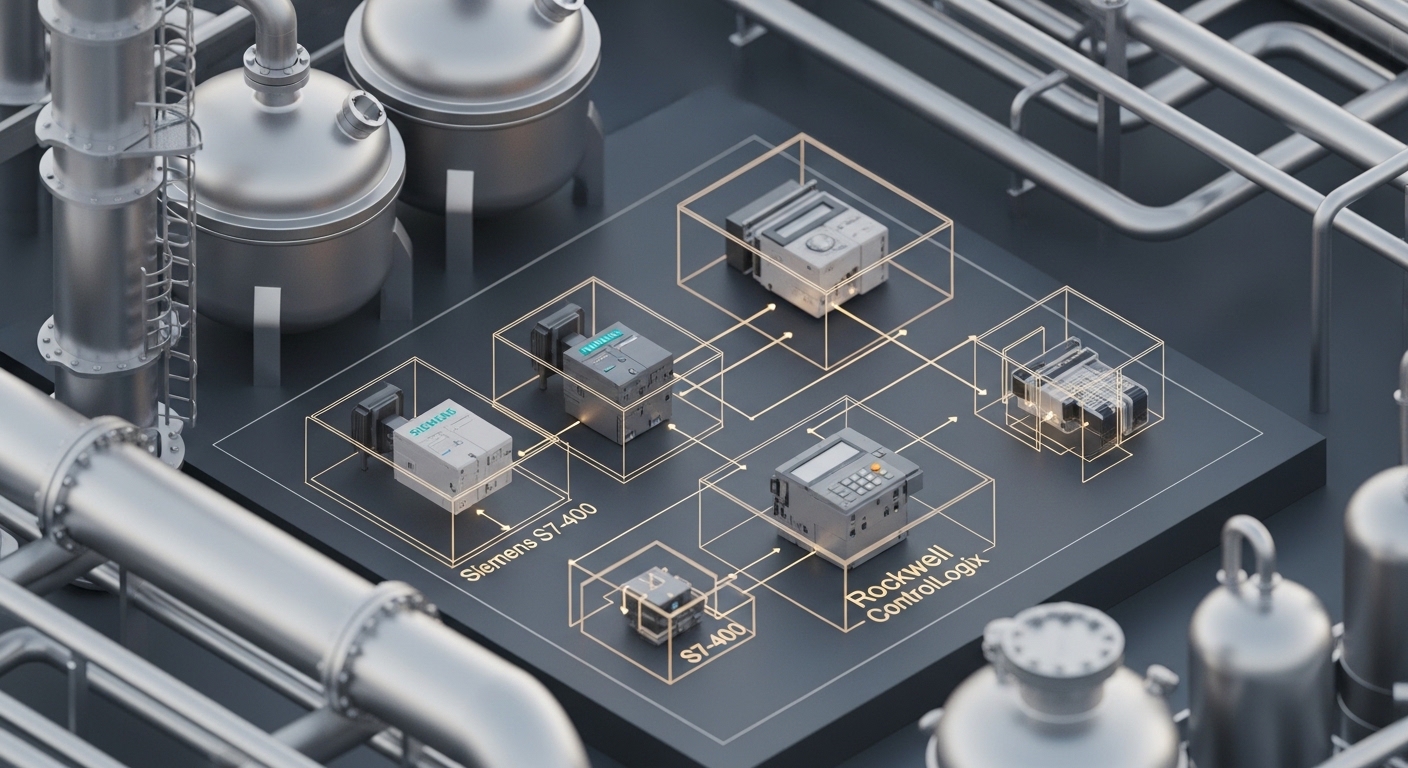
The Deterministic Enclave: Latency-Free Zero-Trust Micro-segmentation for Legacy Siemens & Rockwell PLCs in Chemical OT
Apex Insights Research Desk
Introduction: The Brownfield Imperative in Chemical Processing
The operational landscape of a brownfield chemical plant is a high-stakes environment where process integrity and safety are paramount. These facilities are characterized by continuous or complex batch operations, a heterogeneous mix of control systems spanning decades, and an absolute intolerance for unexpected latency or jitter. The control layer, often populated by venerable workhorses like Siemens SIMATIC S7-300/400 and Rockwell Automation PLC-5/SLC 500/ControlLogix systems, was designed for deterministic performance, not for the security challenges of modern converged IT/OT networks.
The traditional security posture, heavily reliant on the Purdue Model's air-gapped or firewalled perimeter, is fundamentally brittle. A single breach of this perimeter can grant an adversary extensive lateral movement capabilities across a flat, unsegmented Level 1 or Level 2 network. This exposes critical process control and safety instrumented systems (SIS) to unacceptable risk. Zero-Trust architecture, which mandates that no actor is trusted by default, offers a robust alternative. However, the common IT-centric implementation of Zero-Trust—often involving inline appliances and heavy-handed inspection—is a non-starter in an environment where a few milliseconds of unexpected delay can trigger a process upset or a safety trip. This article presents an architectural blueprint for implementing Zero-Trust micro-segmentation for legacy Siemens and Rockwell PLCs in a live chemical plant, focusing on methodologies that preserve the deterministic, low-latency communication fabric essential for safe and continuous operations.
The Latency Conundrum: Why Determinism is Non-Negotiable
To understand the implementation challenge, one must first appreciate the nature of the protocols in question. Siemens and Rockwell PLCs utilize distinct but equally latency-sensitive communication stacks:
- Siemens S7 Communication (S7comm/S7comm-Plus): This protocol, typically running over TCP port 102, is used for programming, diagnostics, and HMI data exchange. While not strictly real-time in the same vein as PROFINET IRT, its performance is critical for operator visibility and control. Excessive latency in HMI updates or command acknowledgments can lead to operational errors.
- Rockwell EtherNet/IP (EIP) with CIP: This protocol suite encapsulates the Common Industrial Protocol (CIP) within TCP/IP and UDP/IP. For I/O and other time-critical functions, EIP relies on UDP. Furthermore, applications involving coordinated motion control or high-speed processes leverage CIP Sync (based on IEEE 1588 PTP) to achieve sub-millisecond clock synchronization. Any security solution that disrupts this timing mechanism is untenable.
Conventional security tools like Next-Generation Firewalls (NGFWs) introduce processing delay. Even a seemingly minor delay, when inconsistent (i.e., jitter), can violate the assumptions of the control loop, causing PLCs to fault or safety logic to engage. Therefore, the core architectural challenge is to enforce granular, identity-based access control without becoming a bottleneck in the data path.
Architectural Blueprint for Zero-Latency Enforcement
Achieving latency-free micro-segmentation in a brownfield environment is not a product deployment but a phased, architectural process. The goal is to move enforcement from a centralized chokepoint to a distributed fabric that operates at line speed.
Phase 1: Non-Intrusive Discovery and Baselining The first principle is to do no harm. Instead of immediately deploying inline devices, the initial phase must be entirely passive. By connecting to Switch Port Analyzer (SPAN) or Test Access Point (TAP) ports on core and distribution switches, network traffic analysis (NTA) and industrial protocol discovery tools can be used. The objective is to build a comprehensive, ground-truth inventory and communication map. This includes identifying every PLC, HMI, and Engineering Workstation (EWS), and baselining every communication flow. This baseline must be granular, detailing not just source/destination IPs and ports, but the specific S7 function codes or CIP service requests being used (e.g.,
Read Variable,Write Variable,PLC Program Download). This detailed understanding is the foundation of any effective policy.Phase 2: Policy Abstraction and Definition With a verified baseline, security policies can be defined in a human-readable, process-oriented manner. Instead of archaic firewall rules like
allow tcp src 10.20.30.4 dst 10.20.30.5 eq 102, a Zero-Trust policy is abstracted:HMI_Reactor_3 is authorized to read_only Tag_Group_Temp from PLC_Reactor_3. This abstraction is critical. It ties security policy to operational intent, making it easier to manage, audit, and adapt. The policy engine must be capable of translating these logical statements into specific, enforceable rules that understand the nuances of industrial protocols. Crafting a robust policy framework that can distinguish between benign and malicious uses of protocols like EtherNet/IP is a complex engineering task, further explored in our guide on Protocol-Aware Micro-segmentation: An Engineering Blueprint for Securing Modbus/TCP and EtherNet/IP.Phase 3: Distributed Policy Enforcement This is the architectural core that circumvents the latency problem. Instead of routing traffic through a central firewall, policy enforcement points (PEPs) are distributed throughout the network, as close to the assets as possible. These PEPs are not traditional firewalls. They can be implemented in several ways:
- OT-Aware Switches: Modern industrial switches that have embedded security features capable of enforcing ACLs or more advanced policies at the port level, at line rate.
- Dedicated Security Appliances: Transparent inline devices designed specifically for OT environments. These appliances must have data plane processing hardware (e.g., FPGAs, network processors) that can execute policy decisions with microsecond-level latency, far below the threshold that would impact control processes. The central Policy Decision Point (PDP) or management console orchestrates the policies, pushing them down to the distributed PEPs. The critical data path traffic, however, only passes through the local, high-speed PEP, eliminating the trombone effect of routing traffic to and from a central security stack.
Phase 4: Phased Enforcement and Validation A 'big bang' cutover is never acceptable in a live plant. The enforcement strategy must be phased:
- Monitor Mode: Initially, all PEPs are placed in a non-blocking, 'monitor' or 'audit' mode. Policies are active, but instead of blocking traffic, the PEPs generate alerts for any communication that would have violated the policy. This allows for validation and refinement of the policy set against real-world traffic without any operational impact.
- Targeted Enforcement: Once confidence in the policies is high, enforcement is enabled for less critical segments first (e.g., segmenting the data historian from the control network).
- Full Enforcement: Critical PLC-to-PLC or PLC-to-SIS communication segments are the last to have blocking policies enabled, only after exhaustive testing and validation.
Practical Implementation Challenges
Deploying this architecture in a chemical plant presents unique engineering hurdles that demand careful consideration.
Unmanaged Network Infrastructure: Many brownfield facilities contain unmanaged switches that lack support for SPAN ports or VLANs. The initial discovery phase may require the temporary installation of network TAPs, and the eventual deployment of PEPs will necessitate a planned network hardware refresh in those segments.
Jitter Impact on Time-Sensitive Protocols: For Rockwell systems using CIP Sync, the primary concern is not just average latency but jitter (variation in latency). A PEP must be certified to pass through IEEE 1588 PTP traffic without altering its timing information or introducing unpredictable delay. Any device that terminates and re-generates PTP traffic is likely unsuitable. The PEP's data plane must be provably deterministic.
Legacy Protocol Obscurity: While S7comm and EtherNet/IP are well-documented, older devices may use vendor-specific encapsulations or customizations. A policy engine must be ables to handle these variations without generating false positives or, worse, failing to identify a malicious command hidden within a seemingly valid packet. The ability to manage these disparate systems is a core tenet of effective micro-segmentation, a concept we detail in The Deterministic Enclave: A Blueprint for Zero-Trust Micro-segmentation on Live Modbus/DNP3 Networks.
Safety Instrumented System (SIS) Isolation: Systems like the S7-400FH or GuardLogix are subject to stringent regulations (e.g., IEC 61511). Any security control applied to the SIS network must be proven to not interfere with its safety function under any failure mode. This requires a dedicated risk assessment and rigorous testing. The policies for SIS segments should be the most restrictive, often allowing communication only between the logic solver and its designated I/O and engineering station. Properly enforcing these boundaries is crucial, as we discuss in The Unbreachable Core: Enforcing Automated Micro-segmentation in SIS with Zero Trust on Brownfield Infrastructure.
In the context of industrial control systems, particularly those governing hazardous processes, the guiding principle for security controls must be based on the engineering maxim of 'Primum non nocere'—first, do no harm. A security policy must demonstrably fail-safe in a way that maintains the integrity of the underlying process.
Conclusion: From Perimeter Defense to Process Resilience
Implementing Zero-Trust micro-segmentation in a brownfield chemical plant is not about replacing firewalls; it's a fundamental shift in security architecture. By moving away from centralized, latency-inducing inspection points and toward a distributed fabric of high-speed, protocol-aware enforcement, it is possible to create granular security enclaves around critical assets like Siemens and Rockwell PLCs without disrupting deterministic process control. This approach transforms the security posture from a brittle perimeter to a resilient, self-protecting ecosystem where trust is explicit, access is least-privilege, and the impact of a potential breach is confined to a minimal blast radius. This is the future of industrial cybersecurity—a model where security enhances, rather than hinders, operational resilience.
Sources / References
- NIST Special Publication 800-207: Zero Trust Architecture. Available at: https://csrc.nist.gov/publications/detail/sp/800-207/final
- ISA/IEC 62443 Series of Standards on Industrial Automation and Control Systems Security. International Society of Automation. More information available at: https://www.isa.org/standards-and-publications/isa-standards/isa-iec-62443-series-of-standards
- Siemens Industry Online Support (SIOS): Technical Documentation for SIMATIC. Available at: https://support.industry.siemens.com/
- Rockwell Automation Literature Library: EtherNet/IP Modules in Logix5000 Control Systems. Available at: https://literature.rockwellautomation.com/