Architecting Immunity: A Zero-Trust Blueprint for Legacy Siemens S7-300 PLCs in Nuclear OT
Apex Insights Research Desk
The Unsecurable Mandate: Zero-Trust in Brownfield Nuclear Environments
The operational technology (OT) networks within a nuclear power plant represent the apex of critical infrastructure. Governed by stringent deterministic requirements and an absolute intolerance for unplanned downtime, these environments are often a living museum of legacy hardware. Among the most ubiquitous of these assets is the Siemens SIMATIC S7-300 series PLC. For decades, these controllers have been the reliable workhorses of countless I&C (Instrumentation and Control) systems, yet from a modern cybersecurity perspective, they represent a significant challenge. Lacking native authentication, encryption, or any semblance of identity-awareness, their core communication protocol, S7comm, was designed for efficiency in a trusted network, not for resilience in the face of today's threats.
The core dilemma facing nuclear asset owners and engineering teams is how to superimpose modern cybersecurity principles, specifically zero-trust micro-segmentation, onto this fragile, legacy foundation without initiating a cataclysmic operational disruption or triggering a prohibitively expensive re-certification cycle with regulatory bodies like the NRC. The challenge is magnified by a critical constraint: any solution cannot involve direct network access for policy enforcement, meaning no agent installation, no IP address changes, and no modifications to the PLC's ladder logic or hardware configuration.
This analysis from the Apex Insights Research Desk presents a non-disruptive architectural blueprint for achieving granular, zero-trust micro-segmentation for Siemens S7-300 PLCs in a brownfield nuclear setting. The methodology hinges on the deployment of compensating controls, specifically through transparent, protocol-aware network security appliances that enforce policy without the PLC ever being aware of their existence.
The S7-300 and Nuclear OT Constraint Matrix
Implementing any change in a nuclear I&C environment requires a profound understanding of the operational and regulatory constraints. The Siemens S7-300 platform exists within a matrix of interlocking challenges that render traditional IT security models inert.
Protocol Vulnerability: The S7comm protocol, typically running over ISO-on-TCP (port 102), lacks authentication. Any device on the network that can route to the PLC can potentially send it valid commands, including critical instructions like STOP CPU, memory writes, or logic downloads. There is no native mechanism within the protocol to differentiate a legitimate command from an HMI from a malicious one from a compromised engineering workstation.
Deterministic Latency: Control loops in a nuclear environment, such as those managing feedwater pumps or control rod actuators, operate on strict, deterministic timetables. Any security solution that introduces significant latency or, more critically, unpredictable jitter, can compromise the stability of the physical process, leading to a safety trip or undesirable operational excursion.
Regulatory Overhead (The Re-Certification Hurdle): Any modification to a safety-related or critical digital asset, including its networking configuration, can trigger the need for a full re-validation and re-certification process. This is an arduously long and expensive undertaking that asset owners will avoid at all costs.
The Unpatchable Asset: Many S7-300 CPUs and their associated communication processors (CPs) are running firmware versions that are decades old. Patches may not be available, or the risk of bricking the device during a firmware update is deemed too high. They must be protected as-is.
These constraints demand a solution that is external, passive in its observation, and minimally intrusive in its enforcement. It must understand the unique syntax and state of the S7comm protocol and enforce policy without altering the fundamental network behavior observed by the legacy endpoints. This is the essence of a non-disruptive approach tailored for securing the unsecurable in brownfield OT networks.
Architectural Blueprint: The Compensating Controls Model
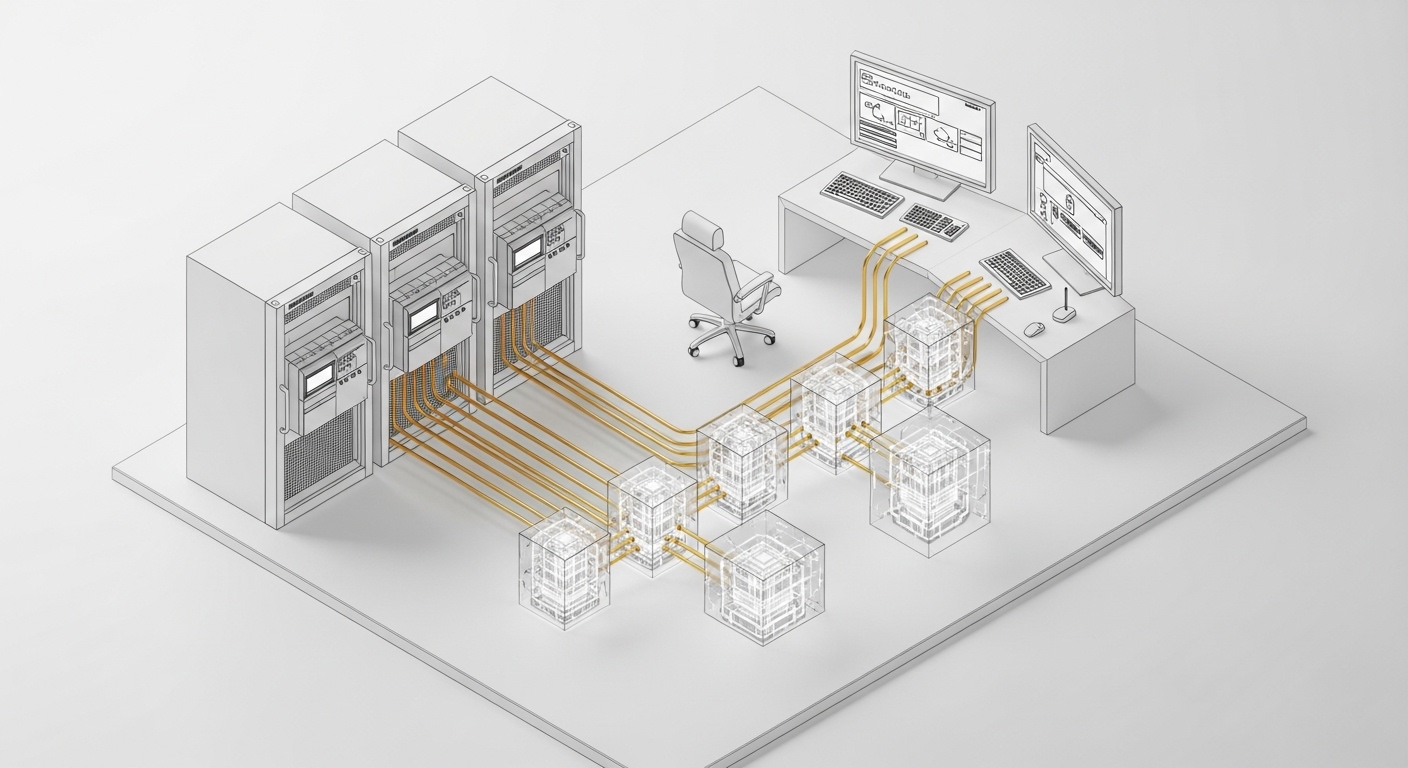
Achieving zero-trust for an S7-300 requires creating a micro-segment of one around the PLC. Since we cannot place a firewall on the PLC, we must create a virtual, policy-defined perimeter around it using an external device. This is accomplished using a transparent (Layer 2) security gateway, often called a 'bump-in-the-wire' appliance, deployed in-line on the network cable connected to the PLC's communication processor.
Here is the phased blueprint for implementation:
Phase 1: Passive Discovery and Traffic Baselining. The transparent gateway is first deployed in a passive, 'monitor-only' mode. It is physically in-line but does not block, alter, or delay traffic. Its purpose is solely to ingest a high-fidelity copy of all S7comm traffic to and from the PLC. Over a period representing a full operational cycle (e.g., 30-90 days), the system's deep packet inspection (DPI) engine builds a granular baseline of all legitimate communications. This baseline should capture source/destination MAC/IP addresses, S7 function codes used (e.g., Read/Write SZL, Read/Write Variable, Start/Stop), data blocks accessed, and the specific engineering workstations authorized to perform program modifications.
Phase 2: Granular Policy Definition. Using the captured baseline, security and I&C engineers co-author a positive security policy—a 'whitelist' of allowed communications. This is the core of the zero-trust model: all traffic is denied by default unless it explicitly matches an allowed rule. A policy for an S7-300 controlling a pump might look like this:
- Allow HMI_1 (IP: 10.10.20.5) to read variables from Data Block 10 (DB10) every 500ms.
- Allow HMI_2 (IP: 10.10.20.6) to write a single boolean 'Start' variable in Data Block 12 (DB12).
- Allow Engineering_WS_1 (IP: 10.10.50.10) to perform 'PLC Stop', 'PLC Start', and 'Download Block' functions, but only during scheduled maintenance windows.
- Deny all other S7comm functions from all other sources implicitly. This level of detail moves beyond simple IP-based rules. True security requires architecting granular control at the PLC register level, which is precisely what a protocol-aware DPI engine enables.
Phase 3: Policy Simulation and Virtual Enforcement. Before activating any blocking, the defined policy is run in a simulation mode against live traffic. The gateway logs every packet that would have been dropped if enforcement were active. This critical phase allows the team to identify any legitimate but rare communication paths missed during baselining (e.g., an annual diagnostic routine) and refine the policy without any operational impact.
Phase 4: Phased Enforcement and Continuous Verification. Once confidence in the policy is high, enforcement is activated. The transparent gateway now acts as a micro-firewall, silently dropping any S7comm packet that deviates from the established whitelist. The principle of 'never trust, always verify' is maintained through continuous monitoring of the traffic flow and alerting on any denied packets, which now represent either a policy misconfiguration or a genuine security event.
Core Engineering Principle: The Principle of Least Privilege In the context of OT, this principle dictates that every component of the system—be it an HMI, a historian, or an engineering workstation—should only be able to communicate using the specific protocols, function codes, and data addresses absolutely necessary for it to perform its designated function, and nothing more. The compensating controls model described here is a direct, practical application of this foundational security principle to legacy devices that cannot enforce it themselves.
Practical Implementation Challenges
Deploying this architecture, while sound in theory, presents significant engineering hurdles that demand careful consideration, particularly within the high-stakes environment of a nuclear power plant.
Latency and Jitter Guarantees
Even a 'transparent' device adds components to the data path (PHYs, switching fabric, processing logic). While the total latency added by modern appliances can be in the low microseconds, the more dangerous variable is jitter—the variation in that latency. A high-speed control loop that depends on deterministic packet arrival times can be destabilized by even minor, inconsistent delays. The chosen hardware must have performance specifications that guarantee latency and jitter well below the tolerance of the most sensitive I&C system it is protecting. This requires rigorous testing in a laboratory environment that precisely mimics the production network load and traffic patterns before any field deployment.
Handling S7comm State and Fragmentation
S7comm is not a simple, stateless protocol. Certain operations involve multi-packet exchanges that must be tracked and understood in context. For example, a large data block read may be fragmented across multiple TCP packets. A simplistic DPI engine that only inspects individual packets might fail to correctly reassemble the session and misinterpret the communication, leading to a false positive block. The security gateway's DPI engine must be stateful and specifically engineered to accurately reconstruct and analyze the S7 application layer, even in the presence of fragmentation or unusual network conditions.
The Fail-Open vs. Fail-Closed Conundrum
What happens if the transparent security gateway fails, loses power, or experiences a software fault? There are two failure postures:
- Fail-Open: The device's internal relays default to a closed state, physically completing the circuit. The link is maintained, but all security enforcement is lost. This prioritizes availability over security.
- Fail-Closed: The relays default to an open state, breaking the link. The PLC is now isolated and incommunicado. This prioritizes security over availability.
In a nuclear context, the answer is determined by the specific function of the PLC. For a safety-critical system, a fail-closed posture that triggers a safe shutdown or operator alarm may be required. For a non-critical system, fail-open might be acceptable. This decision must be made on a per-segment basis through a rigorous engineering change control and safety analysis process.
Conclusion: Achieving Resilience Through External Enforcement
The security of legacy Siemens S7-300 PLCs in sensitive brownfield environments like nuclear power plants is not an insurmountable problem. It is, however, a problem that cannot be solved with conventional IT tools or methodologies. The path to securing these critical assets lies not in attempting to modify the un-modifiable endpoints, but in building a perimeter of intelligent, protocol-aware enforcement around them.
By leveraging transparent security gateways with stateful S7comm DPI, asset owners can implement a robust, non-disruptive zero-trust micro-segmentation strategy. This compensating controls model respects the operational realities of the nuclear industry—zero downtime, deterministic performance, and regulatory stability—while providing the granular, whitelist-based policy enforcement required to defend against modern threats. It is a pragmatic and architecturally sound approach to bringing legacy infrastructure into a defensible, zero-trust posture.
Sources / References
- NIST Special Publication 800-82 Rev. 2: Guide to Industrial Control Systems (ICS) Security. URL: https://csrc.nist.gov/publications/detail/sp/800-82/rev-2/final
- Siemens, SIMATIC S7-300/S7-400 System and Standard Functions Reference Manual. URL: https://support.industry.siemens.com/cs/document/1214574/s7-300-s7-400-system-and-standard-functions?dti=0&lc=en-WW
- Nuclear Energy Institute (NEI) 08-09: Cyber Security Plan for Nuclear Power Reactors. URL: https://www.nrc.gov/docs/ML0928/ML092880422.pdf
- The Wireshark Foundation, S7 Communication Protocol Wiki. URL: https://wiki.wireshark.org/S7comm