The Deterministic Mandate: A Zero-Trust Blueprint for Multi-Vendor Profinet in Brownfield OT
Apex Insights Research Desk
The Shifting Paradigm: From Perimeter Defense to Intrinsic Trust in Profinet Networks
The traditional 'castle-and-moat' security architecture, predicated on a hardened perimeter, is fundamentally obsolete in the context of modern Operational Technology (OT). Brownfield environments, characterized by a heterogeneous mix of legacy and modern assets, present an attack surface that is both porous and complex. For networks built on Profinet, the dominant Industrial Ethernet standard, this challenge is amplified. The protocol's emphasis on real-time performance and deterministic communication creates a unique tension with conventional security controls, which often introduce unacceptable latency and jitter. The assumption of a trusted internal network is no longer tenable. Consequently, asset owners are compelled to adopt a new security philosophy: Zero Trust.
This is not a simple transposition of IT-centric Zero Trust principles. Deploying a Zero Trust architecture in a multi-vendor Profinet environment requires a nuanced, protocol-aware approach that respects the stringent demands of industrial processes. The core mandate is to move from implicit trust based on network location to explicit, continuously verified trust based on identity, context, and posture, applied to every connection request without exception.
Foundational Principles: Adapting Zero Trust for Profinet's Real-Time Constraints
At its core, Zero Trust is defined by three principles: never trust, always verify; enforce least-privilege access; and assume breach. Translating these into a deterministic environment like Profinet requires re-architecting our understanding of identity and enforcement.
The principle of least privilege, as defined within frameworks like ISA/IEC 62443, dictates that an entity should only have the permissions essential to perform its intended function. In a Profinet context, this means an HMI should only be able to read specific process variables from a PLC, not execute a
PLC-Stopcommand or attempt a firmware update, unless explicitly authorized for that specific context and timeframe.
In OT, 'identity' often transcends user credentials. It encompasses the device type (e.g., Siemens S7-1500 PLC, KUKA robot controller), its firmware version, its physical location, and its expected communication patterns. Verification is not a one-time event at login but a continuous process. A key challenge is that Profinet's Real-Time (RT) and Isochronous Real-Time (IRT) traffic (Ethernet Type 0x8892) bypasses the TCP/IP stack, rendering traditional Layer 3/4 firewalls blind. Any security enforcement mechanism must operate at Layer 2 or possess deep protocol-parsing capabilities without disrupting the sub-millisecond cycle times. This is the essence of meeting the sub-10ms mandate for ultra-low-latency zero trust that governs these critical systems.
An Architectural Blueprint for Phased Profinet Zero-Trust Deployment
A successful deployment is not a single project but an iterative process. It requires a methodical, phased approach that minimizes operational disruption while progressively hardening the control environment.
Phase 1: Comprehensive Discovery and Communication Baselining The foundational step is achieving 100% visibility. You cannot secure what you do not know exists. This involves deploying passive network sensors to listen for Profinet's Discovery and Configuration Protocol (DCP) broadcasts, which reveal device identities, names, and IP configurations without intrusive active scanning. The goal is to build a comprehensive asset inventory and, more importantly, a detailed communication map. This 'who-talks-to-who' baseline must document every legitimate flow: which engineering station programs which PLCs, which HMIs poll which controllers, and the specific Profinet services (e.g., Read/Write, IO Data Exchange) used in each transaction. This baseline becomes the foundation of your initial policy set.
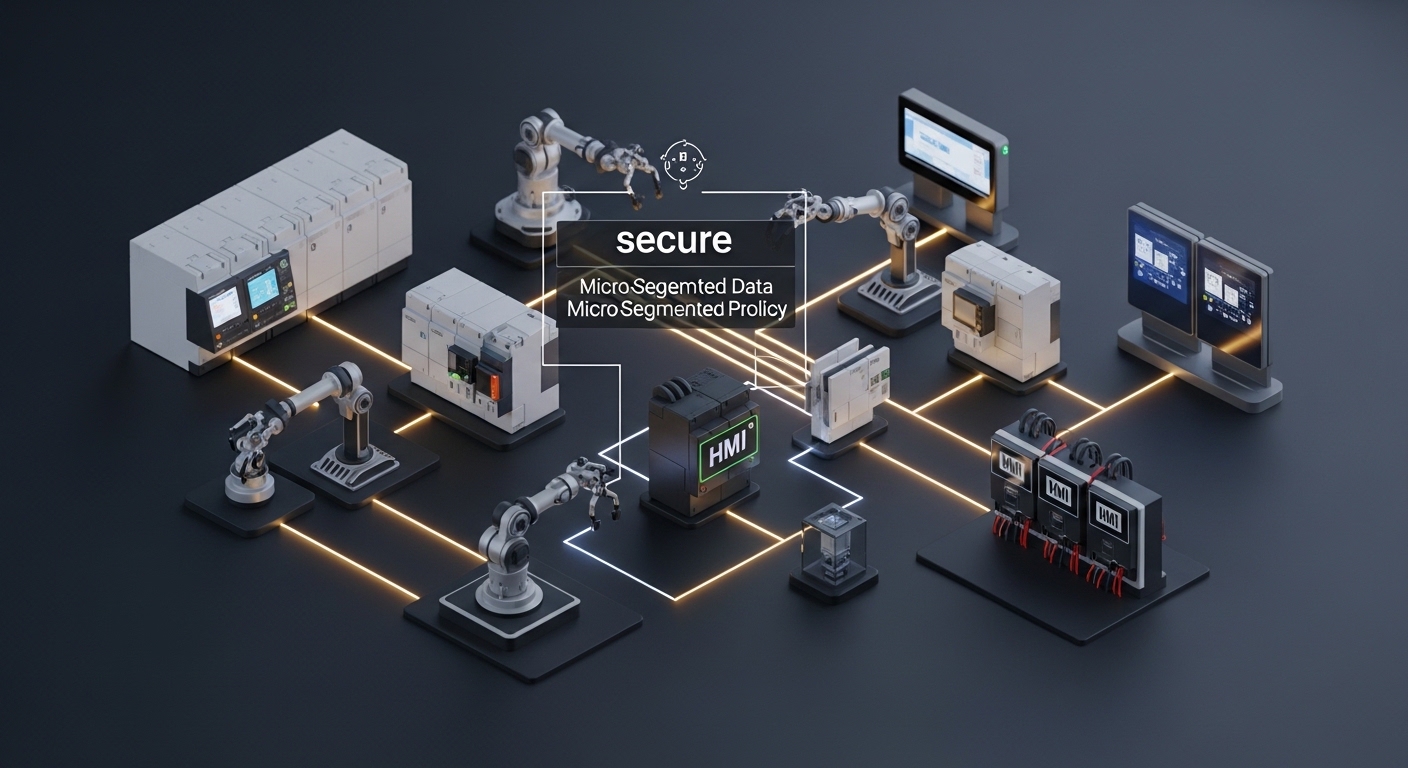
Phase 2: Defining Micro-segments and Policy Enforcement Points (PEPs) With a clear baseline, the next step is to logically group assets into micro-segments. A segment could be a single manufacturing cell, a safety-instrumented system, or even a single critical controller. The principle is to create small, isolated zones to contain lateral movement in the event of a breach. Policy Enforcement Points (PEPs) are the gateways that police traffic between these segments. In a brownfield Profinet network, PEPs are typically not software agents on endpoints but rather OT-aware industrial firewalls or switches positioned at strategic choke points in the network topology.
Phase 3: Crafting Granular, Protocol-Aware Policies This is where the architecture's intelligence lies. Policies must transcend simple IP/port rules. A robust Zero Trust policy engine for Profinet should be able to specify rules such as: "Allow
ES-01(Engineering Station) to initiate aPLC-Stopcommand toPLC-Cell-Aonly on Tuesdays between 2 AM and 4 AM, and only after authenticating the user via MFA." This requires a Policy Decision Point (PDP) that can parse Profinet function codes and context. In a multi-vendor environment, managing these identities is paramount. Establishing a universal identity fabric for vendor-agnostic M2M communication is crucial for creating consistent policies across devices from Siemens, Phoenix Contact, and others.Phase 4: Staged Enforcement and Continuous Validation Activating enforcement in a live production environment is a high-risk maneuver. The initial deployment of policies should be in a 'monitor-only' or 'permissive' mode. In this stage, the PEPs log all traffic that would have been blocked, allowing engineers to validate and refine the policy set against the real-world communication baseline. This process identifies legitimate but unmapped flows, preventing inadvertent process disruption. Only after a high degree of confidence is achieved should the policies be shifted to active 'blocking' mode. Post-deployment, the system requires continuous monitoring, leveraging techniques like agentless behavioral analytics for legacy ICS to detect deviations from established baselines, which could indicate a policy misconfiguration or an active threat.
Practical Implementation Challenges
Deploying this architecture is not without significant engineering hurdles.
The Multi-Vendor Interoperability Conundrum
While Profinet is a standard, its implementation varies between vendors. Device identification relies on GSDML (General Station Description Markup Language) files, which can be vendor-specific. A security platform must be able to ingest and correctly interpret GSDML files from a wide range of manufacturers to understand a device's intended function and communication profile. Furthermore, proprietary, non-standard diagnostics or engineering protocols tunneled over TCP/IP can complicate policy creation, requiring extensive reverse engineering or vendor collaboration to characterize.
Latency Injection and Determinism Disruption
This is the most critical challenge. Profinet IRT, used in high-speed motion control, operates on cycles as low as 31.25 microseconds. An in-line security appliance (a 'bump in the wire') that adds even a few microseconds of processing delay or jitter can disrupt the deterministic nature of the network, leading to dropped packets, synchronization faults, and process shutdown. This forces the architectural decision to place active blocking PEPs outside of these highly sensitive IRT domains, using them to segment RT or TCP/IP traffic while relying on passive monitoring (via SPAN/TAP ports) within the IRT zones.
Policy Management at Scale
In a large plant with thousands of devices, a flat list of firewall rules is unmanageable. The architecture demands a centralized Policy Decision Point (PDP) that can manage policies based on abstract tags and groups (e.g., 'HMI_Panel_Zone', 'Robot_Controllers_Line5'). When a new device is commissioned, it can be assigned tags, and it automatically inherits the correct set of policies. Without this level of abstraction and automation, the operational overhead of managing the Zero Trust environment becomes prohibitive.
Securing Legacy Endpoints
Brownfield reality means dealing with devices running VxWorks, Windows CE, or other legacy embedded operating systems that are unpatchable and inherently vulnerable. Zero Trust provides a powerful compensating control. Since the device itself cannot be trusted, the network must enforce strict controls on its behalf. The network becomes the security backplane, ensuring the legacy PLC can only communicate with its designated I/O modules and HMI, effectively creating a secure enclave around it and preventing it from being used as a pivot point in an attack.
The Path Forward: Network-Centric Enforcement is Key
Given the constraints of brownfield OT, an agentless, network-centric approach to Zero Trust is the most viable path forward. This strategy relies on a combination of technologies working in concert:
- Strategic Micro-segmentation: Using industrial firewalls and data diodes to create high-level segmentation between Purdue Model levels (e.g., separating the control zone from the enterprise zone) and finer-grained micro-segments within the control level.
- OT-Aware DPI for Visibility: Leveraging Deep Packet Inspection that understands Profinet services not for real-time blocking, but for deep visibility, asset identification, and forensic data capture.
- Continuous Anomaly Detection: Deploying passive monitoring systems that baseline normal Profinet traffic patterns and use behavioral analytics to detect suspicious activity, such as an unauthorized device appearing on the network or a PLC communicating with a foreign IP address.
Ultimately, deploying Zero Trust in a multi-vendor Profinet environment is an architectural commitment to cyber resilience. It moves security from a peripheral function to a core design principle of the control system itself. By treating every device, user, and flow as potentially hostile and requiring explicit verification, asset owners can build a more defensible, visible, and resilient industrial operation, even on a foundation of legacy equipment.
Sources / References
- PROFIBUS & PROFINET International (PI). (n.d.). PROFINET Security Guideline. Retrieved from https://www.profibus.com/download/profinet-security-guideline
- National Institute of Standards and Technology. (2020). NIST Special Publication 800-207: Zero Trust Architecture. Retrieved from https://nvlpubs.nist.gov/nistpubs/SpecialPublications/NIST.SP.800-207.pdf
- International Society of Automation. (2018). ISA/IEC 62443 Series of Standards on Industrial Automation and Control Systems Security. Retrieved from https://www.isa.org/isa-standards-and-publications/isa-standards/isa-iec-62443-series-of-standards
- Siemens AG. (2022). PROFINET with STEP 7 - System Manual. Retrieved from https://support.industry.siemens.com/cs/document/109758792/profinet-with-step-7-system-manual