The Deterministic Enclave: A Zero-Trust Blueprint for Real-Time IT/OT Isolation in Multi-Site Chemical Plants
Apex Insights Research Desk
Introduction: Beyond the Air Gap Illusion
In the high-stakes domain of multi-site chemical manufacturing, the integrity of Operational Technology (OT) is paramount. A compromise is not merely a data breach; it is a potential physical event with catastrophic safety, environmental, and financial consequences. For decades, the industry relied on the Purdue Model and the principle of the 'air gap'—a theoretical network chasm between Information Technology (IT) and OT. This model is now fundamentally broken. The demands for process optimization, remote monitoring, and enterprise resource planning have driven a convergence that has transformed the air gap into a highly permeable, multi-lane data highway, exposing deterministic control networks to stochastic IT-borne threats.
The challenge is therefore to achieve robust, real-time isolation of sensitive process control segments from IT intrusions without sacrificing the necessary data flows that drive modern chemical operations. Traditional perimeter defenses, such as firewalls at the IT/OT boundary, are insufficient. Once breached, they offer no protection against lateral movement within the supposedly trusted OT network. This is where a paradigm shift is necessary. The architectural answer lies in adopting Zero-Trust principles, moving from a location-centric security model to an identity-centric one where trust is never implicit, and continuous verification is the default state.
This research brief provides an engineering blueprint for implementing a zero-trust architecture specifically tailored for the unique constraints of multi-site chemical plants. We will dissect the architectural components, implementation strategies, and the formidable challenges of applying this modern security philosophy to legacy, real-time industrial environments.
Deconstructing the Threat Surface in Distributed Chemical OT
The attack surface of a modern, multi-site chemical enterprise is vast and complex. It's a heterogeneous ecosystem spanning geographically dispersed production sites, each with its own mix of modern IIoT devices and decades-old legacy controllers. The primary threat vector is no longer a direct assault on the OT network but a pivot from a compromised IT asset. An attacker gaining a foothold in the corporate network—through a phishing email, a vulnerable web server, or a compromised third-party connection—can look for and exploit the weak bridges into the process control domain.
Key challenges that define this threat surface include:
- IT/OT Protocol Dissonance: IT networks thrive on chatty, high-bandwidth protocols. OT networks rely on deterministic, low-latency, and often proprietary protocols (e.g., Modbus/TCP, PROFINET, EtherNet/IP, OPC UA). A conventional IT firewall is often blind to the malicious manipulation of commands within an allowed OT protocol stream.
- Geographic Distribution and WAN Links: Multi-site operations rely on Wide Area Networks (WANs) or SD-WANs to connect sites to a central enterprise network. These links are prime targets for man-in-the-middle attacks and serve as conduits for threats to propagate from one compromised site to another.
- Legacy System Inertia: Chemical plants operate on 20-30 year lifecycles. This means a significant percentage of assets, such as PLCs and RTUs, are 'brownfield'—lacking modern authentication capabilities, running unpatchable firmware, and incapable of hosting security agents.
- Vendor and Remote Access: The need for specialist vendor support for complex machinery (e.g., centrifuges, reactors) requires granting remote access. These transient, often overly-privileged connections are a significant source of risk if not meticulously controlled.
An Architectural Blueprint for Zero-Trust Isolation
Transitioning to a zero-trust model in a live chemical OT environment is not a 'rip and replace' operation. It is a methodical, phased implementation of principles to create layers of defense that assume the network is already compromised. The goal is to make unauthorized access and lateral movement prohibitively difficult for an adversary.
The foundational principle of Zero Trust is to deny by default and grant access based on the principle of least privilege per-request. As defined by NIST SP 800-207, it is not a single architecture but a set of guiding principles for workflow, system design, and operations that can improve the security posture for any classification of network.
Here is a step-by-step architectural blueprint:
Comprehensive Asset and Flow Discovery: The initial phase is purely observational. Deploy passive network sensors on SPAN/mirror ports of key OT network switches. The objective is to build a high-fidelity inventory of every device (down to the PLC backplane), identify every communication flow, and understand the specific OT protocols in use. This discovery must be agentless to avoid any impact on sensitive controllers. The result is a definitive baseline of 'normal' operational behavior.
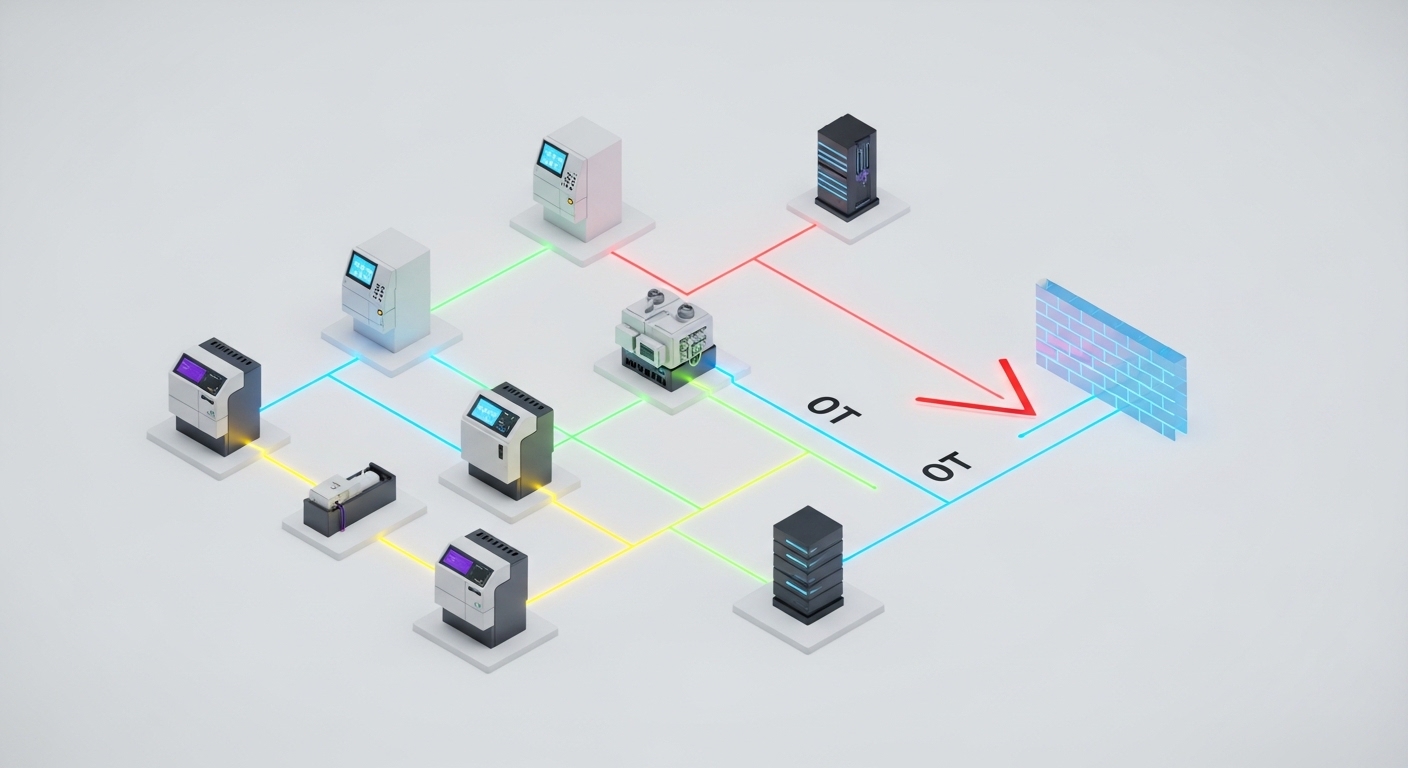
Define Micro-perimeters and Trust Zones: Using the baseline data, logically group assets into granular segments, or 'enclaves'. These segments should not be based on VLANs or subnets, but on process function. For example, the PLCs, VFDs, and sensors controlling a specific chemical reactor loop form one micro-perimeter. The Safety Instrumented System (SIS) for that unit forms another, more critical one. The historians and HMIs form yet another. This strategy contains a breach to a small, functionally-isolated zone.
Deploy Policy Enforcement Points (PEPs): The PEP is the architectural workhorse of zero-trust. In OT, these cannot be software agents on endpoints. Instead, they are typically network-based gateways or transparent inline devices placed strategically at the boundaries of the newly defined micro-perimeters. These PEPs intercept traffic and are the hands that enforce the policy decisions. Their placement is critical to minimize any potential latency impact on real-time control communications.
Establish a Centralized Policy Decision Point (PDP): The PDP, or 'policy engine', is the brain. It consumes contextual data—device identity, user credentials, time of day, device posture, and the specific action being requested—to render an allow/deny decision in real-time. This decision is then communicated to the relevant PEP for enforcement. For a multi-site architecture, the PDP must be designed for high availability and low-latency communication with PEPs across the WAN.
Develop Protocol-Aware, Least-Privilege Policies: This is the core of OT zero trust. Policies must move beyond IP addresses and ports. They must be defined at the protocol's command level (Layer 7). For example:
ALLOWHMI-A toREADHolding Registers from PLC-B.DENYHMI-A toWRITEto Holding Registers on PLC-B.DENYany engineering workstation from uploading new firmware to PLC-B outside a scheduled maintenance window.
This granular control is essential. By understanding the intricate details of OT protocols, the system can differentiate between legitimate operational commands and malicious ones disguised within legitimate traffic. Crafting these policies is a significant undertaking, but it is the foundation of a deterministic security model. Our research on creating a deterministic enclave for legacy Siemens and Rockwell PLCs in chemical OT provides a detailed framework for this critical step.
Integrate with Identity and Continuously Verify: Every request must be tied to a verified identity—whether it's a human operator, an automated process, or a device-to-device communication. This requires integration with an Identity and Access Management (IAM) system, ideally one designed for OT's unique machine-to-machine context. The PDP must continuously re-evaluate trust with every new connection request, ensuring that a previously trusted device that begins behaving abnormally has its access revoked instantly.
Practical Implementation Challenges
Architecting zero trust on paper is straightforward; deploying it within the unforgiving physics of a chemical plant is an engineering feat fraught with challenges.
Deterministic Latency and Jitter: Real-time process control networks are intolerant of non-deterministic latency. Introducing a PEP for deep packet inspection can add microseconds of delay. While negligible for a single packet, cumulative jitter can disrupt sensitive control loops. The solution lies in using hardware-accelerated PEPs with FPGA-based processing and positioning them architecturally where they inspect management and configuration traffic without sitting directly in the time-critical I/O data path.
Brownfield Protocol and Device Heterogeneity: A single plant floor may have Modbus/TCP, PROFINET, and EtherNet/IP running concurrently. The zero-trust solution must be fluent in all relevant protocols. Furthermore, legacy devices may not support any form of authentication. Security must be wrapped around these devices by the network, a concept central to converging mandates like ISA/IEC 62443 and Zero Trust in live chemical OT environments, which stresses compensatory controls when endpoint security is not possible.
Policy Management at Scale: Manually writing and managing command-level policies for tens of thousands of data points across dozens of sites is untenable. This necessitates a sophisticated policy management plane that leverages machine learning to recommend policies based on the observed baseline. It also requires robust 'what-if' simulation tools to test policy changes before they are deployed to avoid inadvertently halting production.
Ensuring Safety System Integrity: Safety Instrumented Systems (SIS) are the last line of automated defense. A zero-trust architecture must be verifiably fail-safe. Policies governing the SIS enclave must be the most restrictive, and the PEPs protecting it must have a proven fail-open or fail-closed state that guarantees the safety function in the event of a security system failure. The logic solver's communication path must be inviolable.
Handling Encrypted OT Protocols: Newer protocols like OPC UA introduce encryption. While beneficial, this can blind network-based PEPs. The architecture must account for this by either using endpoint-based solutions where possible or by integrating with the protocol's security layer through certificate management and session key inspection, adding another layer of complexity to the deployment.
Conclusion: From Probabilistic Defense to Deterministic Resilience
The convergence of IT and OT in multi-site chemical plants necessitates a fundamental rethinking of industrial cybersecurity. The perimeter-based, 'trust-but-verify' model is an anachronism. A zero-trust architecture, built on the principles of granular micro-segmentation, least-privilege access, and continuous verification, provides a robust framework for real-time isolation of critical control processes from IT-borne threats.
While the implementation path is complex and laden with technical hurdles, it is not optional. It is the only viable strategy to build a resilient, defensible, and productive manufacturing environment for the next generation. By treating every device and connection as untrusted by default, organizations can move from a probabilistic defense posture to a deterministic one, ensuring that the integrity of the physical process is protected by design, not by chance.
Sources / References
- NIST Special Publication 800-207: Zero Trust Architecture - https://csrc.nist.gov/publications/detail/sp/800-207/final
- ISA/IEC 62443 Series of Standards on Industrial Automation and Control Systems Security - https://www.isa.org/standards-and-publications/isa-standards/isa-iec-62443-series-of-standards
- MITRE ATT&CK® for Industrial Control Systems (ICS) - https://attack.mitre.org/matrices/ics/