Adaptive Trust in SCADA: A Blueprint for Dynamic Authorization Beyond IT-Centric IAM
Apex Insights Research Desk
The Fallacy of Static Trust in Dynamic Control Systems
The foundational security paradigm for Supervisory Control and Data Acquisition (SCADA) networks has long been rooted in perimeter defense and network segmentation, concepts codified in architectures like the Purdue Model. This model presumes that assets within a given zone share a level of implicit trust. An HMI in the control zone is trusted to communicate with a PLC in the same zone. This static, location-based trust model is no longer tenable. The convergence of IT and OT, the rise of sophisticated state-sponsored threat actors, and the introduction of IIoT devices have rendered the traditional perimeter porous and the assumption of internal trust a critical vulnerability.
Standard IT-centric Identity and Access Management (IAM) solutions, designed for the enterprise world of users, applications, and data, fail catastrophically when retrofitted onto an operational technology environment. Protocols like SAML, OAuth, or OpenID Connect introduce unacceptable latency, lack support for legacy OT protocols like Modbus or DNP3, and require compute resources unavailable on constrained devices like RTUs and older PLCs. The core problem is philosophical: IT IAM verifies identity at the start of a session, granting relatively static permissions. In OT, the legitimacy of an action depends not just on the identity of the source but on the physical state of the process at that exact microsecond. A command to open a valve is legitimate when a tank is empty but catastrophic when it is full. This context is entirely absent in traditional IAM.
This necessitates a paradigm shift from static, session-based authentication to Continuous Adaptive Trust Evaluation (CATE)—a framework that perpetually calculates and re-evaluates the trustworthiness of every device, user, and data flow in real-time based on a rich composite of operational data.
The Architectural Shift: From Static Authorization to a Dynamic Trust Fabric
A CATE framework dismantles the binary allow/deny logic of legacy access control lists and firewalls. Instead, it assigns a dynamic trust score to entities within the SCADA network. This score is not a fixed attribute but a fluid variable that rises and falls based on observed behavior, protocol conformance, and, most critically, physical process context. This approach extends beyond conventional Attribute-Based Access Control (ABAC) by making the 'attributes' dynamic and deeply tied to the cyber-physical process itself.
The objective is to create a security posture that can distinguish between a legitimate, albeit unusual, command from an engineering workstation during a planned maintenance window and a syntactically identical command originating from a compromised HMI during normal operations that would place the system in an unsafe state. This level of granularity is impossible with static rulesets.
Core Pillars of a SCADA-Centric CATE Framework
Building an effective CATE architecture rests on four integrated pillars, each providing a critical stream of data to a central trust evaluation engine.
Deep Packet Inspection (DPI) and Protocol-Aware Monitoring: This is the bedrock. The system must possess native fluency in the language of OT. It's not enough to know a packet's source and destination IP. The framework must parse the application layer of industrial protocols to understand the specific function codes being invoked (e.g., Modbus FC 05: Write Single Coil vs. FC 03: Read Holding Registers), the DNP3 object variations being requested, or the S7comm job types being executed. This level of inspection is the first filter for identifying malformed packets or the use of dangerous, non-standard commands. Effective implementation demands granular, protocol-aware micro-segmentation capable of dissecting these commands at line rate without introducing latency.
High-Fidelity Behavioral Baselining: Once traffic is understood, its patterns must be modeled. The CATE framework must build a multi-dimensional 'pattern of life' or baseline for the entire operation. This isn't just a communication map; it's a profile that includes the sequence of commands, the frequency of polls, the typical data value ranges for specific registers, and the timing between related operations. Machine learning models, particularly unsupervised ones like autoencoders or Long Short-Term Memory (LSTM) networks, are essential for building these baselines without manual rule creation. This addresses many of the core challenges of real-time anomaly detection in legacy networks, transforming anomalous deviations from the baseline into a key input for the trust score calculation.
Process State and Physical Context Awareness: This is the quintessential cyber-physical component that distinguishes OT security from IT security. The CATE framework must ingest data from the process itself. This can come from the historian (e.g., OSIsoft PI), an MES, or even directly from key sensor readings. This data provides the physical context. For example, a command to increase a turbine's speed would have its trust score heavily penalized if sensor data indicates the bearing temperature is already in a critical range. The trust engine correlates the requested digital action with the current physical state to determine its legitimacy.
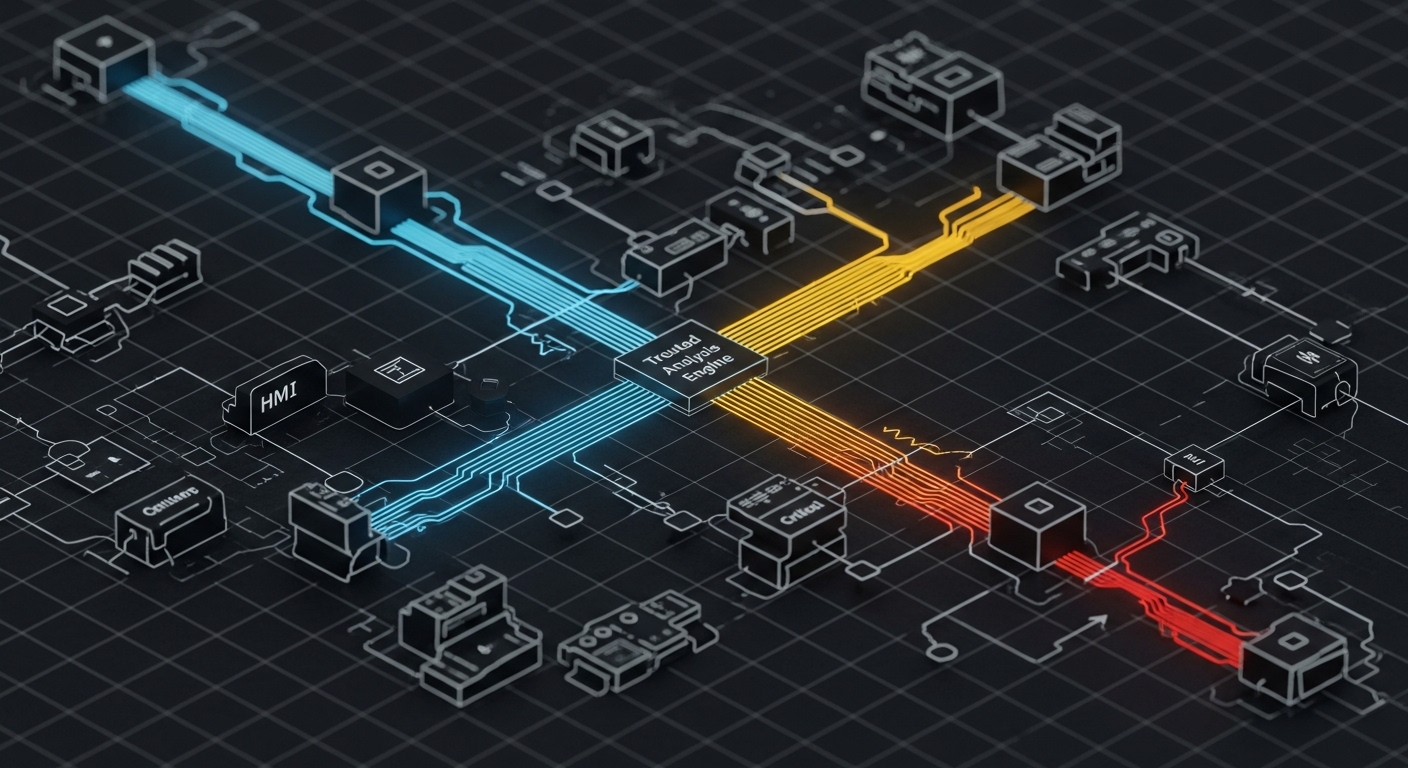
Dynamic Policy and Trust Calculation Engine: This is the brain of the operation. It's a real-time engine that consumes telemetry from the previous three pillars and calculates a composite trust score for every active entity and transaction. The algorithm is typically a weighted model where factors like protocol deviation, behavioral anomaly, and physical process contradiction heavily penalize the score. The policy engine then translates this score into an enforcement action. This isn't necessarily a hard block; actions can be granular: permit read but block write, flag for human review, reduce the entity's network access to a quarantine segment, or allow the command but with a heightened level of monitoring.
Architectural Blueprint: A Phased Implementation Model
Deploying a CATE framework in a brownfield SCADA environment, where downtime is unacceptable, requires a methodical, phased approach.
Passive Data Acquisition: Deploy network sensors (physical TAPs are preferable to SPAN ports to avoid packet loss under high load) at key aggregation points, such as between the control center (Level 2) and the cell/area zones (Level 1). The goal is to gain full visibility into all east-west and north-south traffic without being in-line and posing a risk to operations.
Establishment of the Behavioral Baseline: Ingest the mirrored traffic into the analytics platform. The system should operate in a passive, learning-only mode for an extended period. This period must be long enough to capture multiple production cycles, shift changes, and standard maintenance procedures to build a comprehensive and accurate model of 'normal.' Rushing this phase is the primary cause of high false-positive rates later on.
Trust Algorithm and Policy Definition: Define the trust scoring model and the corresponding policies. For instance, a malformed DNP3 packet might result in a 50-point trust score deduction, while a valid command that contradicts the physical process state might trigger a 90-point deduction. Policies are then defined based on score thresholds (e.g., Score < 30 = Block & Alert; Score 30-60 = Log & Alert; Score > 60 = Permit).
Integration with Policy Enforcement Points (PEPs): The trust engine must communicate its decisions to enforcement points. These are typically next-generation firewalls with OT protocol support or specialized OT security appliances placed at micro-segmentation boundaries. The communication protocol between the trust engine and the PEP must be high-speed and reliable (e.g., using a dedicated API over a secure channel).
Simulate and Validate: Before enabling active enforcement, operate the system in a 'simulation mode.' The PEPs do not block traffic but generate detailed logs and alerts for every policy that would have been triggered. This critical phase allows security and operations teams to validate the model's accuracy, fine-tune trust score weightings, and create exceptions for known operational quirks without impacting production.
Phased Enforcement and Continuous Refinement: Begin active enforcement on the least critical network segments first. Monitor closely for any operational impact. As confidence in the system grows, expand enforcement across the entire SCADA network. The system is never 'done'; it must continuously refine its baselines as the operational environment evolves.
Practical Implementation Challenges
Transitioning from theory to a deployed system presents significant engineering hurdles.
Deterministic Latency Constraints: The entire detect-analyze-decide-enforce loop must complete within the operational time constraints of the physical process. For some high-speed manufacturing or grid protection systems, this window can be in the low milliseconds. Any latency jitter introduced by the security overlay can desynchronize processes, leading to faults or shutdowns.
Proprietary Protocol Opacity: While standards like Modbus/TCP and DNP3 are common, many large vendors (e.g., Siemens, Rockwell) use proprietary protocols or proprietary extensions. Without vendor cooperation or extensive reverse engineering, achieving the necessary DPI fluency to build accurate baselines can be impossible, leaving critical blind spots in the monitoring fabric.
The 'State Explosion' Problem: Accurately modeling the 'valid' state of a complex physical process is computationally intensive. A refinery or a pharmaceutical batch process has a near-infinite number of valid state combinations. A simplistic model will generate a flood of false positives, while a highly complex model may be too slow to be useful for real-time decision-making. This requires a balanced approach using domain-specific heuristics to prune the state space.
Bridging Legacy Serial and Modern IP: Most real-world SCADA systems are a heterogeneous mix of modern EtherNet/IP networks and legacy RS-485 serial multi-drop links. A comprehensive CATE framework must be able to ingest, normalize, and correlate data from both worlds. This often necessitates a strategy for zero-trust micro-segmentation on non-IP ICS devices, treating serial-to-ethernet gateways as critical policy enforcement points and data sources.
The principle of least privilege, a cornerstone of cybersecurity, must be dynamically and continuously enforced. In OT, this means privilege is not just a function of user role, but of time, network conditions, and the physical state of the system being controlled. A static assignment of privilege is an invitation to disaster.
Conclusion: Towards a Resilient, Self-Defending SCADA Architecture
The adoption of a Continuous Adaptive Trust Evaluation framework represents a fundamental evolution in SCADA security philosophy. It moves beyond the brittle, static defenses of the past and embraces the dynamic, interconnected nature of modern industrial control systems. By making trust a calculated, real-time variable instead of an assumed, static constant, CATE provides a mechanism to detect and block attacks that would be invisible to traditional signature-based or rule-based systems. Implementing such a framework is a complex, multi-disciplinary undertaking, requiring a deep fusion of network engineering, data science, and process control expertise. However, for organizations operating critical infrastructure, it is no longer an option but an architectural necessity for achieving true cyber-physical resilience.
Sources / References
- NIST Special Publication 800-82 Revision 2, Guide to Industrial Control Systems (ICS) Security: https://csrc.nist.gov/publications/detail/sp/800-82/rev-2/final
- The International Society of Automation (ISA), ISA/IEC 62443 Series of Standards: https://www.isa.org/standards-and-publications/isa-standards/isa-iec-62443-series-of-standards
- SANS Institute, ICS/SCADA Security Resources: https://www.sans.org/ics-security/