The Uninterruptible Mandate: Agentless Zero-Trust Micro-segmentation for Legacy Modbus/TCP Controllers
Apex Insights Research Desk
Introduction: The Inherent Fragility of the Converged OT Landscape
The convergence of Information Technology (IT) and Operational Technology (OT) networks is no longer a forward-looking trend; it is a present-day reality driven by the insatiable demand for process data and operational efficiency. However, this integration has exposed decades-old, inherently insecure OT protocols to a threat landscape they were never designed to withstand. At the heart of this vulnerability lies Modbus/TCP, a ubiquitous protocol whose design prioritizes interoperability and simplicity over security. Deployed across millions of controllers globally, Modbus/TCP lacks fundamental security primitives like authentication, encryption, and authorization, rendering it a prime target for lateral movement attacks originating from a compromised IT environment.
Traditional OT security paradigms, reliant on perimeter-based defenses and the now-porous concept of an "air gap," are demonstrably insufficient. Once an adversary breaches the perimeter, the flat, unsegmented nature of many legacy OT networks provides an open field for reconnaissance and manipulation. The core challenge is applying modern security principles, specifically Zero Trust, to legacy endpoints like PLCs and RTUs that cannot be patched, cannot host security agents, and whose real-time operational constraints are non-negotiable. This research paper outlines an architectural blueprint for deploying an agentless Zero-Trust micro-segmentation model to protect these legacy Modbus/TCP controllers, effectively neutralizing lateral movement threats without inducing any operational downtime or performance degradation.
The Modbus/TCP Conundrum in Converged Networks
To architect a robust defense, one must first deeply understand the protocol's systemic weaknesses. Modbus/TCP is, by design, a trust-based protocol. It operates on a master-slave (now client-server) model where any device on the network that can form a TCP connection with a controller can send it valid commands. There is no intrinsic mechanism within the protocol to verify the identity of the client or the legitimacy of its request.
This fundamental design flaw manifests in several critical vulnerabilities:
- Lack of Authentication: A threat actor with network access can impersonate a legitimate HMI or engineering workstation and issue commands to a PLC, such as stopping a process (Function Code 05: Write Single Coil) or modifying critical setpoints (Function Code 16: Write Multiple Registers).
- No Encryption: All Modbus/TCP traffic is transmitted in cleartext. An attacker can passively listen to network traffic to map out the entire process logic, identify critical register addresses, and learn operational parameters before launching a sophisticated attack.
- Absence of Authorization: The protocol does not possess a mechanism for granular access control. If a client can connect to the server, it is generally assumed it has the authority to access any data register or execute any function code supported by that server. This allows, for example, a view-only HMI to be used as a pivot point to issue write commands if its host machine is compromised.
In a converged IT/OT network, these vulnerabilities create a direct pathway for exploitation. A common attack vector begins with a phishing email compromising a corporate user's laptop (IT). From this beachhead, the attacker moves laterally, finds a pivot point into the OT network (e.g., a vulnerable engineering workstation), and then uses native Modbus/TCP commands to disrupt the physical process. The deterministic, low-latency requirements of these control systems preclude the use of traditional IT security solutions; deploying a host-based firewall or EDR agent on a 20-year-old PLC is a recipe for operational failure.
Architecting the Agentless Zero-Trust Enclave
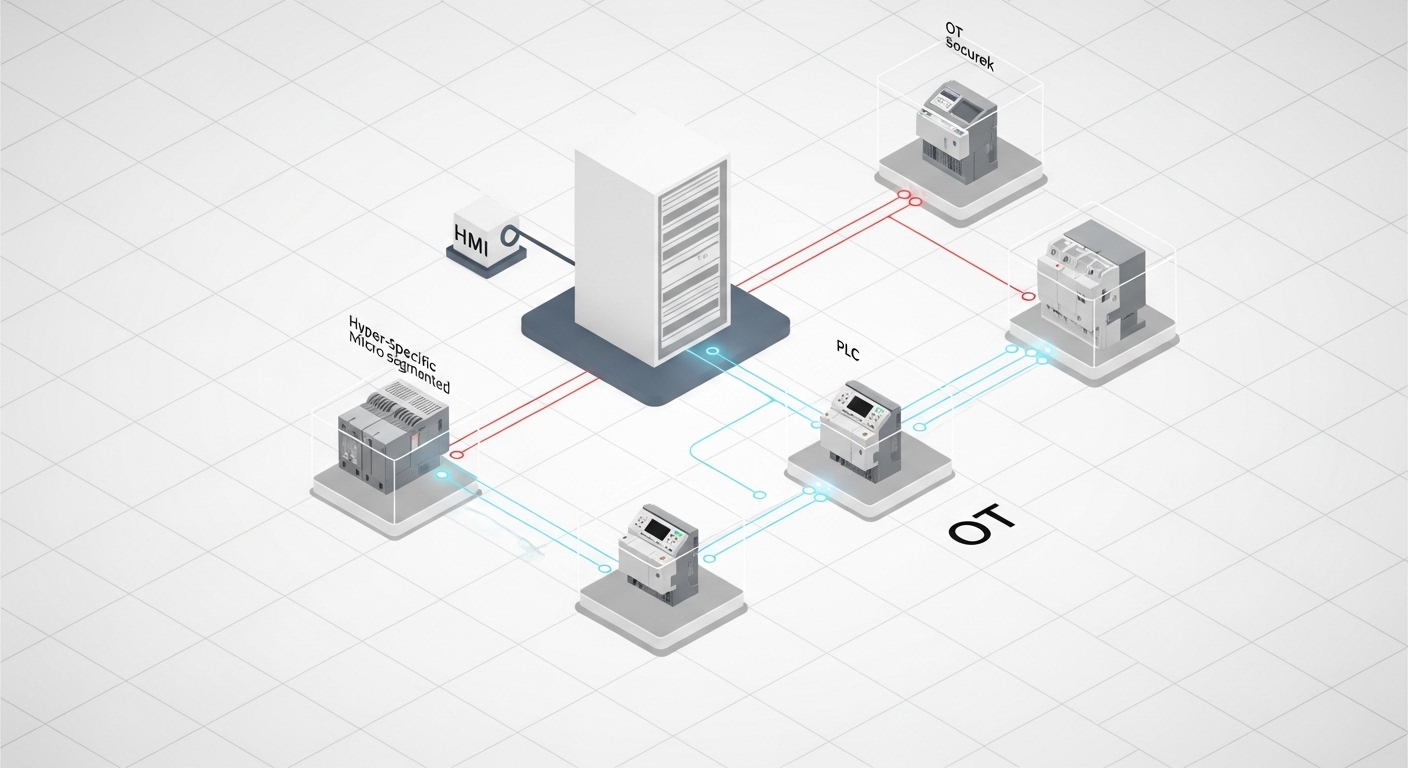
Zero Trust operates on the principle of "never trust, always verify." In the context of legacy OT, where the endpoints themselves cannot participate in the verification process, the security architecture must enforce this principle on their behalf from the network. An agentless model shifts the policy enforcement point from the endpoint to the network fabric, creating a protective enclave around each critical asset or group of assets. This approach is not a single product but a multi-phased architectural strategy.
Phase 1: Passive Discovery and Deep Packet Inspection (DPI) The foundation of any Zero Trust architecture is comprehensive visibility. Deployment begins with the non-intrusive monitoring of network traffic, typically via a Test Access Point (TAP) or a Switched Port Analyzer (SPAN) port. This traffic is fed into a specialized OT security platform capable of protocol-aware DPI. Unlike IT firewalls that may only validate a TCP connection on port 502, OT-specific DPI decodes the entire Modbus Application Data Unit. It identifies the specific client and server, the Modbus Unit ID, the function code being used, and the register addresses and data values being accessed. This granular visibility is the first step in understanding the true operational baseline.
Phase 2: Behavioral Baselining and Policy Synthesis With visibility established, the system enters a learning phase. It passively observes all Modbus/TCP conversations over a significant operational cycle (e.g., days or weeks) to build a high-fidelity model of legitimate behavior. This model maps every sanctioned communication path: which HMI reads which specific registers from which PLC, what function codes the engineering workstation uses during maintenance, and which historian polls data from specific controllers. The output is a highly granular, deterministic communication policy based on observed operational necessity. This process of deep protocol analysis is the cornerstone of an effective defense, as detailed in our research on protocol-aware micro-segmentation for Modbus/TCP and EtherNet/IP.
Phase 3: Deployment of the Policy Enforcement Point (PEP) The PEP is the engine of the agentless model. It is typically a network device deployed inline, acting as a transparent bridge between the protected controllers and the rest of the network. Critically, these devices are purpose-built for OT environments, often using hardware acceleration (FPGAs) to ensure they can enforce policy at line rate with microsecond-level latency, thus having zero impact on real-time control loops. For less critical segments, policies can sometimes be orchestrated and pushed down to capable switches or routers via APIs, creating a software-defined micro-segmentation fabric.
Phase 4: Least-Privilege Policy Enforcement Once the PEP is in place and the baseline policy is loaded, the system transitions from monitoring to active enforcement. This is the implementation of the Zero Trust "allow-list" model. The policy dictates that only the explicitly learned and approved communications are permitted. For example, a policy might state:
ALLOW HMI_01 (192.168.1.10) -> PLC_A (192.168.1.50) | Modbus/TCP | FC 03 (Read Holding Registers) | Addr 40001-40010. Any other traffic, such as an attempt from HMI_01 to use Function Code 16 (Write Multiple Registers) or an unauthorized device attempting any connection to PLC_A, is blocked and logged as a security event. This granular enforcement effectively creates a micro-segment of one around the PLC, which is a key tenet of the unpatchable mandate for securing legacy Modbus/TCP networks.
Preserving Real-Time Determinism: The Non-Negotiable OT Requirement
The entire architectural approach is predicated on its ability to function without disrupting the physical process. This is achieved by adhering to a core engineering principle for OT security:
Any security control implemented within an Industrial Control System must be subordinate to the primary objective of maintaining the safety, reliability, and integrity of the physical process. The control must demonstrably add no perceivable latency or jitter to critical control loops.
Agentless micro-segmentation upholds this principle in two fundamental ways. First, by being agentless, it introduces no additional CPU or memory load on the controller itself, eliminating the risk of resource exhaustion that could lead to a process upset. The PLC's firmware and operational logic remain untouched. Second, the inline PEPs are engineered specifically for high-throughput, low-latency environments. The deterministic nature of OT communications makes their traffic patterns highly predictable, allowing for hardware-optimized policy lookups that are significantly faster than the complex rule-sets of traditional IT firewalls. Failover mechanisms, such as redundant PEPs in a high-availability pair, ensure that a hardware failure does not interrupt the flow of legitimate control traffic.
Practical Implementation Challenges
Deploying this architecture in a brownfield environment is not without its engineering hurdles. A successful implementation requires careful planning to navigate several technical complexities:
- Asset and Topology Discovery: Many mature OT networks suffer from incomplete or outdated documentation. The initial discovery phase can be complicated by unmanaged switches, undocumented network loops, and multi-homed devices, making it difficult to establish clean traffic mirroring and a definitive asset inventory.
- Protocol Nuances and Encapsulation: While Modbus/TCP is a standard, vendors often implement slight variations or use proprietary function codes. The DPI engine must be sophisticated enough to handle these nuances. Furthermore, traffic may be encapsulated within other protocols, requiring the system to look deeper into packet payloads.
- Policy Management at Scale: In a large plant with thousands of devices, defining and managing hyper-granular policies can become an overwhelming task. The security platform must provide tools for policy abstraction, grouping, and templating. It's a fine balance between achieving perfect least-privilege and maintaining an operationally manageable rule set. This is a core challenge discussed in our blueprint for agentless zero-trust micro-segmentation for legacy PLCs.
- The Fail-Safe State: Deciding on the behavior of the PEP in the event of a catastrophic failure (e.g., power loss) is a critical safety and operational decision. A "fail-closed" state offers maximum security but could halt production. A "fail-open" state (often implemented via hardware bypass relays) prioritizes availability but creates a temporary window of vulnerability. This decision must be made on a per-segment basis through a rigorous risk assessment.
- Alert Fatigue and Anomaly Correlation: Once in enforcement mode, the system will generate alerts for any deviation from the baseline. It is crucial to have a well-defined incident response plan and tools that can correlate low-level network alerts with potential process impacts to avoid overwhelming security operations personnel with false positives or irrelevant data.
Conclusion: Achieving Verifiable Security for the Unpatchable
The proliferation of legacy Modbus/TCP controllers in our critical infrastructure represents a significant systemic risk. Their inherent insecurities, combined with the pressures of IT/OT convergence, demand a security architecture that moves beyond the failed perimeter model. Agentless Zero-Trust micro-segmentation provides a powerful and, most importantly, operationally viable blueprint for addressing this challenge.
By decoupling security enforcement from the fragile endpoint and moving it into the network, this model respects the inviolable constraints of real-time OT environments. It transforms the network itself into an intelligent, distributed enforcement fabric that can understand and police the specific language of industrial control. This allows asset owners to build a verifiable, least-privilege security posture around their most critical assets, effectively neutralizing the threat of lateral movement and containing breaches before they can cause physical disruption. It is not merely a defensive measure but a foundational enabler for secure digital transformation in the industrial world.
Sources / References
- Modbus Organization. (2012). MODBUS Application Protocol Specification V1.1b3. Retrieved from https://modbus.org/specs.php
- Rose, S., Borchert, O., Mitchell, S., & Connelly, S. (2020). NIST Special Publication 800-207: Zero Trust Architecture. National Institute of Standards and Technology. Retrieved from https://csrc.nist.gov/publications/detail/sp/800-207/final
- International Society of Automation. (2023). ISA/IEC 62443 Series of Standards. Retrieved from https://www.isa.org/standards-and-publications/isa-standards/isa-iec-62443-series-of-standards