Architecting the Deterministic Enclave: Real-Time Micro-segmentation for Legacy ICS
Apex Insights Research Desk
The Unseen Foundation: The Criticality of Securing Legacy ICS
Industrial Control Systems (ICS) form the silent, operational backbone of modern civilization. From power grids and water treatment facilities to manufacturing floors and petrochemical plants, these systems operate under a mandate of unwavering availability and deterministic precision. Yet, a significant portion of this critical infrastructure runs on legacy hardware and protocols designed decades ago, in an era when network security was an afterthought and physical isolation—the 'air gap'—was the primary defense. Today, as IT/OT convergence accelerates, that air gap has become a porous membrane, exposing insecure-by-design systems to a threat landscape they were never engineered to withstand.
The traditional approach of perimeter-based security, reliant on macro-segmentation via firewalls at the enterprise-industrial boundary, is demonstrably insufficient. Once this perimeter is breached, malware can move laterally with near-impunity across the flat, trusted networks typical of legacy Operational Technology (OT) environments. The architectural imperative, therefore, has shifted from perimeter defense to a model of intrinsic security: real-time, policy-enforced micro-segmentation. This is not merely an adaptation of IT security principles but a fundamental re-architecting of trust within environments where latency is measured in microseconds and downtime is not an option.
This research brief outlines the core architectural considerations for designing and implementing a micro-segmentation framework that respects the stringent, real-time demands of legacy ICS environments. We will dissect the architectural pillars, confront the formidable implementation challenges, and propose a viable blueprint for building deterministic security enclaves around our most critical assets.
The Deterministic Mandate: Why IT Paradigms Fail in OT
The fundamental disconnect between IT and OT security paradigms is rooted in their core priorities. IT systems are governed by the triad of Confidentiality, Integrity, and Availability (CIA). In stark contrast, OT environments prioritize Safety, followed by the deterministic integrity of the control process. Availability, while crucial, is a consequence of these primary factors. Any security architecture that compromises determinism—the guarantee that a specific action will execute within a precise, repeatable time window—is an architectural non-starter.
Introducing IT-centric micro-segmentation tools, such as agent-based solutions on endpoints or cloud-managed virtual firewalls, is untenable in a legacy ICS context. Programmable Logic Controllers (PLCs), Remote Terminal Units (RTUs), and other embedded devices lack the computational resources to host security agents. Furthermore, installing unauthorized software would void vendor warranties and violate stringent certification requirements. Similarly, routing traffic through a standard firewall introduces unacceptable levels of latency and jitter, potentially destabilizing a finely tuned control loop. This leads to a foundational engineering principle for OT security architecture:
The security framework must be external and transparent to the control system assets themselves. It must conform to the network's deterministic requirements, never forcing the control system to conform to the security tool.
This principle dictates an out-of-band management and in-band enforcement model, where the security overlay is a passive observer and active enforcer that does not alter the fundamental communication behavior of the protected assets.
Core Architectural Pillars for a Deterministic Micro-segmentation Framework
Developing a robust framework requires a multi-faceted approach built on several interdependent pillars. This is not a checklist but a blueprint for a cohesive system.
High-Fidelity Passive Discovery and Communication Baselining The foundational step is achieving complete visibility without disruption. Active network scanning is dangerously intrusive in OT. The architecture must rely on passive analysis of network traffic via a SPAN or TAP port. The discovery engine must possess deep packet inspection (DPI) capabilities fluent in the nuances of ICS protocols (e.g., Modbus/TCP, DNP3, EtherNet/IP, PROFINET, S7). The objective is to build a granular, dynamic inventory of all assets and, more importantly, to map every legitimate communication flow, creating a 'digital twin' of the network's expected behavior. This baseline becomes the ground truth for policy creation.
Decoupled Policy Decision and Distributed Enforcement A scalable architecture must separate the 'brain' from the 'muscle'. A centralized Policy Decision Point (PDP) should be responsible for ingesting the baseline data, providing a human interface for policy definition, and computing the enforcement rules. The Policy Enforcement Points (PEPs), however, must be distributed deep within the control network. These PEPs are the lynchpin of the architecture. They are typically specialized industrial security appliances or next-generation industrial switches designed to be placed in-line, operating as transparent bridges. They receive their policy from the PDP but execute it locally, at line-rate, ensuring enforcement decisions do not add round-trip latency to a central controller.
Protocol-Aware, Least-Privilege Policy Engine Effective OT micro-segmentation transcends Layer 3/4 rules (IP/Port). The policy engine must operate at Layer 7, understanding the application context of the protocol. A truly granular policy does not just allow HMI-A to talk to PLC-B over port 502. It specifies that HMI-A can only issue Modbus Function Code 03 (Read Holding Registers) to a specific range of addresses on PLC-B, while explicitly denying Function Code 16 (Write Multiple Registers) to the same device. This level of detail, often referred to as granular Zero-Trust for OT, is the only way to prevent unauthorized commands or malicious process manipulation while preserving necessary operational communication.
Dynamic Identity and Contextual Policy Adaptation Static segmentation, while better than none, is brittle. A forward-looking architecture must build policies based on a richer set of metadata. This involves moving towards an identity-based model where policy is tied to the intrinsic identity of an asset (e.g., serial number, firmware version, physical location) rather than a transient network address. Policies can then become context-aware, adapting to the operational state of the plant. For instance, a policy might allow an engineering workstation to push a new program to a PLC only during a scheduled maintenance window and only after the user has authenticated via a multi-factor system. Architecting this level of context-aware identity for Zero-Trust OT/IT security is a key differentiator between basic segmentation and a resilient, adaptive defense.
Practical Implementation Challenges
Architecting such a system is complex; implementing it in a live, 24/7/365 production environment presents formidable engineering hurdles.
Insertion without Interruption: The primary challenge is physically inserting in-line PEPs without causing downtime. This requires meticulous planning, the use of industrial-grade hardware with true fail-to-wire capabilities (or configurable fail-open/fail-closed states), and a phased deployment. The initial phase is often a 'monitor-only' mode where the PEP is in-line but only logs potential policy violations, allowing engineers to refine policies and build confidence before switching to active blocking mode.
Handling Proprietary Protocols: While standards like Modbus are common, many environments contain proprietary protocols or vendor-specific extensions. The DPI engine within the discovery and enforcement components must be extensible enough to parse these protocols, a task that can require significant reverse engineering or close collaboration with equipment vendors.
Policy Lifecycle Management: In a large plant, a micro-segmentation strategy can result in thousands of individual policies. The architecture must include a robust orchestration layer that simplifies policy creation, validation, deployment, and auditing. This system should be API-driven to allow integration with CMDBs, asset inventories, and incident response platforms.
Deterministic Performance Under Load: The PEP must be able to perform stateful DPI and policy matching at multi-gigabit line speeds with sub-millisecond latency. Any jitter or delay introduced by the PEP could desynchronize high-speed processes like motion control or coordinated drive systems. This requires specialized hardware (FPGAs, network processors) and highly optimized software, a significant challenge detailed in our research on overcoming Zero-Trust micro-segmentation hurdles in live brownfield PLC environments.
Resilience and Fail-Safe Design: The PEP itself becomes a critical asset. The architecture must account for its failure. Does it fail-open, preserving availability at the cost of security? Or fail-closed, preserving security at the cost of stopping the process? The decision is risk-based and process-specific. A robust design will incorporate redundant PEPs in a high-availability pairing, coupled with physical bypass switches for manual override during emergencies.
The Path Forward: From Macro- to Micro-Segmentation
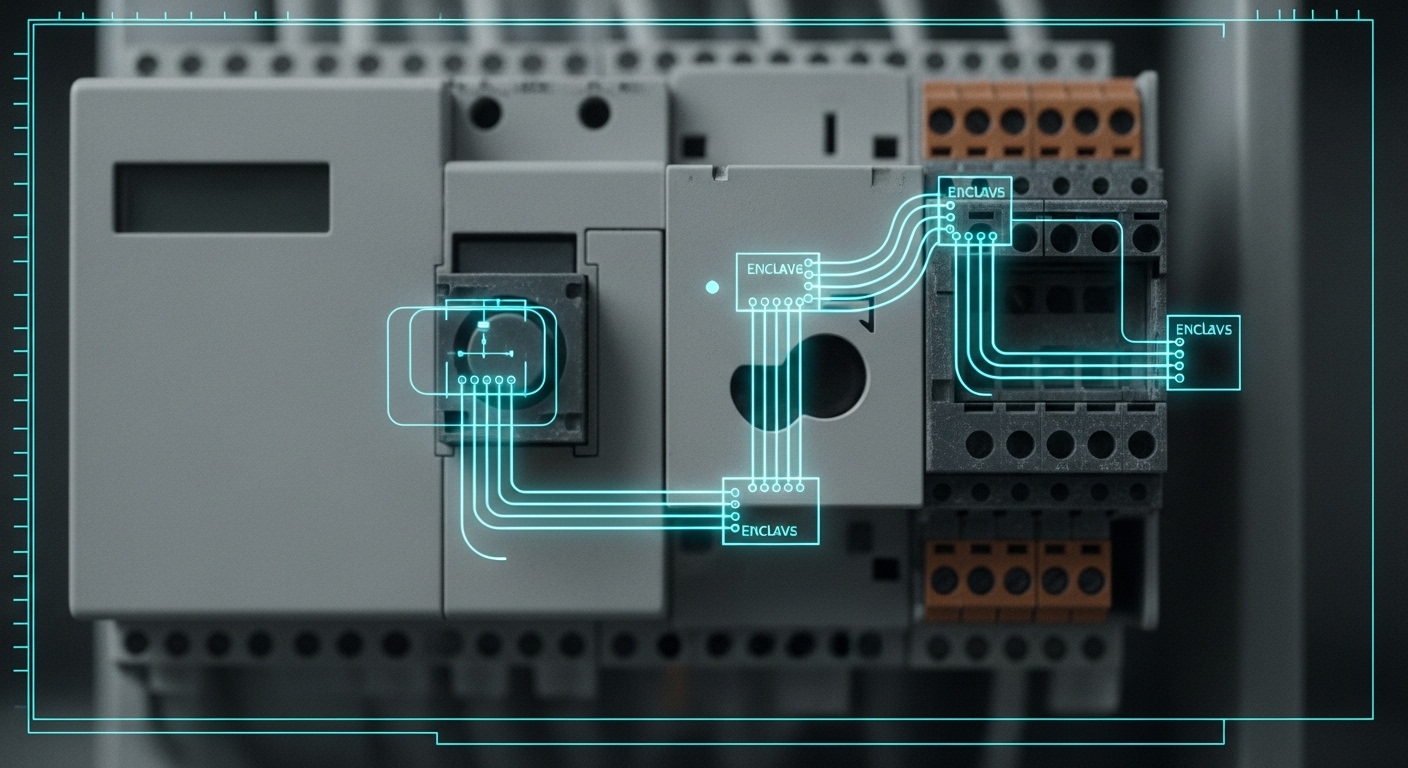
Implementing a real-time micro-segmentation framework in a legacy ICS is not a single project but a strategic evolution. It begins with achieving full visibility, progresses to enforcing macro-segments between Purdue levels (e.g., isolating the control zone from the enterprise zone), and culminates in the creation of deterministic enclaves around the most critical assets—the PLCs, SIS, and DCS controllers that represent the heart of the industrial process. By adopting an architectural approach that prioritizes determinism and is built upon pillars of passive discovery, granular policy, and distributed enforcement, organizations can superimpose a robust Zero-Trust model onto legacy systems without disrupting the very processes they are designed to protect.
Sources / References
- NIST Special Publication 800-82 Rev. 3 (Draft), Guide to Operational Technology (OT) Security: https://csrc.nist.gov/publications/detail/sp/800-82/rev-3/draft
- The International Society of Automation (ISA), ISA/IEC 62443 Series of Standards: https://www.isa.org/standards-and-publications/isa-standards/isa-iec-62443-series-of-standards
- Rockwell Automation, Converged Plantwide Ethernet (CPwE) Design and Implementation Guide: https://literature.rockwellautomation.com/idc/groups/literature/documents/td/enet-td001_-en-p.pdf