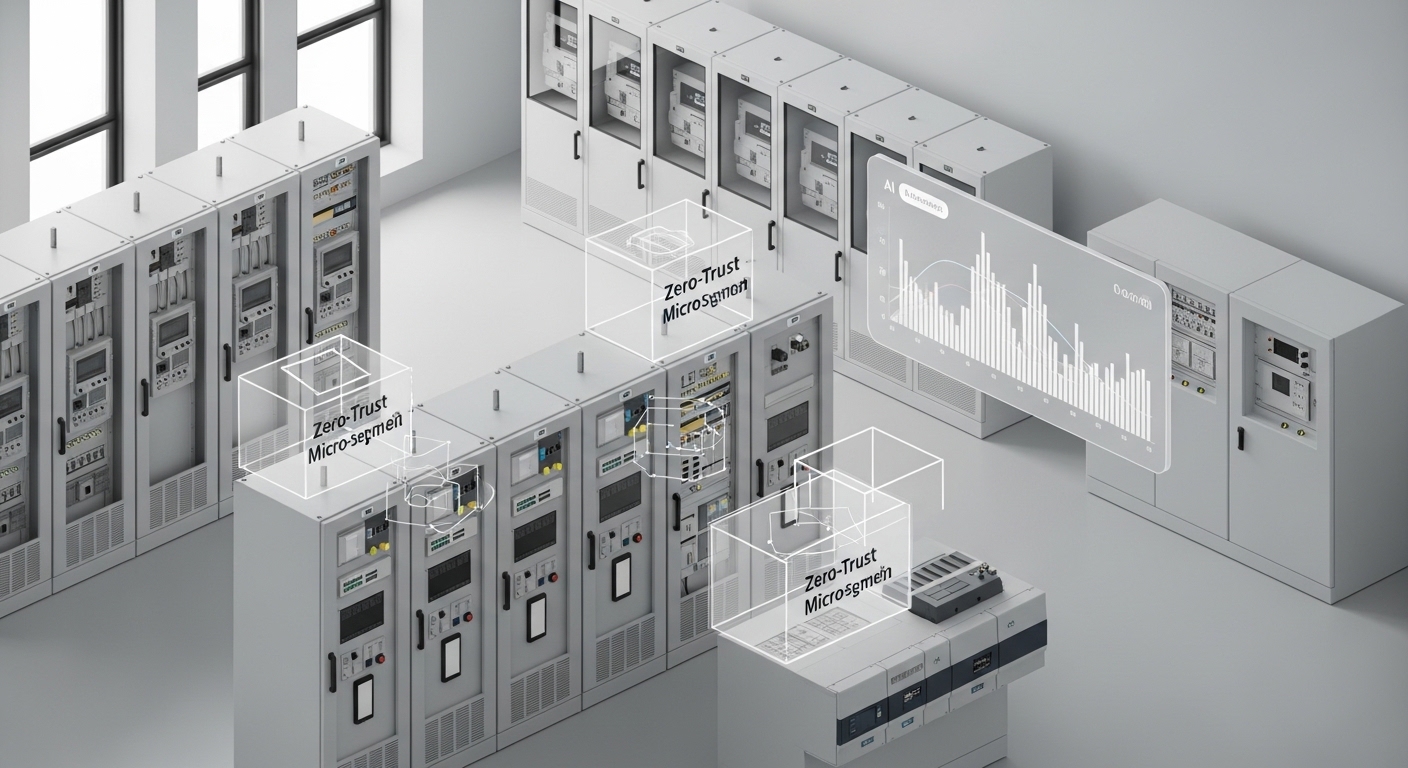
Architecting a Hyper-Converged Zero-Trust Framework for Smart Grid OT/IT Networks with AI Behavioral Analytics
Apex Insights Research Desk
The Imperative for a New Security Paradigm in Smart Grid Substations
The digital transformation of the energy sector is rapidly converging Information Technology (IT) and Operational Technology (OT) networks within critical infrastructure, most notably in smart grid substations. While this convergence unlocks unprecedented efficiency and remote management capabilities, it simultaneously demolishes the 'air gap' that once served as the primary defense for legacy OT systems. Traditional perimeter-based security models, predicated on a trusted internal network, are fundamentally incompatible with the distributed, interconnected, and hostile environment in which modern substations operate. A breach is no longer a matter of 'if' but 'when,' and the potential consequences—from widespread power outages to physical equipment damage—are unacceptable.
This new reality demands a seismic shift in security architecture. The solution lies in a hyper-converged, AI-driven Zero-Trust framework. This approach abandons the outdated notion of a trusted internal network and instead enforces granular security policies based on verified identity, regardless of where the connection originates. By integrating deep OT protocol visibility with advanced AI-powered behavioral analytics, we can build a resilient, self-defending fabric capable of protecting even the most vulnerable legacy assets within a substation's mixed OT/IT environment.
Deconstructing the Legacy Challenge: Brownfield Substations
Modernizing the security posture of a smart grid substation is not a greenfield project. We are dealing with decades-old infrastructure operating alongside state-of-the-art technology. These brownfield environments are characterized by a unique set of constraints that render traditional IT security solutions ineffective or even dangerous.
Key characteristics include:
- Proprietary and Legacy Protocols: Substation networks are a heterogeneous mix of protocols such as DNP3, Modbus/TCP, IEC 60870-5-104, and the highly time-sensitive IEC 61850 (GOOSE and SV). Many of these protocols lack basic security features like authentication or encryption, making them susceptible to man-in-the-middle attacks, replay attacks, and unauthorized commands.
- Deterministic Latency Requirements: Protection and control systems in a substation, such as protective relays and bay controllers, operate on strict, sub-millisecond timetables. The introduction of any significant latency by a security solution (like a traditional firewall) can disrupt these processes, leading to system instability or catastrophic failure. This is why a deep understanding of latency-aware micro-segmentation is not just beneficial, but an absolute engineering prerequisite.
- Fragile Endpoints: Intelligent Electronic Devices (IEDs), Remote Terminal Units (RTUs), and Programmable Logic Controllers (PLCs) often run on real-time operating systems (RTOS) with limited computational resources. They cannot accommodate host-based security agents, and aggressive network scanning can easily cause them to crash.
- IT/OT Skills Gap: The teams managing these systems often operate in silos. OT engineers prioritize availability and safety above all else, while IT security teams prioritize confidentiality and integrity. A successful framework must bridge this operational and cultural divide.
A Blueprint for a Hyper-Converged Zero-Trust Architecture
A robust Zero-Trust framework for this environment must be built upon a foundation of continuous verification. It is not a single product but an integrated architecture designed to protect critical assets from the inside out. The core tenet is simple yet powerful:
Never trust, always verify. Every device, user, and data flow must be authenticated and authorized before being granted access to a resource, for every single transaction. The system must assume that an attacker is already present within the network perimeter.
To translate this principle into a functional architecture for a substation, we must engineer four interconnected pillars: an identity and access control engine, an AI-powered behavioral analytics core, a micro-segmentation and policy enforcement plane, and a converged visibility and orchestration layer.
The AI-Powered Behavioral Analytics Core
This is the cognitive center of the framework. Given the impossibility of deploying agents on most OT endpoints, the analytics core must rely on passively ingested network traffic. By tapping into the substation's process bus and station bus via SPAN ports or network TAPs, we can build a high-fidelity model of all operations without impacting performance.
The AI core performs two critical functions:
Baseline Generation: Using unsupervised machine learning algorithms (e.g., autoencoders, isolation forests), the engine analyzes weeks of traffic to establish a granular, multi-dimensional baseline of normal behavior. This isn't just about source and destination IPs; it's about understanding the specific DNP3 function codes sent from a SCADA master to an RTU, the expected data value ranges from a sensor, the precise timing and sequence of IEC 61850 GOOSE messages during a breaker operation, and the cyclical nature of Modbus polling.
Real-Time Anomaly Detection: Once the baseline is established, the system continuously compares live traffic against it. Deviations, no matter how subtle, are flagged as anomalies. This allows for the detection of sophisticated threats that would bypass signature-based tools, such as zero-day exploits, unauthorized configuration changes (e.g., a modified setpoint on a protective relay), or covert C2 communications masked within legitimate protocol traffic. The ultimate goal is enforcing Zero-Trust with real-time behavioral analytics to identify and neutralize threats before they can impact physical processes.
Step-by-Step Implementation Methodology
Deploying a Zero-Trust architecture in a live substation is a high-stakes endeavor that mandates a phased, methodical approach to eliminate any risk of operational disruption.
Phase 1: Passive Discovery and Asset Mapping. The initial step is purely observational. Deploy non-intrusive network sensors to collect a complete inventory of all assets—IEDs, HMIs, engineering workstations, switches—and map every communication flow between them. This phase often reveals unknown or unauthorized devices and connections, providing immediate security value.
Phase 2: AI Baselining and Policy Simulation. Feed the collected traffic data into the AI analytics engine. Allow the models to train for a sufficient period (e.g., 2-4 weeks) to capture the full spectrum of normal operational states. Based on the discovered flows, automatically generate a preliminary set of micro-segmentation policies. For example, a policy might state, "The SCADA master at IP 10.1.1.5 is only allowed to send Modbus function codes 1 and 4 to the RTU at IP 10.1.1.20 on port 502, and only during its designated polling cycle." Crucially, these policies are run in a simulation or "monitor-only" mode, generating alerts for violations without actually blocking traffic.
Phase 3: Phased Enforcement and Policy Refinement. Begin enforcing the simulated policies, starting with the least critical segments of the network, such as connections to data historians or engineering workstations. This gradual rollout minimizes risk and allows OT engineers to validate that policies do not interfere with legitimate operations. This methodology is central to achieving non-disruptive micro-segmentation in brownfield environments, ensuring that security enhancements do not come at the cost of grid reliability.
Phase 4: Dynamic Adaptation and Automated Response. With policies enforced, the framework transitions to a dynamic state. The AI engine continuously refines its behavioral models. For high-confidence, critical threats (e.g., an attempt to send a trip command from an unauthorized device), policies can be configured to automatically block the connection and quarantine the offending asset. For lower-confidence anomalies, the system can automatically trigger an alert for human-in-the-loop review by a joint IT/OT security team.
Practical Implementation Challenges
Architecting such a system is not without significant engineering hurdles that require specialized solutions:
Deterministic Latency and Jitter: Introducing any security appliance in-line with time-sensitive IEC 61850 GOOSE or SV traffic is fraught with peril. A few microseconds of processing jitter can violate the timing constraints of the protocol, causing protection schemes to fail. Enforcement points must be architected with hardware bypass capabilities (e.g., FPGAs) to ensure they fail-open and can process traffic at wire speed with deterministic, near-zero latency.
Deep Packet Inspection (DPI) for Encrypted/Obscured OT Protocols: While many legacy protocols are cleartext, vendors are increasingly adding proprietary layers of encryption or obfuscation. A generic DPI engine will fail. The security fabric must incorporate specialized protocol parsers, often developed through reverse engineering or close partnership with equipment vendors, to maintain visibility into the application layer (L7) commands.
Scalability and Data Volume: A single substation can generate terabytes of high-resolution sensor and network data per day. The AI/ML infrastructure must be architected to process this massive data stream in real-time without dropping packets. This often requires a distributed architecture with edge processing nodes located within the substation to handle initial analysis before forwarding metadata to a central analytics platform.
Physical Security and Tampering: The Zero-Trust model must extend to the physical layer. The network sensors and enforcement appliances themselves become high-value targets. They must be physically secured in locked cabinets and equipped with anti-tampering mechanisms that trigger an alert if a device is disconnected or physically compromised.
Conclusion: Engineering a Resilient and Defensible Grid
The convergence of OT and IT in smart grid substations is an irreversible trend that offers immense benefits but also introduces systemic risks. A hyper-converged Zero-Trust framework, powered by AI-driven behavioral analytics, provides a viable and necessary architectural path forward. By treating every asset and connection with suspicion and continuously verifying all activity against a granular, learned baseline of normal behavior, we can move beyond reactive, perimeter-based defense. This approach enables us to build a security fabric that is not only robust but also intelligent and adaptive—a deterministic sentinel capable of securing our most critical energy infrastructure against the advanced threats of the modern era.
Sources / References
- NIST Special Publication 800-207: Zero Trust Architecture - https://csrc.nist.gov/publications/detail/sp/800-207/final
- ISA/IEC 62443 Series of Standards on Industrial Automation and Control Systems (IACS) Security - https://www.isa.org/standards-and-publications/isa-standards/isa-iec-62443-series-of-standards
- North American Electric Reliability Corporation (NERC) Critical Infrastructure Protection (CIP) Standards - https://www.nerc.com/pa/Stand/Pages/CIPStandards.aspx
- NIST Special Publication 800-82 Rev. 2: Guide to Industrial Control Systems (ICS) Security - https://csrc.nist.gov/publications/detail/sp/800-82/rev-2/final