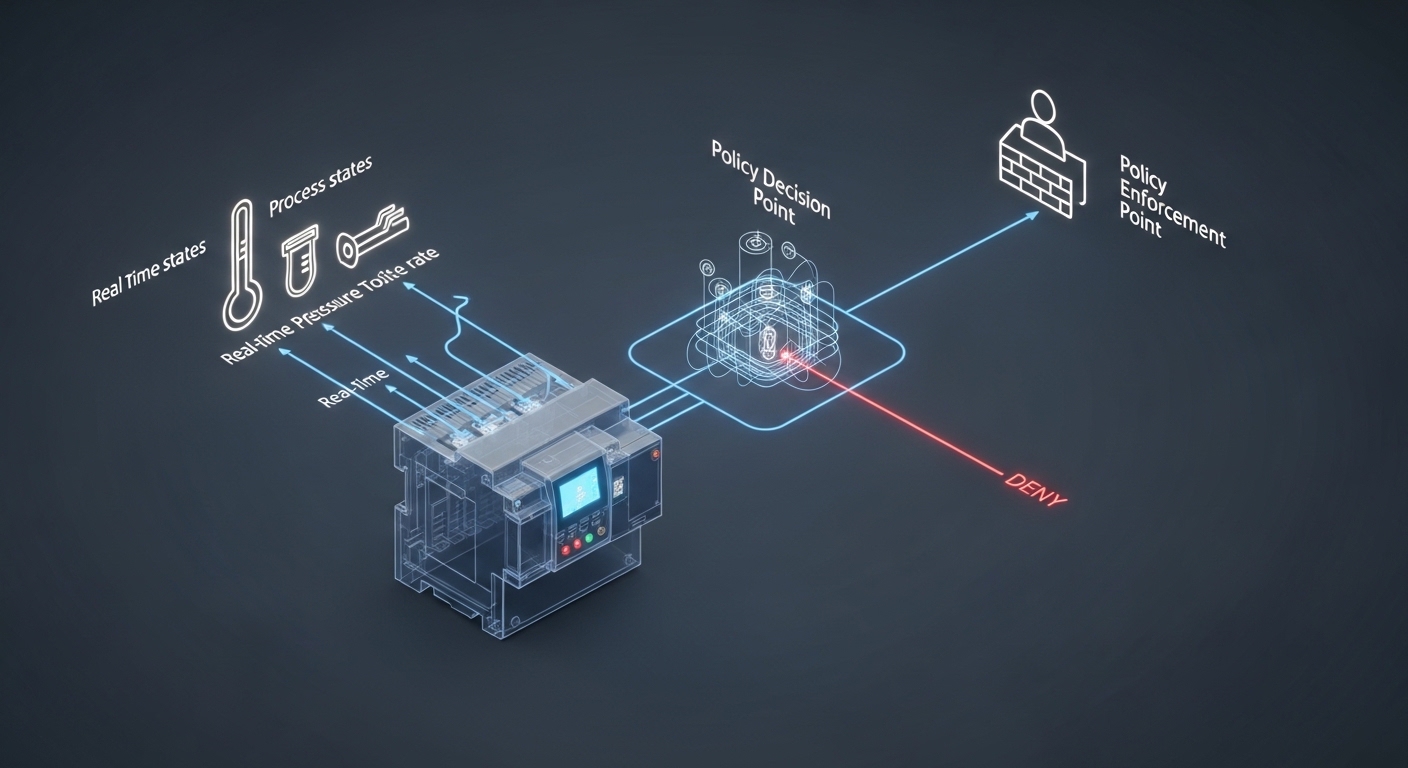
The Sentient Guardrail: Architecting Process-State-Aware PLC Authorization in Zero-Trust OT
Apex Insights Research Desk
The Paradigm Shift: From Static Permissions to Contextual, Process-Aware Control
In the domain of safety-critical Operational Technology (OT), the traditional cybersecurity paradigm, architected around static firewalls and role-based access control (RBAC), is fundamentally inadequate. These systems, while foundational, are blind to the most critical variable in an industrial environment: the real-time state of the physical process. A maintenance engineer may have standing authorization to update PLC firmware, but is that action safe when the PLC is controlling a centrifuge operating at 10,000 RPM? Standard security models cannot answer this question. This is the critical gap where catastrophic cyber-physical events are born.
Zero-Trust architecture (ZTA) has rightfully gained traction in OT, advocating for the principle of "never trust, always verify." However, a naive implementation of ZTA in safety-critical environments often stops at verifying user identity and device posture. This is a necessary but insufficient condition for true operational resilience. The next frontier in OT security is the fusion of cybersecurity policy with process engineering reality. This involves architecting dynamic authorization systems for Programmable Logic Controllers (PLCs) and other Level 1 devices, where permissions are granted or denied not only based on identity but on a continuous, real-time assessment of the physical process state. This is the concept of the sentient guardrail—a security framework with an intrinsic understanding of the physics it is designed to protect.
This research brief from the Apex Insights desk provides an architectural blueprint for implementing such a system, exploring its core components, its alignment with industry standards like ISA/IEC 62443, and the significant engineering challenges that must be surmounted.
Architectural Blueprint for a Dynamic Authorization Engine
To move beyond static access control lists (ACLs) and RBAC, a more sophisticated, state-aware architecture is required. This system must be capable of ingesting real-time process data, evaluating it against a complex policy, and enforcing a decision at line-rate, without introducing latency that could destabilize the control loop. The architecture is comprised of four logically distinct but functionally integrated components.
Policy Decision Point (PDP): This is the centralized orchestration and logic engine. The PDP is responsible for evaluating authorization requests against a rich set of policies. Unlike a traditional identity-based PDP, this engine's logic incorporates variables representing the physical process. For example, a policy might be expressed as:
ALLOW 'firmware_update' FROM 'user:maintenance_lead' ON 'plc:reactor_control' IF 'process:reactor_temp' < 50C AND 'process:batch_status' == 'IDLE'. The PDP ingests contextual data from Policy Information Points to make these real-time determinations.Policy Enforcement Point (PEP): The PEP is the distributed enforcement component that acts as the gatekeeper for the PLC. It must be positioned directly in the communication path to the asset it protects, often implemented as a transparent layer-2 micro-segmentation gateway or embedded within a next-generation industrial firewall. Upon receiving a command destined for the PLC (e.g., a Modbus Write Coil function or an EtherNet/IP explicit message), the PEP intercepts it, queries the PDP for a decision, and then either permits or blocks the packet. The performance of the PEP is paramount; its decision latency must be orders of magnitude lower than the process control cycle time.
Policy Information Point (PIP): The PIP is the critical sensory organ of the architecture. It is responsible for collecting and providing the real-time process state attributes to the PDP. This is the most complex component to integrate, especially in brownfield environments. PIPs can source data from a multitude of systems:
- Data Historians: Directly querying OSIsoft PI, Aspentech IP.21, or similar systems for validated process tags.
- SCADA/HMI Systems: Tapping into the SCADA servers to read current tag values.
- Direct Network Taps: Passively monitoring network traffic (e.g., read-only requests to other PLCs or sensors) to infer process state. This approach is non-intrusive but can be less reliable.
- MES/Batch Systems: Integrating with Manufacturing Execution Systems to understand the broader operational context, such as which recipe is running or if the system is in a maintenance cycle.
Policy Administration Point (PAP): This is the management console where engineers and security personnel define the state-aware authorization policies. The PAP must provide a powerful yet intuitive interface to create, test, and deploy complex rules that link identities, actions, assets, and multiple process conditions. It must also include robust simulation capabilities to model the impact of a new policy before it is enforced on a live system, preventing accidental process disruption.
The Authorization Logic: Fusing Identity with Physical State
Implementing this architecture necessitates a fundamental shift in how security policies are conceived. The core principle must be a cyber-physical interpretation of the Hippocratic Oath: first, do no harm to the physical process.
A requested action upon a safety-critical control system shall be considered unauthorized if its execution, while credentialed, would violate the predefined safe operating envelope of the associated physical process at the moment of execution.
This principle translates into tangible security rules that prevent authorized users from making unsafe changes. For example:
- Deny Remote Valve Actuation: A request from a remote operations center to close a primary coolant valve is denied by the PDP because PIP data from downstream flow meters indicates that a secondary bypass valve has not yet been confirmed open. The user is authorized, but the process state is not permissive.
- Isolate for Maintenance: A request from a technician's tablet to connect to a specific PLC is granted, but the PDP also instructs the PEP to enforce a temporary micro-segment that isolates the PLC and technician from the rest of the production network. This rule is triggered because the PIP reported a 'MAINTENANCE_MODE' tag from the HMI.
This level of granular control relies on deep visibility into the OT network, not just for process values but for behavioral baselines. Understanding normal traffic is a prerequisite for defining abnormal, and therefore potentially unsafe, states. This is where a robust strategy for real-time behavioral anomaly detection for PLC firmware zero-days becomes a critical input, providing a security-centric 'process state' to the PIP.
Practical Implementation Challenges
Architecting and deploying a process-state-aware authorization system is a formidable engineering task, fraught with challenges that bridge the cyber and physical domains.
Deterministic Latency: The round-trip time for an authorization decision—from the PEP intercepting a packet, querying the PDP, receiving a response, and releasing the packet—must be non-disruptive. For high-speed control systems with cycle times in the low milliseconds, this decision loop must be completed with sub-millisecond latency and near-zero jitter. This often precludes the use of cloud-based PDPs for safety-critical loops and necessitates edge-deployed decision engines.
Integrity of State Data: The security of the entire system hinges on the trustworthiness of the data provided by the PIPs. If an adversary can compromise a data historian or spoof sensor values on the network, they can manipulate the PDP into granting unauthorized access. This requires cryptographic validation of data sources, continuous integrity monitoring of historian databases, and anomaly detection on the sensor data itself.
Policy Orchestration at Scale: Defining and managing thousands of state-dependent rules for a complex plant is a monumental task. The risk of policy misconfiguration leading to a false positive (denying a legitimate, critical command) and causing a process trip is substantial. This requires advanced policy-as-code frameworks, rigorous pre-deployment simulation in a digital twin environment, and a phased rollout strategy.
Brownfield Interoperability: The vast majority of OT environments are brownfield sites, filled with legacy equipment that was never designed for such security oversight. Deploying PEPs often requires network re-architecture. Integrating PIPs may involve reverse-engineering proprietary protocols or relying on less-reliable screen-scraping or passive monitoring techniques. A successful deployment often depends on an agentless Zero-Trust micro-segmentation for legacy PLCs approach, where enforcement is handled externally to the endpoint.
Fail-Safe vs. Fail-Secure Design: A critical architectural decision is the system's behavior upon failure of the PDP or loss of communication with a PIP. A fail-secure posture (block all commands) might be appropriate for some processes but could trigger a dangerous shutdown in others. A fail-open posture (allow all commands) maintains availability but temporarily negates the security benefit. The choice must be made on a per-process basis, guided by a formal Process Hazard Analysis (PHA).
Alignment with ISA/IEC 62443
This dynamic authorization model is not a departure from established standards but rather a sophisticated implementation of their core principles. The ISA/IEC 62443 framework provides the foundational requirements that this architecture helps fulfill.
Specifically, it directly addresses ISA/IEC 62443-3-3 (System Security Requirements and Security Levels), Foundational Requirement 5 (AC - Access Control). While a basic RBAC system might satisfy Security Level 1 for SR 5.1 ("Authorization Enforcement"), a process-state-aware system is essential for achieving the higher Security Levels (SL 3 and SL 4) in complex environments. It provides a robust mechanism for enforcing "the principle of least privilege based upon an individual’s roles and responsibilities," where 'responsibilities' are interpreted to include not harming the physical process. This is a core tenet in any comprehensive blueprint for ISA/IEC 62443 and Zero-Trust in live chemical OT environments.
Furthermore, by using attributes (the process state) in addition to identity, the architecture aligns with Attribute-Based Access Control (ABAC), a model explicitly referenced as a powerful access control mechanism within the 62443 series and modern cybersecurity frameworks.
Conclusion: The Future of OT Security is Context-Aware
The era of static, identity-only access control in critical infrastructure is closing. To defend against advanced adversaries who can exploit authorized credentials to trigger unsafe physical outcomes, our security systems must evolve. They must develop an awareness of the physical processes they are tasked to protect. Architecting a dynamic, process-state-aware authorization framework is the logical and necessary evolution of Zero-Trust for OT.
This is not a simple undertaking. It requires breaking down silos between IT security, control engineering, and process safety teams. It demands deep investment in resilient, low-latency infrastructure and sophisticated policy management tools. However, the alternative—continuing to operate with security systems that are blind to physical reality—is an unacceptable risk in a world where the boundary between cyber and physical threats has been irrevocably erased.
Sources / References
- NIST Special Publication 800-82 Rev. 2, Guide to Industrial Control Systems (ICS) Security: https://csrc.nist.gov/publications/detail/sp/800-82/rev-2/final
- ISA/IEC 62443-3-3:2013, Security for industrial automation and control systems - Part 3-3: System security requirements and security levels: https://www.isa.org/standards-and-publications/isa-standards/isa-iec-62443-series-of-standards
- CISA, Recommended Practice: Securing Industrial Control Systems, Control System Best Practices: https://www.cisa.gov/uscert/ics/Recommended-Practices