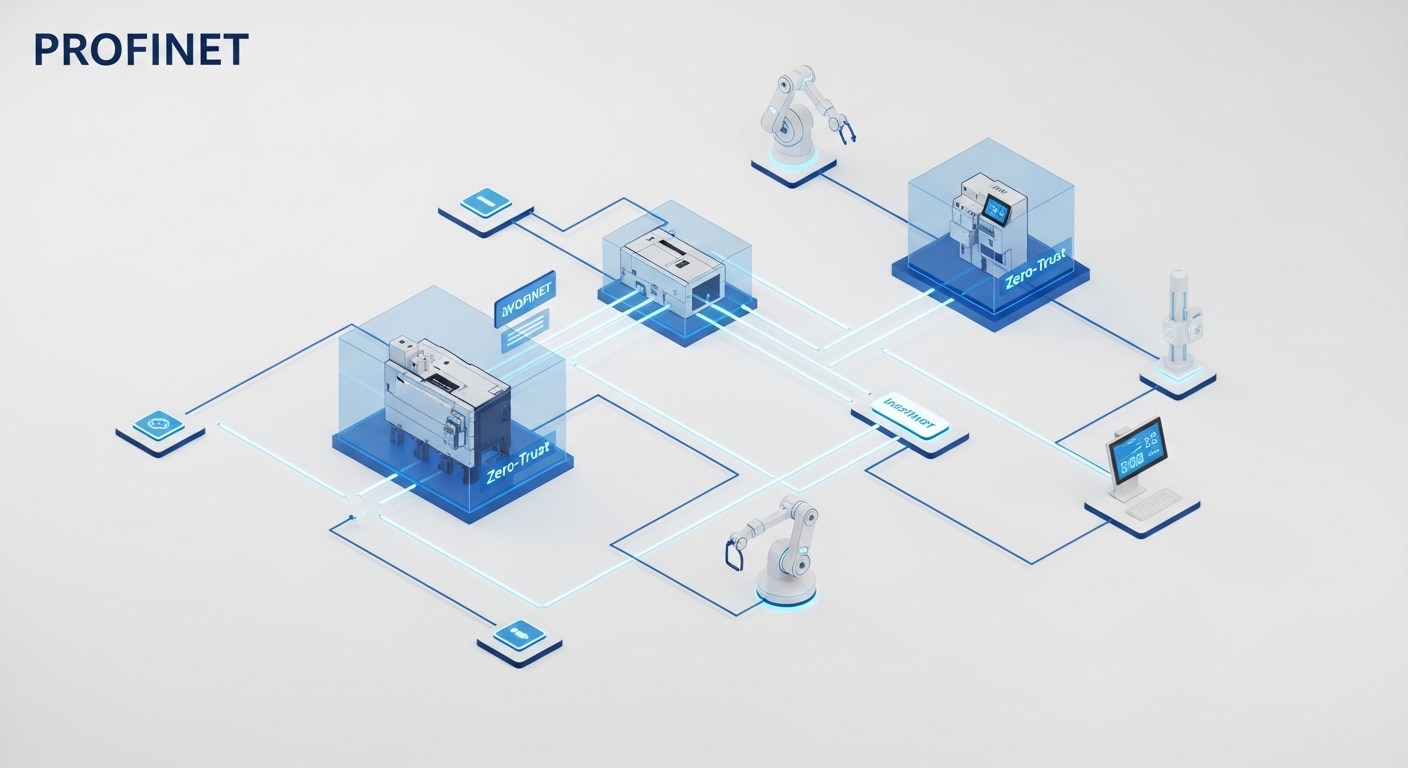
The Deterministic Dilemma: A Blueprint for Non-Invasive Zero-Trust Segmentation in PROFINET ICS
Apex Insights Research Desk
The Fundamental Mismatch: PROFINET Real-Time vs. Zero-Trust Principles
Industrial Control Systems (ICS) built on PROFINET present a unique and formidable challenge to modern cybersecurity paradigms. The protocol's core design philosophy prioritizes high-speed, deterministic, and cyclic data exchange, often at Layer 2 of the OSI model. This creates a flat, highly-interconnected network topology where controllers, I/O modules, drives, and HMIs communicate with minimal latency and jitter. This architectural choice, while brilliant for achieving the demanding cycle times of modern automation, is fundamentally at odds with the core tenets of a Zero-Trust security architecture: assume breach, verify explicitly, and enforce least-privilege access through granular micro-segmentation.
Traditional IT-centric segmentation methods, such as VLANs managed by enterprise firewalls, are ill-suited for the PROFINET Real-Time (RT) and Isochronous Real-Time (IRT) domains. Introducing routing hops and stateful packet inspection from conventional firewalls injects unacceptable latency and, more critically, jitter. For a high-speed packaging line or a multi-axis robotic arm operating on PROFINET IRT, a few milliseconds of unpredictable delay is not a performance degradation—it's a process failure, potentially leading to equipment damage or production halts. This is the central conflict: how does an asset owner superimpose a security model based on explicit trust boundaries onto a network protocol engineered to eliminate those very boundaries for performance reasons? The challenge is to architect containment and control without violating the stringent timing requirements that underpin the physical process itself. This exact issue forms the core of The Determinism Dilemma: Preserving Real-Time Integrity in Micro-Segmented ICS Networks, where even microseconds of jitter can have outsized operational consequences.
A Blueprint for Non-Invasive Segmentation: The Compensating Control Architecture
The most viable strategy for implementing Zero-Trust on a brownfield PROFINET network is to avoid altering the core, real-time communication paths. Attempting to insert firewalls between a PLC and its remote I/O is operationally untenable. Instead, the architecture must focus on creating secure enclaves around functional zones and enforcing policy non-invasively at the boundaries where non-real-time, routable traffic (TCP/IP) interacts with the PROFINET control plane. This is achieved through the strategic deployment of compensating controls that understand the protocol and its operational context.
This approach aligns with established industrial security standards, which advocate for a defense-in-depth model built on logical zones.
The concept of zones and conduits is a foundational element of the IEC 62443 series of standards. A zone is a grouping of logical or physical assets that share common security requirements. A conduit is the logical grouping of communication channels connecting two or more zones. Security policies are then applied to the conduits to protect the zones.
An effective, non-invasive deployment follows a precise architectural sequence:
Passive Discovery and High-Fidelity Baselining: The initial phase is exclusively observational. Using network TAPs or SPAN ports connected to an OT-aware monitoring solution, the objective is to build a complete, high-fidelity map of the PROFINET domain. This goes beyond a simple IP address list. The baseline must include every PROFINET device (by name, vendor, and firmware), its MAC address, its role (Controller, Device, Supervisor), and, most importantly, the specific communication relationships. This map must detail which PLC cyclically communicates with which I/O block, which HMI reads/writes data to which controller, and which engineering station initiates stop/start commands. This granular introspection is the bedrock of any credible Zero-Trust policy.
Logical Zone Definition: Based on the asset inventory and communication baseline, the network is logically partitioned into functional zones. These zones should mirror the physical process. For example: 'Zone-Cell-10-Welding', 'Zone-Cell-11-Painting', 'Zone-Safety-Interlocks'. This is a policy and documentation exercise, not a physical re-cabling effort. Each zone contains all the assets required for that specific function. The goal is to define the smallest possible trust zones without breaking cyclic RT/IRT communications within them.
Strategic Placement of Segmentation Enforcement Points (SEPs): SEPs are the compensating controls that will enforce the Zero-Trust policy. These are not general-purpose IT firewalls. They are typically OT-native gateways or transparent inline protection devices deployed at the logical conduits between zones. For example, an SEP would be placed between the 'Zone-Cell-10-Welding' and the upper-level SCADA or MES network. It would also be placed at the ingress point for remote engineering access. The key is that they do not sit within the hard real-time communication paths of a single functional cell.
Context-Aware Policy Authoring: With the SEPs in place, policies are defined and enforced. This is where OT-protocol awareness becomes critical. A Zero-Trust policy for PROFINET is not as simple as
Allow TCP/102. It is a granular, stateful rule set that understands the protocol's nuances. This allows for the creation of extremely precise rules that significantly reduce the attack surface by halting lateral movement across disparate PLC ecosystems before an incident can escalate.
Granular Policy Enforcement Beyond L3/L4
To effectively segment PROFINET, the SEPs must perform deep packet inspection (DPI) and enforce policies at the application layer (Layer 7). This allows for a level of control that is impossible with traditional network security tools. The objective is to move from a permissive 'allow-all-within-the-zone' model to a default-deny posture where only explicitly defined communications are permitted.
Key examples of granular PROFINET policies include:
- Device and Function Code Whitelisting: The policy explicitly allows
PN-IO Read/Writecommands only between the S7-1500 controller at192.168.1.10and the ET 200SP I/O modules in the range192.168.1.50-60. Any other device attempting to issue write commands is blocked and an alert is generated. - Restricting Engineering Access: The policy dictates that
PROFINET Start/Stop CPUcommands can only originate from the designated engineering workstation IP (10.50.10.5) and only target controllers within the maintenance-approved zone. An attempt to stop a PLC in a different zone, even from a valid workstation, would be denied. - Read-Only HMI Access: The policy for an HMI allows it to read process variables from a specific controller but explicitly blocks any attempt to write setpoints or issue control commands, enforcing a read-only view and preventing unauthorized operator actions.
Achieving this level of control requires a profound understanding of the protocol itself. The ability to differentiate between a standard cyclic I/O update and a ladder logic download is paramount. This deep dive into protocol-specific rules is central to any successful deployment, as detailed in our research on architecting granular introspection for PROFINET and Siemens S7 systems at the industrial edge.
Practical Implementation Challenges
The Isochronous Real-Time (IRT) Jitter Problem
While the recommended architecture avoids placing SEPs inside an IRT domain, network designs can be complex. In scenarios where an SEP must be placed inline on a path carrying IRT traffic, even microsecond-level jitter introduced by the device can be catastrophic. IRT relies on a precisely scheduled, hardware-based switching fabric. The processing overhead of an inline security device, however minimal, can cause frames to miss their scheduled time slot, leading to communication faults and tripping the entire motion control application.
PROFINET Device Naming and MAC-based Addressing
Early in its startup sequence, a PROFINET controller identifies devices by their symbolic name (e.g., 'robot-welder-cell-5'), not their IP address. It uses the DCP (Discovery and Configuration Protocol) to resolve this name to a MAC address and then assign an IP address. An L3/L4 firewall is completely blind to this initial, critical exchange. If it is not configured to handle Layer 2 protocols like DCP transparently, it can block the device initialization process, preventing a cell from coming online after a power cycle or maintenance event.
The Brownfield Documentation Deficit
In an ideal world, every PROFINET network is perfectly documented. In reality, many brownfield environments have evolved over years, with devices added and configurations changed without corresponding updates to network diagrams or asset inventories. Deploying a Zero-Trust model with a 'default-deny' policy in such an environment is fraught with risk. An incomplete traffic baseline will inevitably lead to policies that block legitimate, but unknown, communication paths, causing production stoppages. The engineering effort required for comprehensive, passive discovery before any enforcement is non-trivial and absolutely critical.
State-Awareness for Alarms and Diagnostics
PROFINET utilizes acyclic communication for alarms and diagnostics. This traffic is high-priority but not part of the constant cyclic data exchange. A simplistic, static policy might inadvertently block these critical alarm notifications. A robust SEP must be state-aware, understanding that a diagnostic request from an engineering station to a device that has just issued a fault alarm is likely a legitimate maintenance activity and should be permitted, even if it is not part of the standard communication baseline.
Sources / References
- PI International. (2019). PROFINET Security Guideline. Available: https://www.profibus.com/download/profibus-profinet-international-security-guideline
- National Institute of Standards and Technology. (2024). SP 800-82 Rev. 3 (Initial Public Draft) - Guide to Operational Technology (OT) Security. Available: https://csrc.nist.gov/pubs/sp/800/82/r3/ipd
- International Electrotechnical Commission. IEC 62443 Series - Security for industrial automation and control systems. Available: https://www.iec.ch/cyber-security