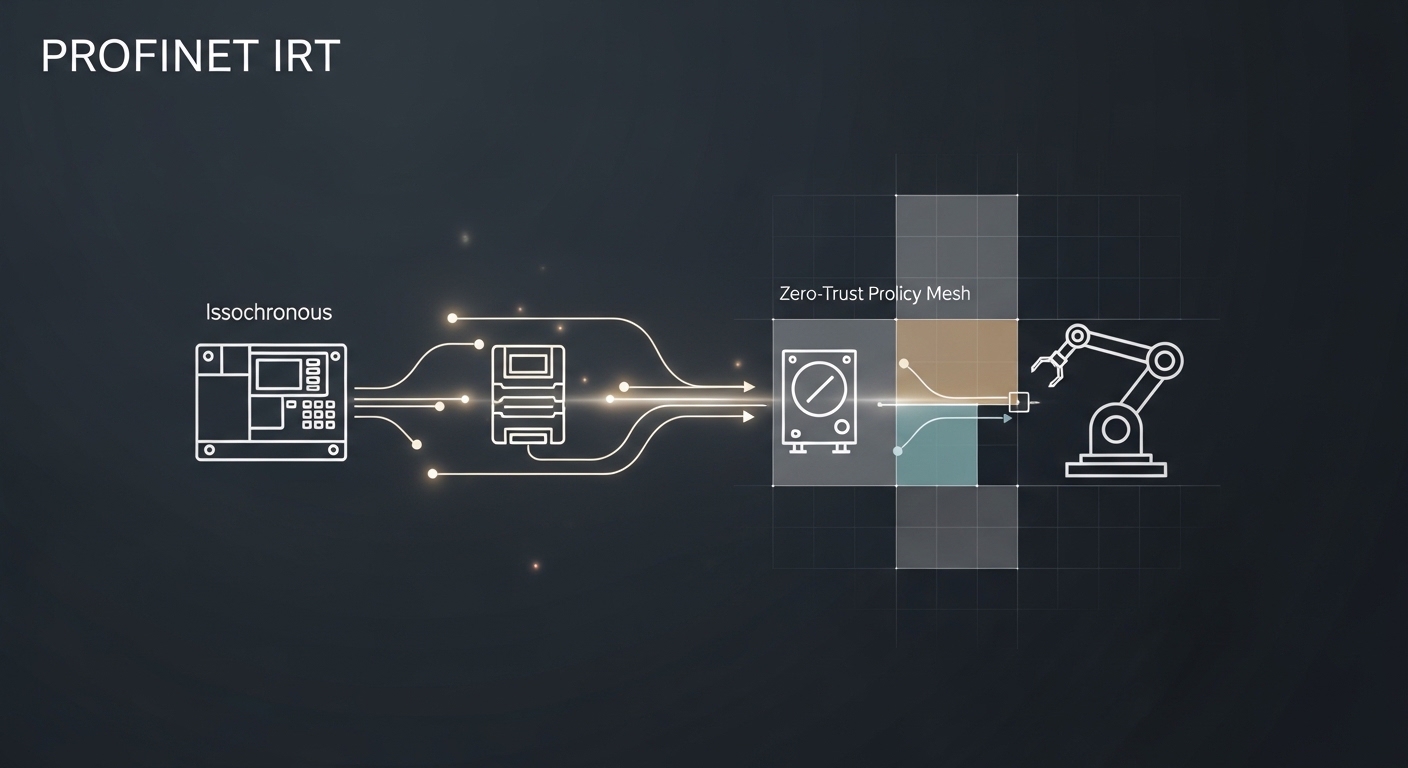
The Deterministic Handshake: Architecting Real-Time M2M Trust in PROFINET IRT for Converged Zero-Trust OT
Apex Insights Research Desk
Introduction: The Unforgiving Intersection of Speed and Security
The convergence of Information Technology (IT) and Operational Technology (OT) is no longer a forward-looking concept; it is the established reality of the modern industrial landscape. While this fusion unlocks unprecedented efficiency and data-driven optimization, it simultaneously dismantles the air-gapped fortresses that once protected critical control systems. In this new paradigm, high-performance OT protocols like PROFINET Isochronous Real-Time (IRT) are exposed to attack vectors originating from the enterprise network. The core challenge is one of fundamental incompatibility: how does one impose the rigorous, validation-heavy principles of a Zero-Trust Architecture (ZTA) upon a protocol engineered for sub-millisecond determinism and microsecond-level jitter sensitivity?
Traditional IT security mechanisms, with their multi-millisecond latency for cryptographic handshakes and policy lookups, are fundamentally unsuitable for the PROFINET IRT domain. Attempting to inject a standard TLS handshake into a motion control loop is an act of operational sabotage, guaranteed to cause process failure. Yet, the alternative—leaving machine-to-machine (M2M) communication within the control network implicitly trusted—is an unacceptable risk in a converged environment. This paper from the Apex Insights Research Desk presents an architectural blueprint for achieving real-time M2M trust validation within PROFINET IRT, harmonizing the deterministic mandate of OT with the security imperatives of a zero-trust model.
Deconstructing the Deterministic Challenge: PROFINET IRT & Zero Trust
To engineer a viable solution, one must first deeply appreciate the conflicting physics of the two domains. PROFINET IRT is not merely fast Ethernet; it is a Layer 2 protocol extension that creates a deterministic, time-division multiplexing (TDM) schedule on the wire. Communication occurs in fixed, isochronous cycles, often as low as 250 microseconds. Within this cycle, a reserved channel is created where IRT frames are transmitted according to a precise, pre-calculated schedule managed by the IO-Controller. This hardware-level time synchronization, often implemented in dedicated ASICs, ensures that jitter—the variation in packet arrival time—is kept to an absolute minimum, a non-negotiable requirement for synchronized multi-axis motion control.
Conversely, a zero-trust model operates on the principle of "never trust, always verify." It mandates that every access request, whether from a user or a machine, must be explicitly authenticated and authorized before communication is permitted. The traditional application of this involves a Policy Decision Point (PDP) and a Policy Enforcement Point (PEP). When a device attempts to connect, the PEP halts the communication, queries the PDP for a policy decision based on identity and context, and only then allows or denies the flow. This entire process is antithetical to the uninterrupted, pre-scheduled flow of IRT traffic.
The core conflict is the latency budget. A typical cryptographic identity verification process involves a certificate exchange and validation chain, consuming anywhere from 50 to 200 milliseconds. A PROFINET IRT cycle might be a thousand times shorter. It is this temporal chasm that any viable security architecture must bridge.
Architectural Blueprint for Real-Time M2M Trust Validation
Achieving trust validation within the IRT cycle is not possible by performing the validation during the cycle. Instead, the architecture must shift the computational and cryptographic burden outside the real-time path, leveraging a system of pre-authorization and lightweight in-band attestation. This can be conceptualized as a three-stage process.
Phase 1: Out-of-Band Identity Verification and Policy Pre-computation The foundation of this model is strong device identity. We must move beyond ephemeral identifiers like MAC addresses and towards cryptographically verifiable identities, such as those defined by IEEE 802.1AR (IDevID), embedded in hardware through a Trusted Platform Module (TPM) or similar secure element. When a PROFINET device (e.g., a servo drive) boots up, it establishes a secure, standard IT-protocol-based connection (e.g., TLS) to a central Zero-Trust Policy Engine (the PDP). During this non-real-time phase, it presents its hardware-backed certificate. The PDP verifies its identity, checks its role and context against the central policy database, and determines precisely which other devices it is authorized to communicate with, and under what operational conditions. The result is a set of signed, short-lived authorization tokens or session keys, specific to the approved M2M communication paths.
Phase 2: Distribution of Authorization Tokens Once the PDP has generated the authorization tokens, it securely pushes them down to the relevant devices and, crucially, to the Policy Enforcement Points. These PEPs are no longer generic firewalls but protocol-aware, high-performance industrial switches with specialized hardware (e.g., FPGAs) capable of line-rate inspection of PROFINET frames. The PEPs cache these authorizations, mapping device identities to their permitted communication peers and associated tokens. This pre-positioning of policy is critical to eliminating lookup latency during the real-time operational phase.
Phase 3: In-Band Lightweight Attestation and Line-Rate Enforcement This is the core of the real-time mechanism. During the isochronous IRT cycle, when Device A sends a frame to Device B, it does not perform a new handshake. Instead, it inserts its pre-computed, short-lived authorization token into a designated, non-time-critical field within the PROFINET frame itself. The PEP, sitting in the data path, inspects this frame at line rate. Its specialized hardware extracts the token and validates its signature and validity against its local cache—a process that must be completed in nanoseconds, adding no discernible jitter to the packet timing. If the token is valid, the frame is forwarded. If it is missing, invalid, or expired, the frame is dropped instantly. This approach effectively creates a system of policy-enforced micro-segmentation in real-time ICS without disrupting the deterministic nature of the control loop.
Practical Implementation Challenges
Deploying this architecture in a real-world industrial environment presents significant engineering hurdles that extend beyond theoretical design.
The fundamental engineering principle is this: any security function inserted into a deterministic data path must not consume an unpredictable amount of time. Its worst-case execution time must be known, bounded, and fit within the jitter budget of the protocol.
- Hardware-Accelerated Enforcement: The requirement for nanosecond-level inspection and enforcement at the PEP cannot be met by software running on general-purpose CPUs. This necessitates the use of security-aware industrial switches built with FPGAs or network processors specifically programmed to parse PROFINET IRT frames and perform cryptographic validation at multi-gigabit line rates. Sourcing and qualifying such hardware is a primary challenge.
- Brownfield Integration and Legacy Devices: The vast majority of deployed PROFINET devices lack TPMs or the processing power for even basic modern cryptography. This is a common problem when applying Zero-Trust for multi-vendor Profinet in Brownfield OT. In these scenarios, the PEP must assume a more active role. It can act as a cryptographic proxy, or