The Sub-Millisecond Mandate: Architecting a Real-Time Policy Enforcement Engine for Legacy SCADA Micro-segmentation
Apex Insights Research Desk
Introduction: The Deterministic Security Paradox in OT
In the realm of Operational Technology (OT), particularly within legacy PLC/SCADA systems, the laws of physics and the demands of deterministic process control are absolute. Critical control loops—governing everything from turbine speeds and chemical mixtures to safety interlock systems—operate on timescales where a single millisecond is an eternity. The introduction of any latency or jitter is not a performance degradation; it is a direct threat to physical safety, operational stability, and product quality. This creates a fundamental paradox for cybersecurity: how do you implement modern security controls like Zero Trust micro-segmentation in an environment that is, by design, intolerant of the very inspection and decision-making overhead that security implies?
Traditional IT security appliances, such as next-generation firewalls (NGFWs), are fundamentally unfit for this purpose. Their software-based packet processing stacks, running on general-purpose CPUs, introduce tens or even hundreds of microseconds of latency and unpredictable jitter, shattering the deterministic guarantees of protocols like PROFINET IRT, EtherCAT, or even time-sensitive Modbus TCP communications. The challenge, therefore, is not merely to adapt IT security for OT, but to re-architect security from first principles, building a Policy Enforcement Engine (PEE) that can execute granular access control decisions within the sub-millisecond latency budget of the most demanding control loops. This article presents an engineering blueprint for designing such a system.
Foundational Principles: The Primacy of the Latency Budget
Before designing a solution, we must quantify the problem. The core constraint in any real-time ICS is the 'latency budget' of a given control loop. This is the maximum permissible round-trip time for a control signal—from sensor to PLC, through a logic solve, and out to an actuator—before the physical process becomes unstable. In high-speed manufacturing, robotics, or power grid applications, this budget is often less than one millisecond.
A security control placed in-line with this communication path becomes a 'line item' in that budget. If a standard firewall consumes 100 microseconds (µs) for inspection, it has just used 10-20% of the entire budget for a 500µs to 1ms control loop. More damagingly, if this latency varies (jitter), the control algorithm in the PLC, which assumes consistent timing, can be destabilized. The primary engineering directive is therefore absolute: the PEE must introduce a deterministic, ultra-low, and predictable latency overhead, measured in nanoseconds or single-digit microseconds at most.
Architectural Blueprint for a Sub-Millisecond Policy Enforcement Engine
A PEE capable of meeting these stringent demands cannot be a monolithic appliance. It must be a distributed system built on specialized hardware and a sophisticated understanding of industrial protocols. The architecture can be broken down into the following core components:
Distributed Enforcement, Centralized Intelligence: The architecture must physically separate the real-time enforcement from the non-real-time policy management. Policy Enforcement Points (PEPs) are compact, hardened hardware devices deployed 'in-line' or as a 'bump-in-the-wire' as close to the Level 1 assets (PLCs, RTUs, I/O blocks) as possible. These PEPs make instantaneous allow/deny decisions. A centralized Policy Decision Point (PDP) or Policy Administration Point (PAP) serves as the management plane where human operators define security policies. These high-level policies are then 'compiled' and pushed down to the PEPs asynchronously, ensuring that policy updates do not interfere with real-time data flows.
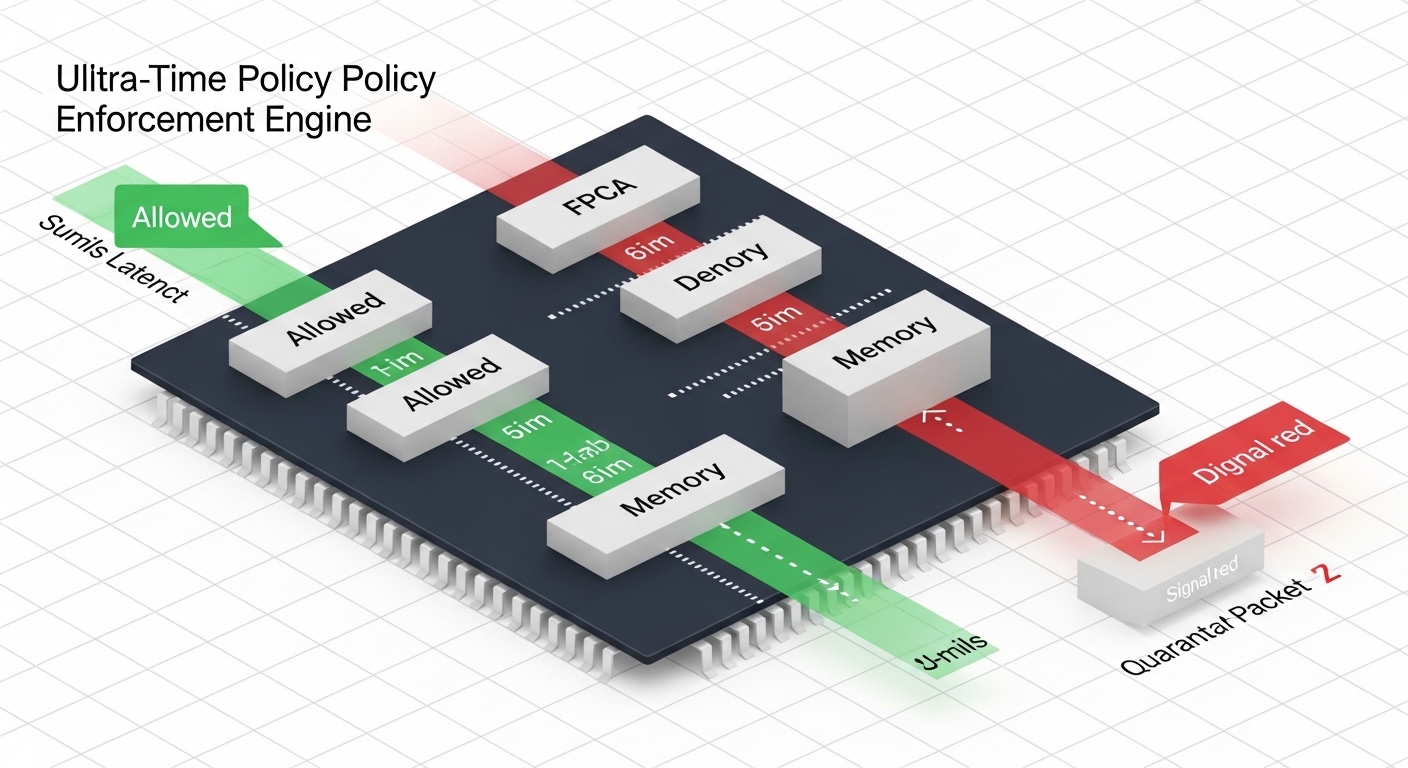
Hardware-Accelerated Packet Processing: General-purpose CPUs are incapable of meeting the latency requirements. The core of the PEP must be a Field-Programmable Gate Array (FPGA) or an Application-Specific Integrated Circuit (ASIC). FPGAs offer the ideal balance of performance and flexibility, allowing packet processing logic to be defined in hardware. This enables true line-rate inspection and policy evaluation, with decision latencies falling into the nanosecond range. The entire journey of a packet—from ingress on one port, through parsing, rule evaluation, and egress on another—can be fully pipelined in the hardware fabric.
Protocol-Aware Deep Packet Inspection (DPI): The PEE cannot operate at Layer 3/4 alone. It must possess a deep understanding of the application-layer (Layer 7) OT protocols. The FPGA logic must include parsers capable of decoding proprietary and standard protocols like Modbus/TCP, S7Comm, DNP3, and EtherNet/IP. This allows for the creation of highly granular policies. For instance, a policy can differentiate between a Modbus Read Coils (function code 01) request and a Write Multiple Registers (function code 16) command. This level of granularity is essential for implementing least privilege, as discussed in our research on The Deterministic Dilemma: Integrating Zero-Trust Micro-segmentation in OT with Proprietary Protocols like S7Comm+. The DPI engine must validate not just the command but the syntax and bounds of the request, detecting malformed packets used in reconnaissance or exploit attempts.
Policy Compilation and Atomic Updates: Security policies are defined by humans in an abstract, readable format (e.g.,
ALLOW HMI_01 -> PLC_MOTOR_CTRL (READ, REGISTERS 40001-40010)). The PAP must compile this abstract rule into a specific set of hardware instructions for the target FPGA—such as entries in a Ternary Content-Addressable Memory (TCAM) and associated logic. When policies are updated, the new compiled ruleset must be loaded onto the PEP atomically, without causing a single dropped packet or a latency spike. This is typically achieved using dual-bank configuration memories within the FPGA, allowing the new policy to be loaded into a shadow bank and then switched over in a single clock cycle.
The Policy Evaluation Logic: Beyond IP Addresses
To achieve true micro-segmentation, the policy logic must be far more sophisticated than simple 5-tuple (source/destination IP, port, protocol) filtering. This is a core tenet of modern Zero Trust architecture.
The foundational principle of Zero Trust is to never trust and always verify. In an industrial context, this means every single communication packet, even between two devices on the same local subnet, must be authenticated and authorized against a granular policy before it is allowed to proceed.
This requires a policy model based on rich context, moving towards an Attribute-Based Access Control (ABAC) framework. The PEE's evaluation logic should consider multiple dimensions:
- Source Identity: Who or what is making the request? (e.g., Engineering Workstation
ENG_WS_05, HMIHMI_OPS_02). - Resource Identity: What specific asset is being targeted? (e.g., PLC
PLC_PUMP_STATION_A). - Action/Data: What specific action is being requested? (e.g.,
READ,WRITE,STOP_CPU) and what specific data objects are involved? (e.g., Coil 10, Register 40100). - Process Context: What is the current state of the industrial process? A firmware update command might be legitimate when the PLC is in
PROGRAMmode during a scheduled maintenance window but is highly malicious if attempted while the PLC is inRUNmode.
By building this stateful, context-aware logic into the FPGA, the PEE can enforce policies that reflect the intended operational workflow. This prevents not just external attacks but also insider threats and misconfigurations that could lead to catastrophic process failures. The overall goal is to achieve what our team has previously defined as The Deterministic Mandate: Applying Zero-Trust to Brownfield OT Without Disrupting Real-Time ICS, where security is woven into the operational fabric without causing disruption.
Practical Implementation Challenges
Designing such a system is not without significant engineering hurdles that go beyond pure logic design. These practical challenges often dictate the viability of a solution in the field.
- Jitter Injection: The most critical and often overlooked parameter. While average latency might be low, any variation in processing time (jitter) can wreak havoc on time-synchronized control loops. The PEE's data path through the FPGA must be designed to have a fixed-length pipeline, ensuring that every packet of the same type experiences the exact same latency, down to the nanosecond.
- Environmental and Power Constraints: PEPs are not deployed in climate-controlled data centers. They are typically DIN rail-mounted inside industrial cabinets with extreme temperatures, vibration, and strict Power over Ethernet (PoE) or 24V DC power budgets. This severely constrains the choice of FPGA, favoring low-power variants and requiring meticulous thermal engineering.
- Fail-Safe State Engineering: The PEP's behavior during a power loss or internal fault is a critical safety consideration. Should it 'fail-open' (become a passive wire, sacrificing security for availability) or 'fail-closed' (sever the link, sacrificing availability for security)? The correct answer depends on the specific process. The ideal design incorporates a configurable, electrically latched bypass relay that can be set to the desired fail-state based on a risk assessment for that specific control loop.
- Handling Protocol Anomalies: Real-world OT networks are filled with devices that implement protocols with slight, non-standard variations. The DPI engine must be robust enough to handle these edge cases without misinterpreting them as threats or dropping legitimate traffic. This requires extensive protocol fuzzing and testing against a wide library of real-world devices.
- Certification Overhead: Any active electronic component introduced into certain industrial environments (e.g., power utilities, chemical processing) must undergo rigorous certification (e.g., IEC 61850-3, ATEX). This process is lengthy and expensive, and the hardware design must account for these requirements (e.g., component selection, PCB layout for EMI/EMC compliance) from day one.
Conclusion: Weaving Security into the Deterministic Fabric
The notion of applying meaningful, real-time security to legacy SCADA systems has long been dismissed as infeasible due to the inviolable constraints of deterministic control. However, by shifting the paradigm from software-based IT appliances to purpose-built, hardware-accelerated enforcement points, it is entirely possible to architect a solution that respects the sub-millisecond mandate. The blueprint outlined here—combining distributed FPGA-based PEPs, centralized policy management, protocol-aware DPI, and a rich ABAC model—provides a viable path forward. This approach enables asset owners to implement granular micro-segmentation, a cornerstone of anomaly-driven micro-segmentation in brownfield ICS for Zero-Trust, effectively containing threats without compromising the physical process the system is designed to control. The future of OT security lies not in bigger firewalls, but in smarter, faster, and more deeply embedded enforcement that operates at the native speed of the industrial process itself.
Sources / References
- ISA/IEC 62443 Series of Standards on Industrial Automation and Control Systems Security. URL:
https://www.isa.org/standards-and-publications/isa-standards/isa-iec-62443-series-of-standards - NIST Special Publication 800-82 Rev. 2, Guide to Industrial Control Systems (ICS) Security. URL:
https://csrc.nist.gov/publications/detail/sp/800-82/rev-2/final - P4 Language Consortium. P4 Language Specification. URL:
https://p4.org/specs/ - IEEE Xplore Digital Library (for research papers on FPGA-based network processing and security). URL:
https://ieeexplore.ieee.org