The Deterministic Mandate: Applying Zero-Trust to Brownfield OT Without Disrupting Real-Time ICS
Apex Insights Research Desk
The Core Conundrum: Determinism vs. Security in Legacy Industrial Environments
The fundamental design principle of Operational Technology (OT) networks, particularly within Industrial Control Systems (ICS), is deterministic, real-time communication. For a Programmable Logic Controller (PLC) managing a high-speed bottling line or a Distributed Control System (DCS) orchestrating a chemical reaction, a packet delayed by a few milliseconds is not merely an inconvenience; it is a critical failure that can lead to production halts, equipment damage, or catastrophic safety incidents. This unwavering requirement for predictable, low-latency data exchange stands in stark contrast to the traditional IT security paradigm, which often introduces processing overhead in the name of threat prevention.
This creates a significant architectural challenge in brownfield environments, which are characterized by a heterogeneous mix of legacy equipment, proprietary protocols, and decades-old network infrastructure. Attempting to bolt on conventional IT security solutions—such as next-generation firewalls (NGFWs) performing deep packet inspection inline or endpoint detection and response (EDR) agents on operator workstations—is a non-starter. The latency, jitter, and potential for packet drops introduced by these systems would violate the core operational tenets of the underlying process. Yet, the imperative to secure these networks against escalating cyber threats has never been more urgent. The solution lies not in adapting IT tools, but in re-architecting security principles around the non-negotiable constraints of the OT domain. The objective is to implement Zero-Trust not as a disruptive overlay, but as a native, deterministic control fabric.
Re-Engineering Zero-Trust for the Realities of the Plant Floor
The philosophy of Zero-Trust, as defined by tenets like "never trust, always verify" and "assume breach," is sound. However, its practical application in OT requires a significant translation from user-centric IT models to a machine-centric, process-aware framework. The perimeter is not just the firewall; it is the boundary around every single critical control loop.
In the context of ICS, the principle of least privilege extends beyond user access to machine-to-machine (M2M) communication. A Zero-Trust model must enforce not only which devices can communicate but also what they are allowed to say, how they can say it, and within what operational parameters. This is the essence of process-integrity validation.
Translating this requires a shift in perspective:
- Identity Moves Beyond Users: In OT, identity encompasses the intrinsic function of an asset. An HMI is an identity. A specific PLC on Line 5 is an identity. A variable frequency drive (VFD) is an identity. Even a specific Modbus/TCP request-response pair for a critical setpoint is a form of transactional identity. Verification must be based on this deep contextual understanding.
- Verification Must Be Passive and Continuous: Active scanning or cryptographic challenges can destabilize fragile legacy devices. Instead, verification must be achieved out-of-band through continuous, passive monitoring of network traffic. The network itself becomes the sensor, verifying that every communication conforms to a meticulously baselined model of normal behavior.
- Enforcement Must Be Latency-Free: The most critical translation is in the enforcement mechanism. Any solution that sits inline and adds unpredictable processing delay is fundamentally incompatible with real-time control. Therefore, enforcement must be decoupled from inspection and implemented at line-rate in the network fabric, ensuring that legitimate, time-sensitive traffic is never impeded.
An Architectural Blueprint for Non-Intrusive, Deterministic Zero-Trust
Implementing a robust Zero-Trust architecture in a live brownfield environment without a maintenance window is a formidable task, but it is achievable through a phased, network-centric approach that prioritizes operational continuity.
Phase 1: Deep Asset Discovery and Communication Baselining. The initial step is to achieve complete visibility without transmitting a single packet. By deploying passive network TAPs or configuring SPAN ports on managed switches, a full fidelity copy of network traffic is fed to an OT-aware analysis engine. This engine must possess deep packet inspection (DPI) capabilities for a wide range of industrial protocols (e.g., EtherNet/IP, PROFINET, Modbus/TCP, DNP3, S7comm). The goal is to build a high-resolution map of the environment: identifying every device, its role, firmware version, and, most importantly, its precise communication patterns. This creates a granular baseline of all legitimate M2M conversations, including source/destination, protocol commands, register values, and even inter-packet timing.
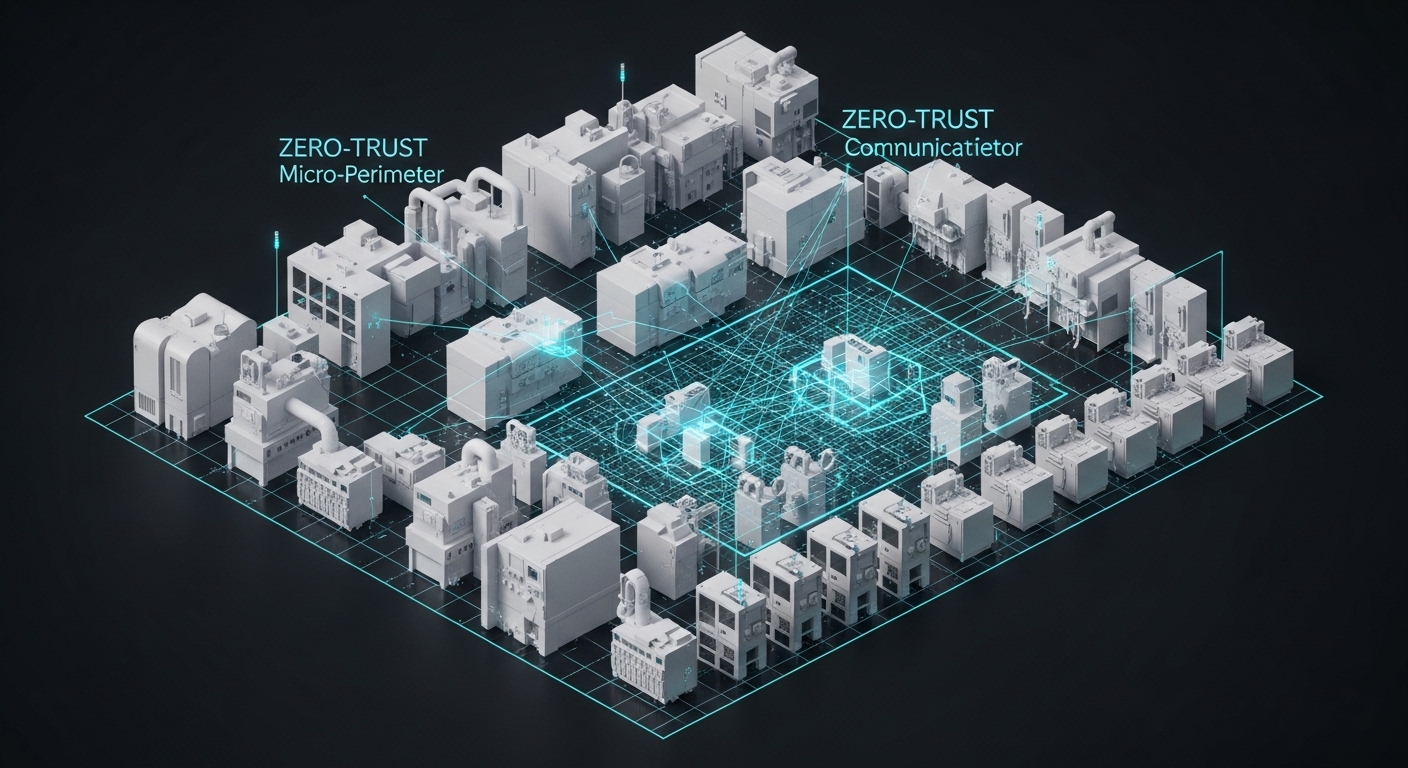
Phase 2: Virtual Micro-segmentation and Policy Simulation. With a rich baseline established, the next phase involves defining micro-segments and modeling Zero-Trust policies in a monitor-only mode. This is not traditional VLAN segmentation, which is often too coarse. Instead, it's about defining logical zones of trust based on process function—for instance, creating a virtual segment that contains only the PLC and VFDs for a specific conveyor system. Within this segment, a policy is modeled:
ALLOW HMI_A to PLC_B using S7comm 'Write' to Variable_X, DENY ALL ELSE. Simulating this policy against live traffic allows engineers to validate rules and identify potential operational conflicts without any risk of disruption. This stage is crucial for architecting dynamic Zero-Trust policy for heterogeneous legacy OT where pre-defined rules cannot account for every operational state.Phase 3: Line-Rate Policy Enforcement via the Network Fabric. Once policies are validated, enforcement is activated. To avoid latency, this is not done via a traditional inline firewall. Instead, the centralized policy engine can programmatically push enforcement rules to capable network devices at key architectural chokepoints (e.g., between the Purdue Model's Level 1 and Level 2). This could involve orchestrating Access Control Lists (ACLs) on industrial Ethernet switches or configuring flow-based rules on dedicated security gateways that operate at line rate. The security decision is made nearly instantaneously, ensuring that deterministic traffic flows are unimpeded. The challenge of securing brownfield PLC networks with Zero-Trust without sacrificing real-time latency is directly addressed by this out-of-band control plane and in-fabric enforcement model.
Phase 4: Continuous Verification and Anomaly Detection. Static policies are necessary but not sufficient. The final layer involves continuous analysis of traffic against the established baseline, looking for subtle deviations that may indicate a compromise. This is not just about blocking forbidden commands but detecting anomalous-but-allowed behavior. For example, a legitimate command sent at an unusual frequency or a process value changing faster than physically possible can be flagged. This behavioral analysis provides a powerful defense against attacks that exploit legitimate protocol functions.
Practical Implementation Challenges
Deploying this architecture is not without significant engineering hurdles that require specialized expertise and tooling.
- Legacy Endpoint Fragility: Many brownfield devices lack robust TCP/IP stacks. Even a port scan from a misconfigured IT tool can cause them to fault or fail. This mandates that the discovery and monitoring phase be 100% passive to avoid any operational impact.
- Proprietary Protocol Variants: While standards like Modbus exist, many vendors implement proprietary extensions or encapsulations. A DPI engine must be sophisticated enough to parse these variants correctly to avoid false positives and maintain an accurate communication baseline.
- Heterogeneous Network Infrastructure: Brownfield networks are rarely uniform. They often consist of a mix of unmanaged switches, daisy-chained devices, and serial-to-Ethernet converters alongside modern managed switches. This makes universal policy enforcement difficult. In such cases, a strategy built around an agentless Zero-Trust for SCADA model, focusing on protecting key assets via strategically placed enforcement points, is often the most viable path.
- Operational State vs. Security State: A change in the OT network is not always a security event. It could be a planned re-tooling of the production line. The Zero-Trust system must be able to distinguish between authorized operational changes and unauthorized, malicious activity, which requires tight integration with operational workflows and change management processes.
- Asymmetric Routing and Complex Topologies: Decades of organic growth can lead to convoluted network paths. Accurately mapping these paths and ensuring that monitoring and enforcement points have visibility into all relevant traffic flows is a non-trivial discovery challenge.
Conclusion: Weaving Security into the Deterministic Fabric
The application of Zero-Trust principles to brownfield OT networks is not an IT security project; it is a control engineering discipline. It requires a fundamental shift away from disruptive inline appliances and toward a network-centric model of passive discovery, granular policy simulation, and line-rate enforcement. By treating the network itself as the primary sensor and enforcement platform, it is possible to create resilient, defensible micro-segments around critical control processes without adding a single microsecond of unacceptable latency.
Ultimately, the goal is to make security a deterministic attribute of the system, just like cycle time and I/O response. By verifying the identity and integrity of every M2M interaction against a known-good operational baseline, this architecture moves beyond merely preventing intrusion and begins to actively guarantee process integrity—the true objective of security in any industrial control system.
Sources / References
- NIST Special Publication 800-82 Rev. 3 (Draft), Guide to Operational Technology (OT) Security: https://csrc.nist.gov/publications/detail/sp/800-82/rev-3/draft
- NIST Special Publication 800-207, Zero Trust Architecture: https://csrc.nist.gov/publications/detail/sp/800-207/final
- The International Society of Automation (ISA), ISA/IEC 62443 Series of Standards: https://www.isa.org/standards-and-publications/isa-standards/isa-iec-62443-series-of-standards