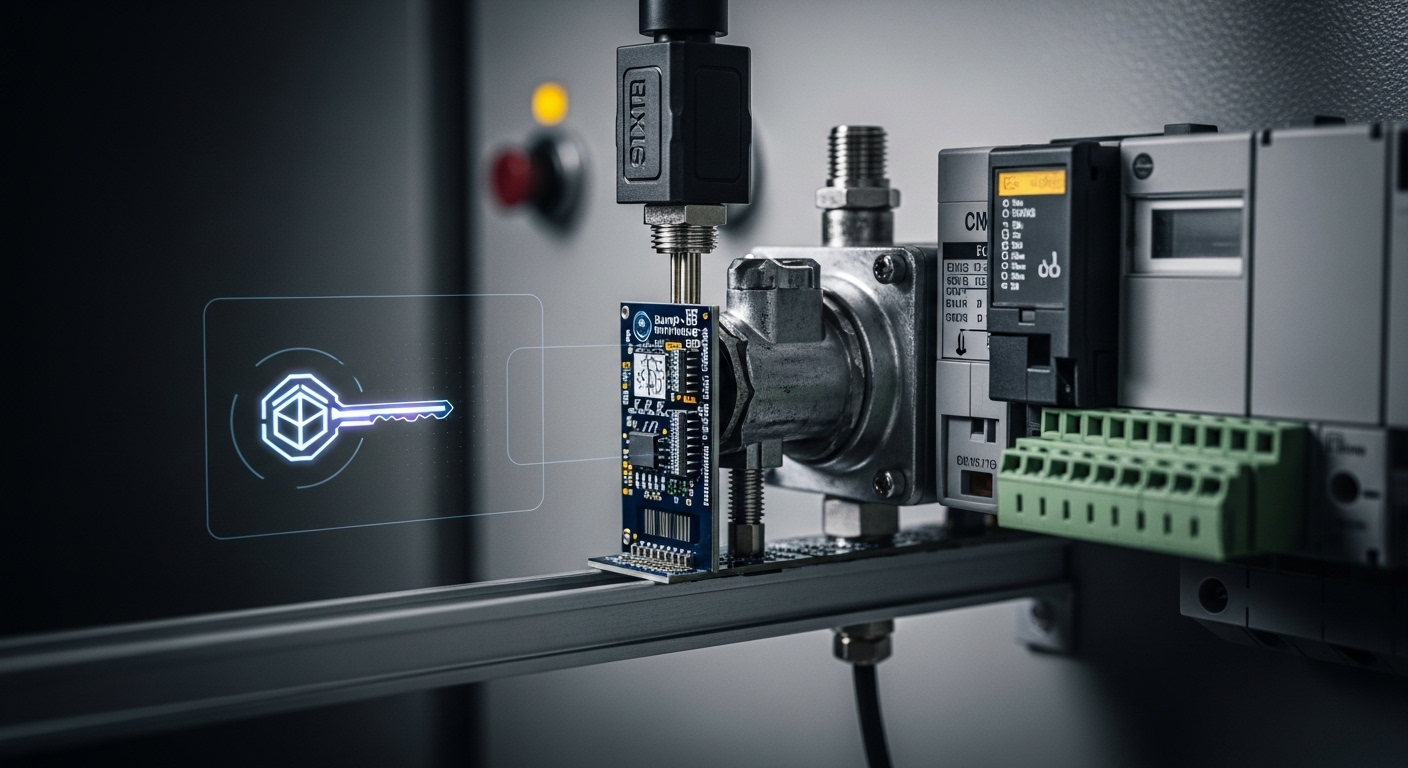
The Last Mile of Defense: A Blueprint for Sensor-Level Zero-Trust in Legacy OT
Apex Insights Research Desk
The Expanding Attack Surface: From the Enterprise to the Field Device
The traditional Purdue Model, with its neatly defined levels and air-gapped perimeters, is an architectural relic. In the era of converged IT/OT networks, Industrial Internet of Things (IIoT), and remote operations, the attack surface no longer stops at Level 3. It has permeated the control network and now extends to the most fundamental components of industrial automation: the sensors and actuators at Level 0. These devices—pressure transmitters, temperature sensors, valve actuators, motor drives—are the physical interface between the digital control logic and the real-world process. Compromising them means compromising the process itself, with potentially catastrophic consequences for safety, quality, and uptime.
However, these legacy field devices were designed for reliability and deterministic performance, not security. They lack the computational resources for modern authentication protocols, possess no native identity beyond a MAC address (if they are even IP-based), and speak unencrypted, decades-old protocols like Modbus or PROFIBUS. The central engineering challenge is therefore profound: How can we apply the rigorous principles of a Zero-Trust Architecture (ZTA) to these resource-constrained endpoints within a brownfield environment without introducing latency, disrupting real-time control loops, or requiring a complete system overhaul? The answer lies not in modifying the endpoint, but in architecting a non-intrusive trust boundary around it.
Deconstructing Zero-Trust for Level 0: From User Identity to Device Behavior
In enterprise IT, Zero-Trust revolves around user and device identity, authenticating every access request to a resource. This model does not translate directly to the static, deterministic world of Level 0 and Level 1 OT. Here, the concept of identity and trust must be re-framed around operational behavior and communication patterns.
The core tenet of Zero Trust, 'never trust, always verify,' must be re-architected for the OT context. For a sensor, this translates to 'continuously verify that the device identity, data payload, and communication cadence conform to a rigorously defined and immutable operational baseline.'
A Zero-Trust strategy at the sensor/actuator level is built on three pillars:
- Implicit Device Identity: Since a sensor cannot present a cryptographic certificate, its identity is derived from a combination of its network address, its physical port on a switch, and most importantly, its unique communication fingerprint—the specific commands it sends, the registers it accesses, and the timing of its transmissions.
- Granular Policy Enforcement: Trust is not a binary state. A policy must define the exact operational parameters allowed for a given device. This is not simply allowing a sensor to talk to a PLC; it is allowing that specific sensor to send a temperature reading within an expected range, using a specific function code, to a particular memory address on its designated controller, within a strict timing window. Any deviation is a policy violation.
- Non-Disruptive Enforcement: The enforcement mechanism cannot be an agent on the sensor or PLC. It must be an external, out-of-band or 'bump-in-the-wire' component that can inspect and control traffic without adding prohibitive latency or requiring changes to the existing control logic.
The Architectural Blueprint: The Policy-Enforced Micro-Enclave
Implementing Zero-Trust at this granular level without downtime requires a phased, network-centric approach. The objective is to create a micro-enclave around each sensor or a small group of related sensors, turning the network itself into the enforcement fabric. This can be achieved through a dedicated, ruggedized security gateway or a capable industrial switch acting as a Policy Enforcement Point (PEP).
Here is a step-by-step engineering blueprint for deploying these micro-enclaves:
Phase 1: Deep Packet Inspection and Passive Baselining. The first and most critical step is to achieve complete visibility without any operational risk. A network tap or a switch's SPAN/mirror port is used to feed a copy of the traffic between the sensor/actuator and the PLC/RTU to a deep packet inspection (DPI) engine. This engine, which must have fluent understanding of OT protocols (Modbus TCP, PROFINET, S7comm, EtherNet/IP, etc.), spends weeks or months learning the deterministic patterns. It maps every device conversation, identifying source, destination, protocol function codes, memory registers accessed, and cyclical timing. This foundational step is essential for establishing the 'golden baseline' and leverages principles of real-time behavioral analytics to define what constitutes normal operation.
Phase 2: Policy Generation and Simulation. Using the baseline data, a highly granular Zero-Trust policy is automatically generated. For a pressure sensor, this policy might state:
ALLOW {Source MAC: 00:1B...; Dest MAC: 00:0A...; Protocol: Modbus/TCP; Function Code: 4 (Read Input Registers); Register Address: 30001; Cycle Time: 250ms +/- 5ms}. This policy is then run in a simulation mode against live traffic. The system logs any and all deviations as 'policy violations' without blocking them. This phase is crucial for refining the policy, accounting for non-standard operational states like maintenance or calibration, and ensuring zero false positives that could disrupt the process.Phase 3: Inline Deployment in Logging Mode. Once the policy is validated with high confidence, the enforcement device (e.g., a compact industrial firewall or security gateway) is physically inserted 'bump-in-the-wire' between the sensor and the rest of the network. Initially, it is placed in a logging-only mode. It inspects all traffic in real-time and logs any violation of the established policy, but still allows the traffic to pass. This step validates the hardware's performance, ensuring it doesn't introduce unacceptable latency into the control loop. This cautious, staged approach is central to the uninterruptible mandate for retrofitting Zero Trust on live systems.
Phase 4: Active Enforcement. After a final review of the logs and confirmation that no legitimate traffic is being flagged, the enforcement device is switched from logging mode to active blocking mode. This is typically done during a brief, planned maintenance window to mitigate any residual risk. From this point forward, any communication that deviates from the narrowly defined policy—be it a malicious command from a compromised HMI or a malfunction causing erratic data—is instantly blocked and logged, effectively creating a Zero-Trust enclave around the sensor.
Practical Implementation Challenges
While this blueprint is architecturally sound, implementation in a real-world brownfield facility presents significant engineering hurdles that must be addressed.
Deterministic Latency and Jitter
Any inline device adds latency. In high-speed, deterministic applications like motion control using PROFINET IRT or EtherCAT, even microseconds of added latency or jitter can cause process faults. The PEP must be purpose-built with hardware acceleration, often utilizing FPGAs or network processing units (NPUs) to perform DPI and policy evaluation at line-rate with sub-millisecond latency. Software-based firewalls running on general-purpose CPUs are typically unsuitable for this layer of the network.
Environmental and Physical Constraints
Level 0 devices often exist in harsh environments with extreme temperatures, vibration, and limited space. The PEP hardware must be industrially hardened, fanless, have a small form factor (e.g., DIN rail mountable), and be powered by standard industrial DC voltage. Deploying thousands of such devices also presents a significant physical installation and cabling challenge.
Protocol and Payload Ambiguity
Standard OT protocols are frequently modified by vendors with proprietary extensions. Furthermore, some protocols use generic data-container function codes (like Modbus Function Code 43/14), where the actual command is hidden within the data payload. A generic DPI engine may not understand this encapsulated logic. The PEP's inspection engine must have an extensive and constantly updated library of these protocol variants or employ advanced anomaly detection to identify deviations in payload structure even when the header is valid.
Policy Orchestration at Scale
Managing unique, granular policies for tens of thousands of individual sensors is not feasible using manual spreadsheets or GUIs. This is where a centralized Policy Decision Point (PDP) becomes essential. The solution must support a policy-as-code paradigm, where policies can be scripted, templated, and managed programmatically via APIs. This allows for the automation of policy creation and deployment, which is a key component of architecting dynamic Zero-Trust policy for heterogeneous OT environments.
Conclusion: Redefining the Security Perimeter
Implementing Zero-Trust at the sensor and actuator level is the ultimate expression of micro-segmentation and the logical endpoint for OT security architecture. It moves the security perimeter from a distant firewall down to the data's point of origin, creating a system that is resilient by design. By assuming breach and verifying every single transmission against a known-good operational baseline, this approach can prevent attackers from manipulating the physical process even if they have already gained access to the control network. It is a complex engineering endeavor, fraught with challenges related to latency, protocol diversity, and scale. However, through a non-disruptive, phased methodology centered on passive discovery and inline, policy-enforcing micro-enclaves, it is possible to secure the last mile of our critical infrastructure without interrupting the continuous operations they support.
Sources / References
- NIST Special Publication 800-207: Zero Trust Architecture - https://csrc.nist.gov/publications/detail/sp/800-207/final
- ISA/IEC 62443 Series of Standards on Industrial Automation and Control Systems Security - https://www.isa.org/standards-and-publications/isa-standards/isa-iec-62443-series-of-standards
- SANS Institute - Securing Industrial Control Systems - https://www.sans.org/industrial-control-systems-security/