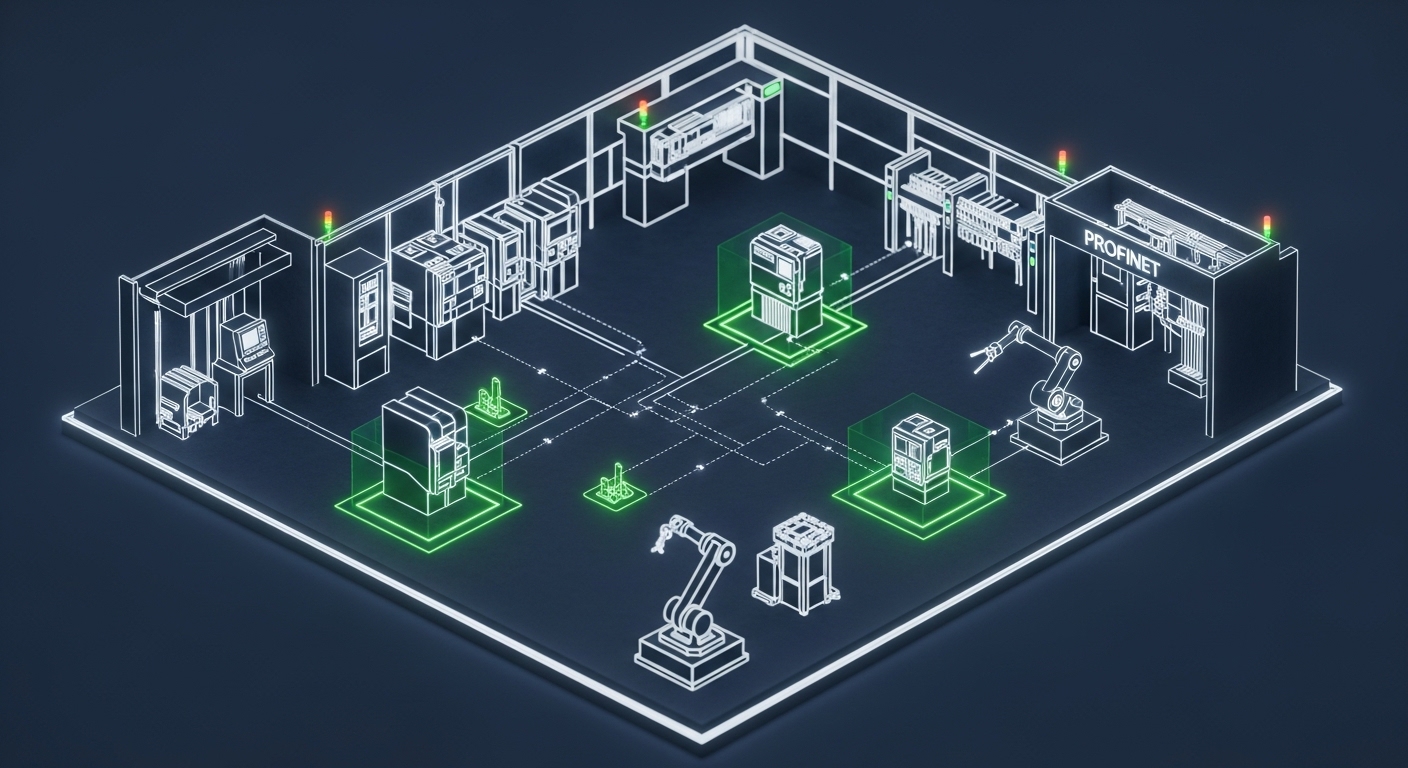
The Deterministic Enclave: A Zero-Trust Blueprint for PROFINET without Compromising Real-Time Integrity
Apex Insights Research Desk
The Apex Insights Research Desk
Introduction: The Deterministic Security Paradox
In the realm of critical infrastructure and advanced manufacturing, PROFINET stands as a cornerstone protocol, orchestrating high-speed, deterministic communication between controllers, drives, and I/O devices. Its ability to guarantee data delivery within microsecond-level cycle times is fundamental to modern automation. However, this very determinism creates a profound security paradox. The traditional IT security playbook, predicated on perimeter defenses and inline inspection, is fundamentally incompatible with the stringent real-time requirements of PROFINET's Isochronous Real-Time (IRT) and Real-Time (RT) communication classes. Introducing even milliseconds of latency for security analysis can trigger faults, halt production lines, or destabilize critical processes.
This has led to a dangerous inertia, where operational technology (OT) networks are often left flat, unsegmented, and vulnerable, operating under an implicit trust model that is no longer defensible. The convergence of IT and OT, coupled with the rise of sophisticated state-sponsored threats, necessitates a paradigm shift. The solution lies in applying the principles of Zero-Trust architecture, not as a clumsy IT overlay, but as a deeply integrated, protocol-aware strategy. This research desk provides an architectural blueprint for securing PROFINET devices using a Zero-Trust model that preserves deterministic integrity, enabling resilience without compromising performance.
Deconstructing the PROFINET Determinism Challenge
To architect a viable security solution, one must first respect the physics of the protocol. PROFINET operates across several communication channels, each with distinct performance characteristics:
- NRT (Non-Real-Time): Standard TCP/IP and UDP/IP traffic used for diagnostics, configuration, and parameterization. This channel is tolerant of latency and jitter.
- RT (Real-Time): Bypasses the standard TCP/IP stack, sending data directly in Layer 2 Ethernet frames (EtherType 0x8892). This significantly reduces overhead and is used for cyclic I/O data with cycle times typically in the low millisecond range.
- IRT (Isochronous Real-Time): The highest performance class, IRT utilizes a time-scheduled, TDMA-based approach to achieve sub-millisecond cycle times with jitter of less than 1µs. This is essential for high-speed motion control and coordinated robotics.
Any security control placed directly in the data path of RT or, most critically, IRT traffic acts as a potential source of latency and jitter. A conventional firewall performing deep packet inspection (DPI) on every frame would shatter the delicate timing of an IRT network. The challenge, therefore, is not to inspect every packet but to ensure that only legitimate, authenticated endpoints are permitted to communicate over these real-time channels in the first place.
The core principle of Zero-Trust in a deterministic environment must shift from content inspection at the transaction level to identity and path validation at the architectural level. We must verify the legitimacy of the endpoints and the communication path itself, rather than attempting to police the payload of time-critical frames.
The Architectural Blueprint for a Deterministic Zero-Trust Enclave
A successful implementation requires a phased, methodical approach that builds security layers without disrupting live operations. This is not a single product deployment but an architectural evolution.
Phase 1: Absolute Visibility and Communication Baselining The foundational axiom of Zero-Trust is to explicitly verify every connection. This is impossible without a complete and accurate inventory of all assets and their communication patterns. Passive, out-of-band network monitoring is non-negotiable. Deploy taps or switch SPAN ports to feed a dedicated OT security monitoring platform. This platform must possess deep protocol-parsing capabilities for PROFINET to automatically identify devices, their roles (IO-Controller, IO-Device, IO-Supervisor), and parse GSDML (General Station Description Markup Language) files to understand their expected operational parameters. The output is a high-fidelity map of the entire PROFINET domain and, critically, a 'golden baseline' of all legitimate cyclic and acyclic communication flows.
Phase 2: Defining Identity Beyond the IP Address In OT, an IP or MAC address is insufficient as an identity marker. A Zero-Trust identity for a PROFINET device must be a composite, context-aware attribute. It should include static and dynamic properties: device vendor/model, firmware version, physical location (switch and port), configured device name (e.g., 'KUKA-Robot-Cell-4'), and its functional role in the process. This rich identity becomes the basis for policy. The question is no longer 'Can 192.168.1.10 talk to 192.168.1.20?' but rather 'Is the Siemens S7-1500 PLC in the primary mixing station authorized to send IRT frames to the SEW Eurodrive VFD controlling the main agitator?'
Phase 3: Micro-segmentation via Network Fabric Enforcement This is the core of the strategy. Instead of inserting inline firewalls, we leverage the network fabric itself—the managed industrial Ethernet switches—as the Policy Enforcement Points (PEPs). The security platform acts as the Policy Decision Point (PDP), translating the high-level Zero-Trust policy into specific, low-level Access Control Lists (ACLs) or flow-based rules and pushing them to the switches.
Initially, segmentation targets the lowest-hanging fruit: NRT traffic. Rules are created to strictly limit engineering workstation access to specific PLCs, prevent unauthorized devices from communicating, and block all non-essential IT protocols from entering the OT zone. This approach provides significant risk reduction with zero impact on real-time processes. The nuances of establishing such rules are complex, particularly when dealing with mixed-protocol environments, a subject detailed in our analysis of Granular Zero-Trust for OT: Policy Enforcement Strategies for Modbus/TCP and Profinet.
Phase 4: Securing Real-Time Channels Without Inspection To secure RT and IRT traffic, the policy enforcement shifts from Layer 3/4 ACLs to Layer 2 controls. The established baseline defines the exact, immutable paths for all real-time frames. The policy pushed to the switches will configure them to allow EtherType 0x8892 frames only between the specific MAC addresses of the authorized IO-Controller and its designated IO-Devices, and only on the physical ports where those devices are connected. Any attempt by an unauthorized device to inject PROFINET RT/IRT frames onto the network is dropped at the switch port before it can propagate. This creates a deterministic enclave, enforcing a 'least privilege' model on the real-time data plane without adding a single microsecond of inspection latency. This level of granular control is crucial for establishing real-time M2M trust in PROFINET IRT within a converged architecture.
Phase 5: Continuous Verification and Anomaly Detection A Zero-Trust environment is not static. The passive monitoring established in Phase 1 now serves as the continuous verification engine. It perpetually compares live traffic against the enforced policy and the established baseline. Any deviation—a new device appearing, an attempt to use a blocked port, a change in cyclic data patterns, or unauthorized engineering access—generates an immediate alert. This moves the security posture from reactive to proactive, detecting the earliest stages of a potential intrusion.
Practical Implementation Challenges
Deploying this architecture in brownfield critical infrastructure environments is fraught with engineering hurdles that require careful planning and specialized expertise.
- Heterogeneous Network Infrastructure: Many existing plants have a mix of unmanaged switches, older managed switches with limited ACL capabilities, and modern hardware. A viable strategy must accommodate this heterogeneity, potentially by creating secure islands around modern switches while isolating legacy segments.
- PROFINET Conformance and Security Classes: PROFINET defines Conformance Classes (CC) and Security Classes (SC). Devices may only support basic connectivity (CC-A) with no built-in security features, making them entirely reliant on network-based compensating controls. Architecting a uniform policy across devices with varying native capabilities is a significant challenge, especially in multi-vendor Profinet brownfield OT deployments.
- Maintaining PTPv2 Integrity: PROFINET IRT relies on the Precision Time Protocol (PTPv2) for clock synchronization. Misconfigured switch ACLs or quality-of-service (QoS) settings can inadvertently block or delay these critical timing packets, causing the entire isochronous domain to collapse. The policy orchestration system must be explicitly aware of PTPv2 and ensure its traffic is always prioritized and never blocked between legitimate PTP masters and slaves.
- Operational Workflows and Emergency Access: A rigid Zero-Trust policy can impede maintenance. The architecture must include a secure mechanism for 'break-glass' or just-in-time (JIT) access. This typically involves integration with privileged access management (PAM) and ticketing systems, where a technician can be granted temporary, audited, and highly specific access to a device for a limited time.
- GSDML and Vendor Nuances: While GSDML files provide a standard device description, vendors often include proprietary parameters. An effective monitoring and policy platform must correctly interpret these nuances to avoid mischaracterizing a device's function and creating flawed security policies.
Conclusion: From Conduit to Active Defense
Implementing a Zero-Trust architecture in a PROFINET environment is not a simple matter of deploying new firewalls. It is a fundamental reconceptualization of the network's role, transforming it from a passive data conduit into an active, intelligent enforcement layer. By leveraging out-of-band analysis, context-aware identity, and fabric-based enforcement, it is possible to create robust micro-perimeters that prevent lateral movement and unauthorized access without disrupting the sensitive, high-speed communication that underpins modern industrial processes. This architectural approach moves beyond the fragile, perimeter-based models of the past and provides a resilient, verifiable security posture fit for the unique challenges of critical infrastructure protection.
Sources / References
- PI North America. (n.d.). PROFINET System Description. PROFIBUS and PROFINET International. Retrieved from: https://us.profinet.com/documentation/profinet-system-description/
- International Electrotechnical Commission. (2018). IEC 62443-4-2: Security for industrial automation and control systems - Part 4-2: Technical security requirements for IACS components. Retrieved from: https://webstore.iec.ch/publication/63603
- National Institute of Standards and Technology. (2015). NIST Special Publication 800-82 Rev. 2: Guide to Industrial Control Systems (ICS) Security. Retrieved from: https://csrc.nist.gov/publications/detail/sp/800-82/rev-2/final
- Siemens AG. (2022). PROFINET with STEP 7 - Function Manual. Retrieved from: https://support.industry.siemens.com/cs/document/109758625/profinet-with-step-7-